Facebook
 Google
 GitHub
 Linkedin
EPC Space Brings Rad-Hard eGaN FETs for Space Power Conversion
The three radiation-hardened eGaN FETs combine sub-milliohm on-resistance with immunity to over 1 Mrad of total ionizing dose for next-generation space computing hardware.
EPC Space has released three radiation-hardened eGaN power transistors—the EPC7050PCSH, EPC7065PCSH, and EPC7066PCSH—designed to deliver clean, efficient power to the GPUs and system-on-chips (SoCs) now finding their way into satellites and spacecraft.
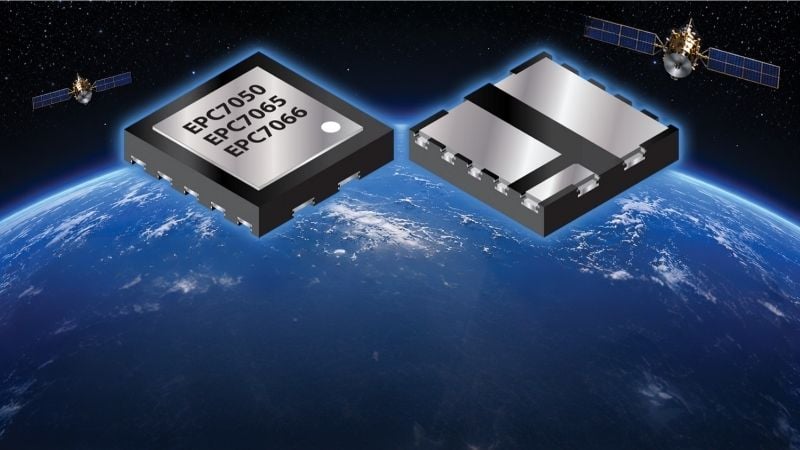
The radiation-hardened eGaN power transistors are aimed at satellites and spacecraft. Image used courtesy of EPC Space
Why Silicon Power Stages Struggle in Orbit
Power delivery for space-based processors faces a constraint ground systems don't: radiation. Two distinct mechanisms threaten conventional silicon MOSFETs.
The first is total ionizing dose, the cumulative radiation absorbed over a mission's lifetime. This radiation gradually shifts a transistor's threshold voltage and increases leakage until the device drifts out of spec.
The second is single-event effects, where a single high-energy particle strike can trigger a single-event burnout or latch-up, causing a destructive short circuit in an instant rather than over years.
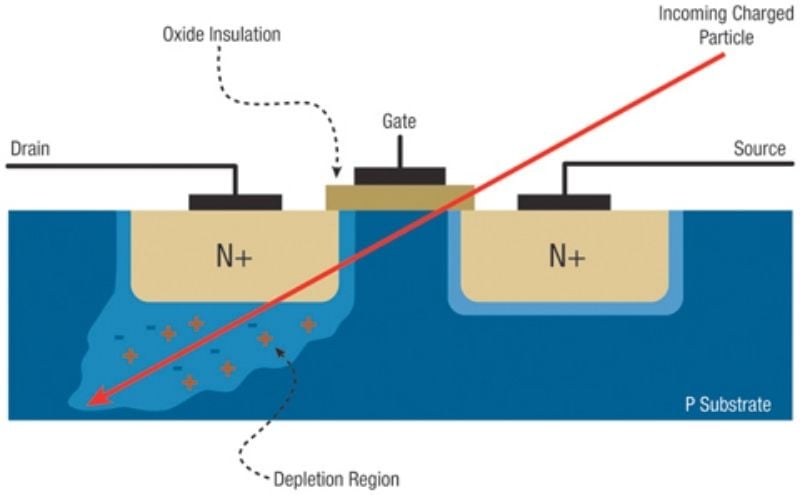
A charged particle striking a MOSFET can ionize a path through the depletion region, causing a single-event effect. Image used courtesy of Semiwiki
Both problems are getting harder to ignore. As satellites and spacecraft begin carrying GPUs and system-on-chips (SoCs) for onboard AI processing, their power stages must convert and regulate far more current than legacy avionics ever demanded. Doing that efficiently means minimizing conduction and switching losses, since every watt lost as heat is a watt that must be radiated away in an environment with no air for cooling.
The power stage feeding a modern space processor therefore has to be simultaneously high-current, low-loss, and radiation-tolerant. This is where EPC Space's eGaN FETs come in.
Three Voltage Classes, One Current Rating
The three parts share a 101 A continuous current rating and differ mainly in voltage class. The EPC7050PCSH is the 15 V member, with a typical on-resistance of 0.28 mΩ. Stepping up, the EPC7066PCSH carries a 25 V rating and 0.37 mΩ typical on-resistance, while the EPC7065PCSH sits at the top with a 40 V rating and 0.5 mΩ.
Those on-resistance figures, all well under a milliohm, are what keep conduction losses low when the full 101 A flows through the channel, so less of the delivered power turns into waste heat.
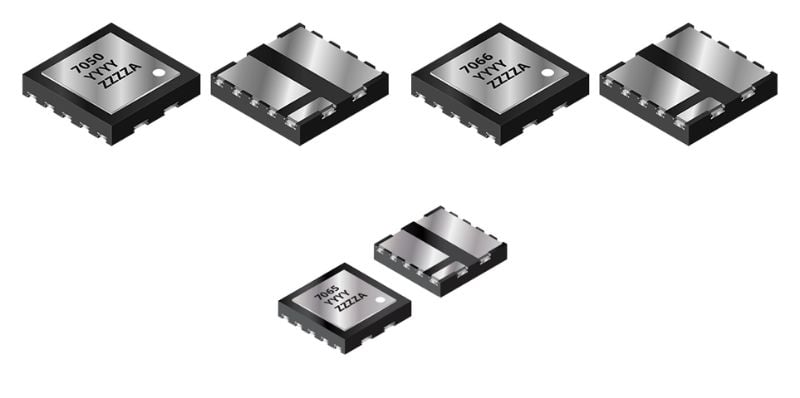
Top and bottom package views of the eGaN power transistors. Image used courtesy of EPC Space
All three arrive in compact PQFN surface-mount packages with a backside thermal pad, which gives the heat generated in the die a short, direct path out to the board. The transistors also switch with zero reverse-recovery charge, a trait inherent to how gallium nitride conducts.
Radiation Hardness Across Three Fronts
What separates these from commercial GaN parts is the radiation qualification. EPC Space rates all three for a total ionizing dose above 1 Mrad, meaning they can absorb a large cumulative radiation load over a long mission before their characteristics drift.
For single-event effects, the devices are hardened to a linear energy transfer of 85 MeV·cm²/mg, a measure of how energetic a particle strike they can shrug off without failing. They are also specified to withstand a neutron fluence greater than 4 × 10¹⁵ n/cm², which covers the neutron exposure encountered in certain harsh environments.
Where the Devices Sit in the Power Chain
The devices are aimed squarely at the power conversion chain that feeds a space processor. EPC Space positions them as synchronous rectifiers on the secondary side of intermediate bus converters, producing 5 V to 12 V outputs, where their low RDS(on) × QG figure of merit lets designers push the switching frequency higher while maintaining efficiency.
These same transistors are also used in voltage-regulator modules, intermediate-voltage regulation, and point-of-load converters, ultimately feeding demanding space processors such as AMD's Versal SoCs or NVIDIA GPUs.
For full electrical and radiation specifications, see EPC Space's datasheets for the EPC7050PCSH, EPC7066PCSH, and EPC7065PCSH.
The Bottleneck Moves to Power
At GTC 2026, NVIDIA unveiled its Space-1 Vera Rubin module and named partners such as Planet and Starcloud, moving compute into orbit, echoing Google's Project Suncatcher.
The recurring caveat in each is the same: with no air in space, there's no convection to carry heat away, so every watt a converter wastes becomes a thermal burden the spacecraft must shed. That is the gap parts like these target. Whether GaN becomes the default will hinge on the flight heritage these devices have yet to earn, but rad-hard silicon now has a serious challenger.