Facebook
 Google
 GitHub
 Linkedin
Diodes’ Automotive-Compliant Silicon Carbide MOSFETs Enable Higher Efficiency
The products from Diodes hope to elevate efficiency levels in automotive applications. This article examines silicon carbide, its role in automotive systems, and the new release from Diodes.
In the past ten years, seemingly no industry has undergone a more drastic revolution than the automotive sector. Between the industry-wide shift from internal combustion-powered vehicles to electric vehicles and the emergence of advanced driver assistance systems (ADAS), today’s automobiles are significantly different than what existed ten years ago.
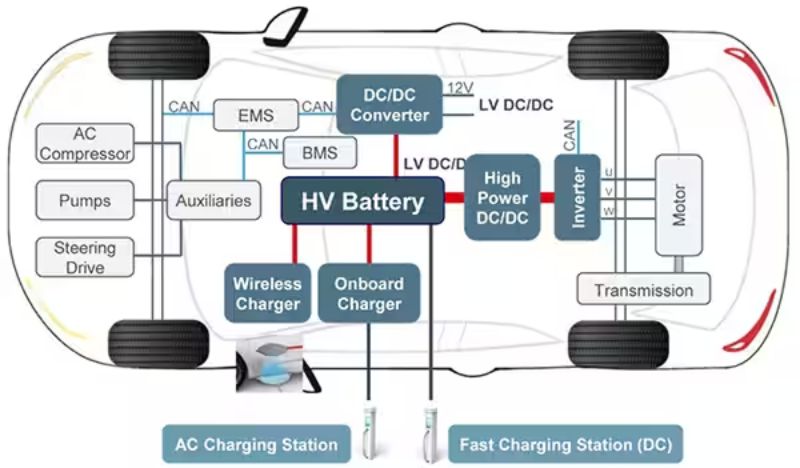
The many applications for SiC in an EV. Image used courtesy of DigiKey
As advancements in this industry accelerate, there is an unprecedented demand for smarter, more efficient, and more powerful electrical systems. In response, Diodes Incorporated has created a line of automotive-compliant silicon carbide (SiC) MOSFETs to improve the capabilities of automotive subsystems.
Silicon Carbide: A History of Success
Of all the semiconductor materials being evaluated in the power electronics industry, silicon carbide has become particularly successful.
Silicon carbide is a crystalline material comprised of carbon and silicon. A wide bandgap semiconductor material, SiC is well-known for its electrical properties enabling significantly improved performance compared to traditional silicon.
Specifically, SiC boasts an impressive list of features that make it ideal for power electronics, including a bandgap energy three times greater than silicon, a thermal conductivity ten times higher, and a breakdown electric field ten times stronger.
As a result of these impressive electrical properties, SiC-based transistors, and power electronics can achieve levels of efficiency and density that are simply not possible with silicon. As a result, SiC MOSFETs have boomed in popularity, offering better energy efficiency, lower cooling requirements, and smaller sizes than traditional silicon-based MOSFETs.
Silicon Carbide in Automotive Applications
Thanks to the exceptional properties of SiC, the material has become a cornerstone of the electric vehicle (EV) revolution. Where automotive applications demand highly efficient, compact, and robust components that can operate reliably in harsh conditions, SiC MOSFETs are uniquely well-positioned to meet these demands.
.jpg)
Tesla. Image used courtesy of Pexels
Primarily, SiC plays an instrumental role in electric vehicle power systems, including onboard battery chargers and powertrain inverters. These systems are responsible for converting and controlling the flow of electric power within the vehicle. SiC's unique characteristics, such as robustness against high voltages and faster switching capabilities, make it an ideal choice for these applications.
SiC FETs can efficiently handle high power and extreme temperatures, thus improving the performance of the electric drivetrain. Furthermore, by minimizing power losses during energy conversions, SiC also contributes to extending the driving range of EVs.
SiC also brings considerable benefits in terms of space and weight. Due to its superior power density, SiC components can be smaller than their silicon counterparts for the same power ratings. This allows for more compact and lighter power electronics, which is particularly important in the automotive sector, where space and weight are at a premium.
Diodes’ Automotive-Compliant SiC MOSFETs
Diodes’ latest line of automotive-compliant SiC MOSFETs includes two N-channel MOSFETs, the DMWSH120H90SM4Q and DMWSH120H28SM4Q, designed for automotive power systems such as motor controllers, EV traction inverters, and DC-DC converters.
SiC boasts an impressive list of features that make it ideal for power electronics, including a bandgap energy three times greater than silicon, a thermal conductivity ten times higher, and a breakdown electric field ten times stronger.
The FETs are produced with a planar manufacturing process which Diodes says led to greater reliability and robustness in the form of higher breakdown voltage, drain current, and junction temperature than previous generations.
To quantify their performance, Diodes shares that the DMWSH120H90SM4Q offers a nominal drain-source voltage (VDS) of 1200 V, a gate-source voltage (Vgs) of +15/-4 V, and a typical on-resistance (RDS(ON)) of 75 mΩ at a Vgs of 15 V. Meanwhile, the DMWSH120H28SM4Q operates at similar voltage levels, up to 1200VDS and +15/-4 Vgs, but has a lower typical RDS(ON) of 20 mΩ at 15 Vgs.
Their impressive thermal performance and ruggedness also contribute to their ability to withstand the rigors of automotive environments. As a testament to this, the devices are fully automotive-compliant, meeting the rigorous AEC-Q101 standards.
Related Content