Facebook
 Google
 GitHub
 Linkedin
DC EV Fast Charger Meter Offers Accurate Current Measurement
Carlo Gavazzi’s DCM1 energy meter offers accurate direct connection DC power metering with an ethernet-connected remote display for status monitoring in EV fast chargers.
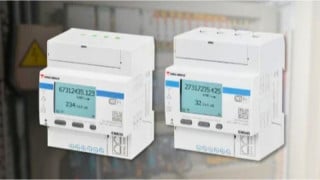
Carlo Gavazzi has released a DCM1 energy meter building on the company’s DCT1 precision current, voltage, and power measurement capabilities. The meter is paired with a separate display module for easy integration into electric vehicle DC fast chargers for metering and billing applications.
DCMI energy meter. Video used courtesy of Carlo Gavazzi
The separate display module incorporates RS485 Modbus RTU and Ethernet Modbus TCP communication protocols to facilitate data transfer. It allows for the display to be placed away from high voltages so it can be viewed safely by users.
Direct connection DC metering, as applied in the DCM1, can be more accurate than many alternative approaches commonly used within the industry. With temperature and cable loss compensation features, the DCM1 offers a power measurement resolution down to 0.1 Wh and a current measurement accuracy of 1%.
In addition to EV fast charging applications, the DC energy meter is suitable for solar energy storage, DC microgrids, and similar high-voltage DC systems.
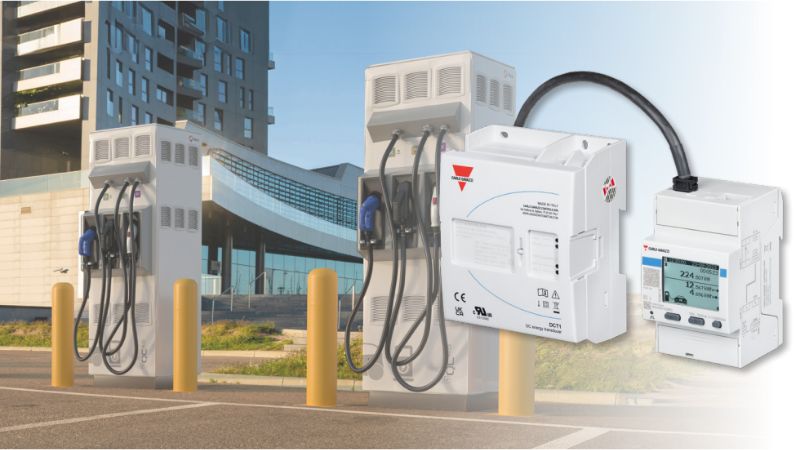
DCM1 energy meter for DC fast chargers. Image used courtesy of Carlo Gavazzi
Metering and Billing for EV Fast Charging
Manufacturers of DC fast chargers need a solution to reliably and accurately measure the amount of energy delivered to an EV’s battery for billing purposes. The DCM1 energy meter is a direct connection solution placed on the charger's DC side. According to Carlo Gavazzi, the DCM1’s in-line DC approach is far more accurate as a metering and billing solution than charge-by-time or upstream AC metering systems, which are notoriously inaccurate.
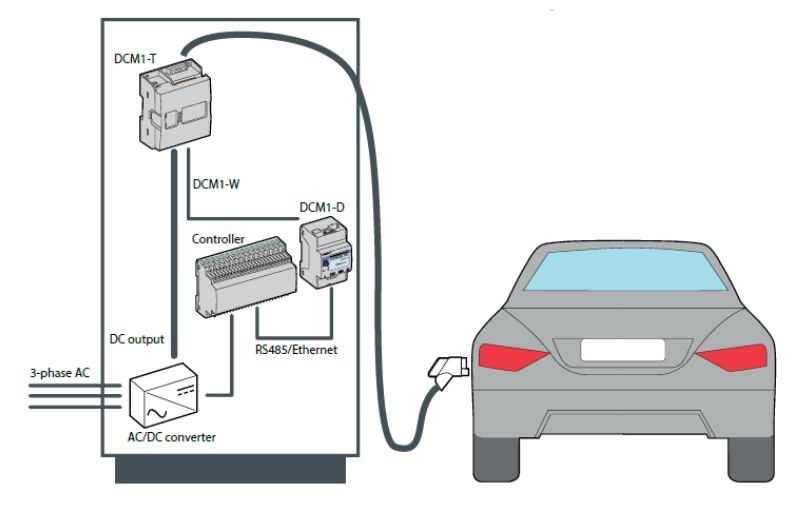
EV fast charge metering with the DCM1. Image used courtesy of Carlo Gavazzi
The DCM1 meter comprises two components: a transducer unit (DCM1-T) for direct connect voltage and current measurements and a display unit (DCM1-D) featuring a 128 x 96 matrix LCD backlight display, Modbus RTU, and Modbus TCP communication ports. The separate display unit allows placement in an isolated location, away from high voltages, to ensure the safety of charging system users.
The transducer unit incorporates a high-voltage current transducer with dual temperature measurement for compensation and an integrated DC voltage measurement capability. Temperature compensation allows current level measurement with 1% accuracy.
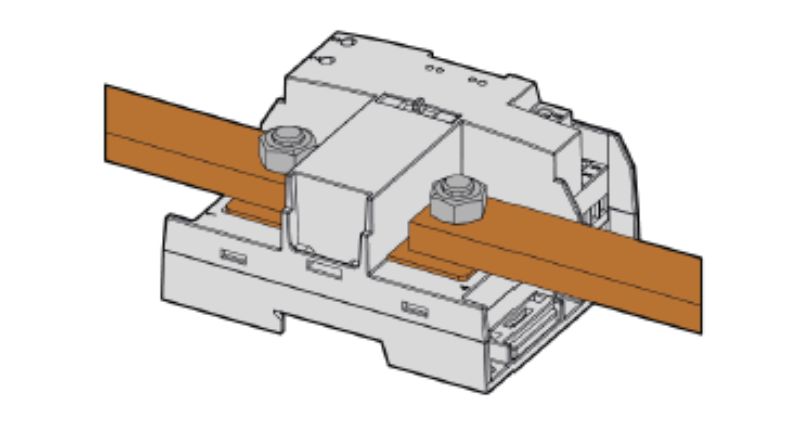
Bus bar connection of the DCM1-T transducer module. Image used courtesy of Carlo Gavazzi
Other Key Features
The wide voltage (150 to 1000 VDC) and current (300 or 600 A) measurement ranges of the DCM1 make it a suitable solution for most fast charger models. The meter complies with charging system standards for European and U.S. markets.
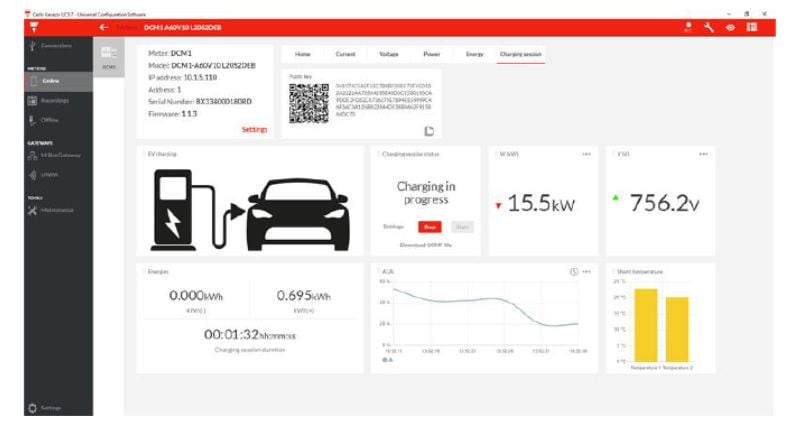
DCM1 Universal Configuration Software. Image used courtesy of Carlo Gavazzi
Within the DCM1 meter, a cable loss compensation feature subtracts transmission losses from the charger’s total power to ensure that the customer is only charged for the actual power delivered to the battery.
Configuration for the DCM1 can be through RS485 from a PC, UWP3.0/UWP4.0 via LAN, or the Carlo Gavazzi website using the free download Universal Configuration Software.