Facebook
 Google
 GitHub
 Linkedin
Boston Semi Enhances Zeus Handler for HV Gan, SiC Testing
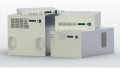
Boston Semi Equipment’s Zeus gravity feed test handler doubles the platform’s high-voltage testing capability to an industry-leading 24 kV peak for power IC testing applications.
Boston Semi Equipment (BSE) has released a test site module for its Zeus gravity feed test handler for HVPD (high voltage and partial discharge) power device testing.
According to Colin Scholefield, BSE Director of Product Marketing, the upgrade essentially doubles the Zeus platform’s high-voltage test capabilities. It was developed in response to the growing number of high-voltage gallium nitride (GaN) and silicon carbide (SiC) power applications.
The test site module’s innovative microchamber design supports isolation testing up to a peak voltage of 24 kV and is backward compatible with already deployed Zeus handlers using an upgrade kit.
According to the Yole Group, the total power electronics market is anticipated to rise to $33.3 billion by 2028, driven largely by high-voltage compound semiconductor materials like SiC and GaN.
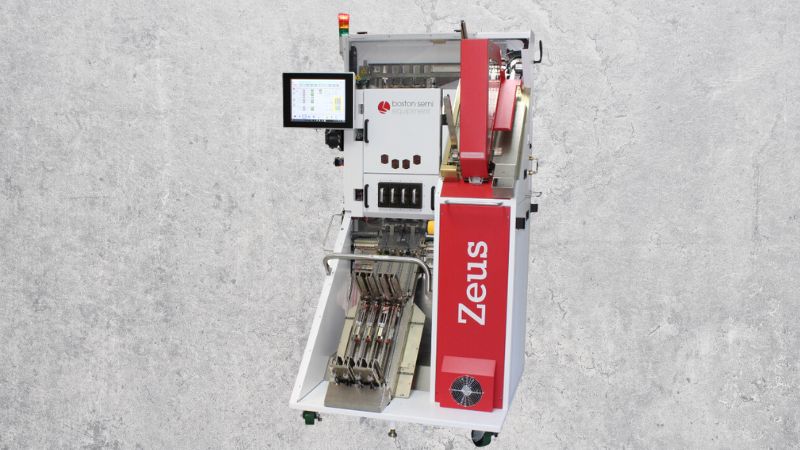
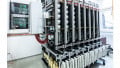
Zeus gravity feed test handler. Image used courtesy of Boston Semi Equipment
Gravity Feed Test Handler
Zeus is a gravity feed test handler that supports packaged semiconductor devices testing at multiple temperatures and can handle up to eight test sites with an index time as low as 650 ms. The index time is roughly the time it takes to remove tested devices from the test sockets and replace them with new, untested devices.
As the name suggests, gravity feed test handlers use gravity to feed chips or devices under test (DUT) to the test sockets enclosed within the handler. With this technique, numerous devices can be quickly tested to screen for faulty devices or failure to meet all the required specifications. This ensures that faulty, weak, or compromised parts are not released for shipment and do not end up in customer applications. The Zeus handler supports tube and metal magazines feeding DUTs to the test sites.
The Zeus platform's test time is around 1.5 seconds, which, combined with the low index time and eight test sites, results in a total tested device throughput of several thousand or more units per hour. Device test time impacts product cost for IC manufacturers, with shorter test times lowering per-unit overhead and allocated costs, allowing for more aggressive pricing and increasing ROI for the test platform.
High-Voltage Partial Discharge Testing
Partial discharge (PD) occurs when minor arcing occurs across an insulation system. High levels of PD can indicate the potential degradation of a power electronics device's insulation capabilities. Over time, excessive PD events will damage the device insulation, ultimately causing failure.
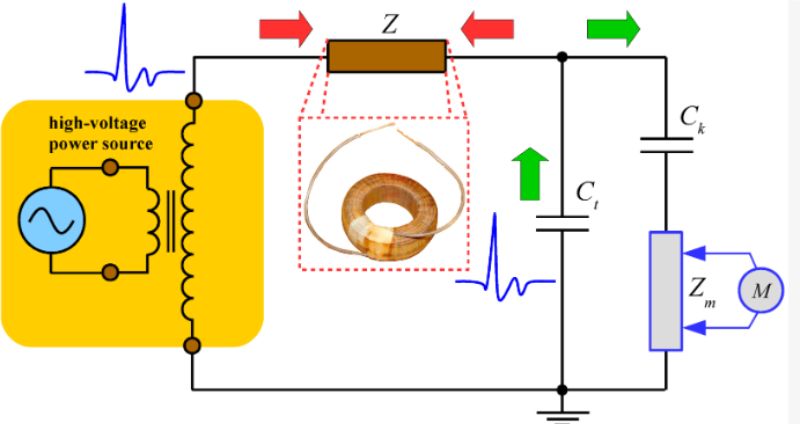
High-voltage partial discharge measurement test circuit. Image used courtesy of MDPI
HVPD testing is a form of nondestructive testing used to evaluate a device’s susceptibility to PD and its subsequent isolation barrier failure. In HVPD testing, high-voltage pulses are applied to the device, and any minor arcing or breakdown in its insulation properties is measured via a test circuit.
A device susceptible to larger amounts of PD may be screened as a test failure due to concerns over its ability to maintain the integrity of its isolation barrier across its useful life when deployed to the field.
The Zeus handler's 24 kV rating supports this type of HVPD testing for higher voltage GaN and SiC components.