Facebook
 Google
 GitHub
 Linkedin
Balancing Safety and Space in Power Protection
PULS PISA-M electronic circuit breakers address size and safety challenges in small to mid-sized power applications.
One of the greatest design challenges for the power electronics designer is handling circuits' increasing complexity while working toward more compact solutions. From a safety perspective, these two needs are at odds: how does one guarantee robust safety measures while maximizing space efficiency?
To solve this challenge, PULS has developed a 4-channel electronic circuit breaker (ECB) that combines a compact form factor with unique safety features. The product addresses challenges facing conventional circuit breakers and introduces new benefits.

Electronic circuit breaker. Image used courtesy of PULS
Unveiling Circuit Breaker Challenges
A circuit breaker is designed to cut power when excessive current flows through electrical wiring.
A basic circuit breaker comprises a simple switch connected to a bimetallic strip or electromagnet. The hot wire connects to the switch ends, allowing electricity to flow through the electromagnet when the switch is on. If the current exceeds safe levels, the electromagnet pulls down a metal lever, breaking the circuit and disconnecting electricity in milliseconds.
However, modern power distribution systems, particularly industrial and automotive applications, demand more precise and rapid protection. These systems often operate at higher frequencies and extreme power densities, with complex load profiles, including high inrush currents and transient spikes. Conventional breakers face challenges such as nuisance tripping, which results from an inability to distinguish between momentary surges and genuine faults. Additionally, the increasing integration of digital control systems necessitates protection devices with enhanced communication capabilities and programmable trip characteristics.
Traditional breakers' thermal management also poses challenges in compact, high-density installations, where space constraints and ambient temperatures can affect performance. These technical challenges and the demand for remote diagnostics and predictive maintenance capabilities have driven the development of advanced ECBs that offer faster response times and more sophisticated current sensing and control algorithms.
Smart Protection in a Slim Package
PULS introduced the PISA-M 4-channel ECBs, an advanced power distribution and protection solution in systems ranging from 9 0W to 480 W.
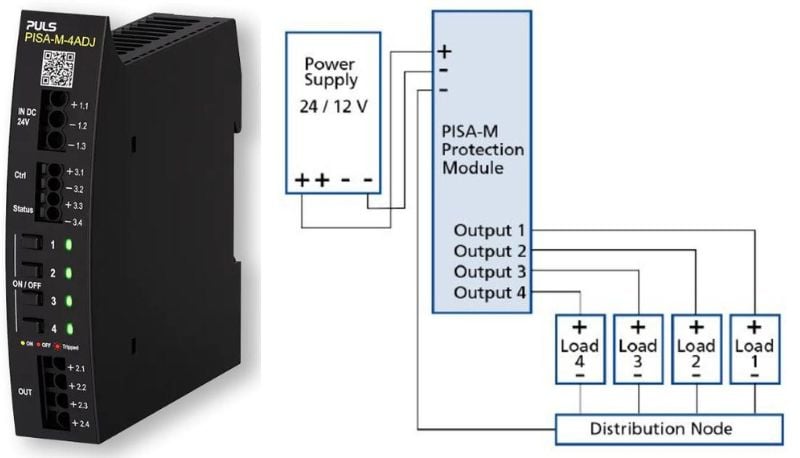
The PISA-M ECB and its standard wiring diagram. Image courtesy of the PULS datasheet
The ECBs are independent channel devices offering comprehensive safety features, including overcurrent, short-circuit, and overload protection for system components and power supplies. The PISA-M series’ notable features are the option for adjustable current settings from 1 A to 8 A per channel, a rapid 1 ms response time for overload detection, up to 99% efficiency, selective tripping to maintain power to unaffected channels, and power supply overload protection.
With a compact design of only 22.5 mm width, these 24 VDC devices offer a current limit of 20 A and a product lifetime of more than 200,000 hours, ensuring long-term reliability. Importantly, they also feature a digitally coded interface for remote control and monitoring, making them compatible with PLCs and central user interfaces.
Advancing Power Infrastructure
As electronic systems grow more intricate and power-dense, reliable and efficient protection solutions are becoming increasingly important. With advanced features such as adjustable current settings, rapid response times, and remote monitoring capabilities, PULS’ ECBs will be able to meet modern demands with precision and flexibility.