Facebook
 Google
 GitHub
 Linkedin
Alpha & Omega Intros DrMOS Devices for High-Demand AI Workloads
Alpha and Omega Semiconductor’s high-performance DrMOS family offers high-accuracy overcurrent protection directly within the power stage.
The power stages inside AI server voltage regulators are under more stress than ever. As GPU and accelerator workloads grow denser, peak current transients are pushing inductors toward saturation, a condition that can destroy a high-side MOSFET in microseconds.
Alpha and Omega Semiconductor (AOS) is addressing this problem with the launch of its SmartClamp DrMOS family, a line of smart power stages that protect against overcurrent and negative current events by directly monitoring inductor current cycle by cycle within the power stage, without relying on the controller.

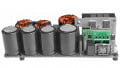
The AOZ53228QI in its compact 5 mm × 5 mm QFN package. Image used courtesy of Alpha & Omega Semiconductor
The Problem: 50 ns Is Too Slow
In a conventional multiphase voltage regulator, overcurrent protection is handled at the controller level. That worked well enough for lower-power platforms, but AI workloads can produce di/dt events that outrun controller response times.
According to AOS, a 50 ns OCP delay, well within the range of a typical digital controller, is enough to allow a 30 A current overshoot. At those magnitudes, a saturating inductor stops limiting current, leaving the high-side MOSFET exposed to the full force of the surge.
SmartClamp: Protection Built Into the Power Stage
The SmartClamp family solves this by moving both overcurrent and negative current protection inside the power stage itself. Rather than waiting on the controller, the device uses an internal rising-edge current ramp to monitor inductor current on a cycle-by-cycle basis. When the current exceeds the set threshold, the device forces an early termination of the high-side on-time.
The flagship device, the AOZ53228QI, consists of two asymmetrical MOSFETs and an integrated driver, and can handle a continuous output of 60 A, with short-pulse ratings of 80 A for 10 ms and 120 A for 1 ms, at up to 18 V input. The high-side MOSFET prioritizes fast switching with low capacitance and reduced gate charge, while the low-side MOSFET is optimized for minimal conduction loss. It also supports diode emulation mode, letting the converter run asynchronously and reduce losses at light loads. The device also continuously reports internal die temperature, giving the system real-time thermal visibility.
On the protection side, the OCP threshold is set at 100 A with ±10% accuracy, and a 75 ns leading-edge blanking time prevents false triggers. On the low side, negative current protection activates at -50 A to guard against energy discharge during load steps, releasing once current recovers above -30 A.
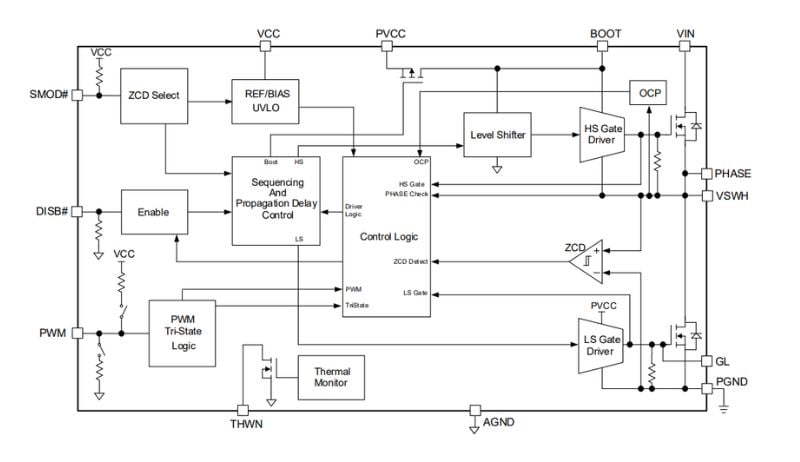
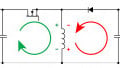
 Internal block diagram, illustrating the OCP, zero-cross detection, gate driver, and thermal monitor subsystems. Image used courtesy of Alpha and Omega Semiconductor
The device switches at up to 2 MHz and accepts 3 V/5 V Tri-State PWM signals. The SmartClamp devices work with standard COT and fixed-frequency PWM controllers from multiple vendors, as well as AOS's own A2TM multiphase controller series. AOS pairs it with its own OVR16, OVR4-22, and Intel IMVP/AMD SVI3-compatible controllers, giving designers the option to build a complete Vcore solution for high-density power applications.
The AOZ53228QI supports a junction temperature range of -40°C to +125°C and is housed in a 5 mm × 5 mm QFN31 package optimized to minimize parasitic loop inductance.
A Family Spanning AI Servers to Gaming PCs
The SmartClamp line covers six devices across two voltage rails. Three 18 V parts: AOZ53228QI, AOZ53262QI, and AOZ53263QI, which target AI servers, data centers, and high-end graphics cards, with continuous output ranging from 60 A to 80 A. Three 25 V parts—the AOZ53261QI, AOZ53267QI, and AOZ53268QI—provide the same protection for gaming and AI PCs, covering 55 A to 70 A. All six share the same ±10% peak current accuracy.
The SmartClamp series is in production now with a 12-week lead time. For full electrical characteristics, see the AOZ53228QI datasheet.
The Road Ahead
The launch arrives as AI accelerator power envelopes continue to climb. NVIDIA's Blackwell-class GPUs are breaking the 1,000 W per-card barrier, and next-generation platforms are expected to push further still. Voltage regulator designs that worked at 400 W are under real stress at those numbers, and protection architectures built around controller-level OCP are increasingly inadequate. Moving current limiting into the power stage is a logical evolution, and other DrMOS suppliers will likely follow.