Facebook
 Google
 GitHub
 Linkedin
AI System-On-Chip Leads to Better Battery Management
Eatron’s AI-powered solution integrates intelligent software and an ultra-low power processor for exceptional battery performance.
Efficient battery utilization poses significant challenges, including maintaining optimal performance, prolonging lifespan, and ensuring safety. To this end, battery management systems (BMS) are crucial in any battery system. As artificial intelligence (AI) continues to grow in prominence, predictive battery health monitoring with BMS is starting to emerge.
Eatron and Syntiant have partnered to develop a cutting-edge AI-powered BMS. The intelligent BMS could provide an effective solution for battery management issues.
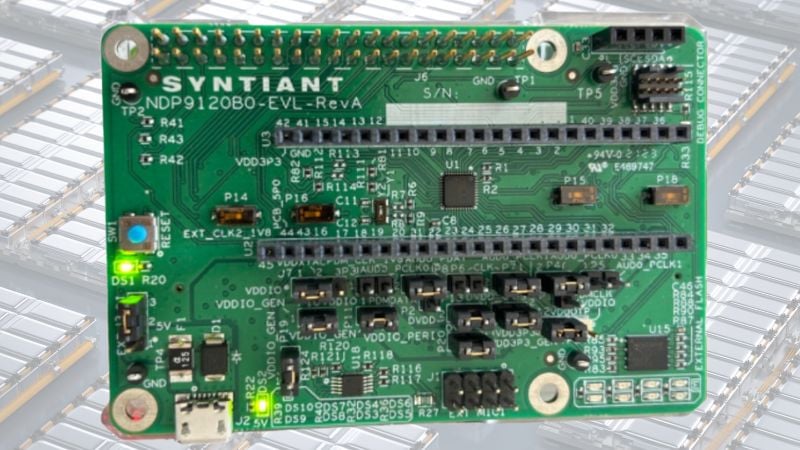
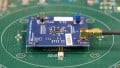
Eatron-Syntiant AI-BMS on chip. Image used courtesy of Eatron Technologies
The What’s and Why’s of Battery Management Systems
A BMS is an electronic system that oversees and regulates rechargeable batteries’ performance. These systems continuously monitor key battery parameters in real time, including current, voltage, temperature, and state of charge (SOC), to assess battery health and detect anomalies. The BMS controls charging and discharging currents to prevent overloading or deep discharges, which can damage batteries, particularly lithium cells, which must stay within a specific voltage range (10.5 V to 14.8 V).
Part of this operation is temperature monitoring, which helps prevent overheating, fires, or explosions. Moreover, the BMS communicates critical information such as SOC, state of health, and fault statuses through reporting. Such data from BMS enables other systems to make informed decisions and adjustments and informs users about the battery's current condition. For example, the BMS interfaces with the central control unit to relay battery pack information in electric vehicles, influencing vehicle operations.
In multi-cell battery packs, each cell may exhibit slight character variations, resulting in imbalances among cells. To address this issue, the BMS performs cell balance by redistributing energy or adjusting charging levels for individual cells to create consistent voltages across all cells. This cell balancing procedure helps preserve the battery pack’s long-term performance and reliability.
Redefining Battery Performance With AI-Powered BMS
Eatron Technologies, in collaboration with Syntiant, has introduced an AI-powered BMS on-chip (AI-BMS-on-chip). Specifically, this collaboration integrates Eatron’s sophisticated Intelligent Software Layer with Syntiant’s ultra-low power NDP120 Neural Decision Processor.
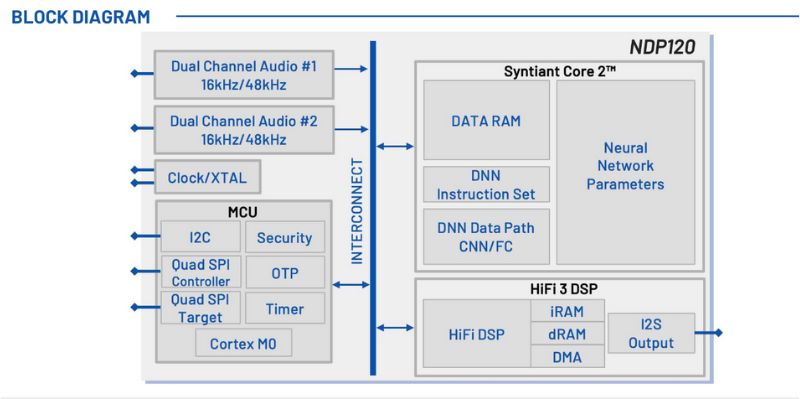
Block diagram of NDP 120. Image used courtesy of Syntiant
The AI-BMS-on-chip delivers several technical advancements. It utilizes pre-trained AI models to accurately assess the state of health, SOC, and remaining useful life of batteries, yielding up to 10% additional capacity and extending battery lifespan by as much as 25%. Syntiant’s NDP120 enables real-time edge processing, facilitating on-device analysis and decision-making. Real-time edge processing outperforms cloud computing by processing data locally at the source, minimizing latency and reducing bandwidth usage. This approach allows for immediate response times necessary for mission-critical applications like autonomous vehicles and industrial control systems. It also enhances security and reliability by operating independently of cloud connectivity.
According to the companies, this BMS was designed to support various battery-powered applications, from light mobility to industrial and consumer electronics. The solution is “plug-and-play” by nature, accelerating time to market, while a customizable toolchain allows designers to perform optimization for specific applications.
From Innovation to Impact
With AI permeating increasingly modern electronics, battery management systems can gain much from the technology. With the ability to better assess state of health, SOC, and remaining useful life, AI-powered solutions like those from Eatron and Syntiant can have major implications for future consumer electronics and electric vehicles.