Facebook
 Google
 GitHub
 Linkedin
3 New Power MOSFETs for Next-Gen Technology
Toshiba, Littelfuse, and Vishay have introduced MOSFET technologies to maximize efficiency without compromising reliability.
Industries like automotive, telecommunications, and computing push the boundaries of power management. Manufacturers are focused on developing components that can handle higher currents, minimize energy losses, and operate reliably under increasingly challenging conditions.
The industry has made numerous advancements in MOSFET technology that have led to more efficient devices. Here’s the latest.

Littelfuse Ultra Junction 4X-Class series. Image used courtesy of Littelfuse
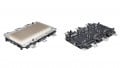
Toshiba’s SiC MOSFET Die
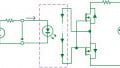
Silicon power MOSFETs inherently feature a body diode between the drain and source terminals. In the off-state, the body diode blocks reverse current and conducts when forward-biased. The internal body diode can also serve as a freewheeling diode in switching applications, thereby eliminating the need for an external anti-parallel diode.
While SiC body diodes exhibit minimal carrier injection at room temperature, carrier injection and the associated reverse recovery current become significant at high temperatures. This can cause increased turn-on resistance, higher switching losses, or even catastrophic failures. On the other hand, minimizing on-state resistance may introduce risks like short circuits decreasing short-circuit durability.
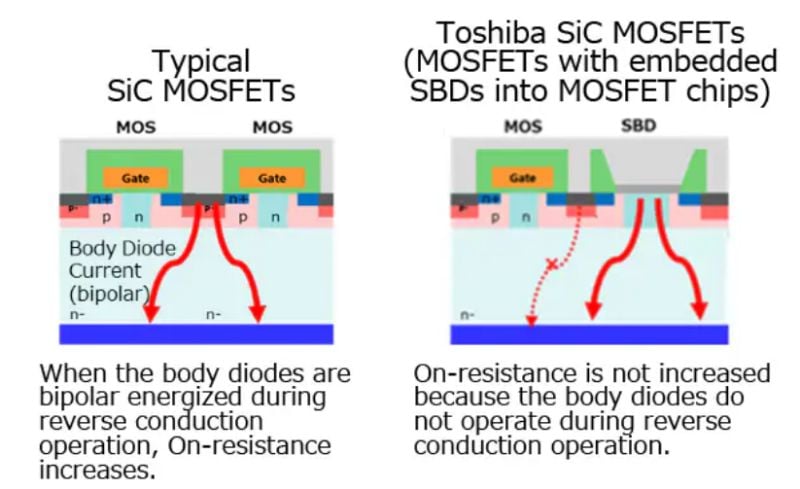
Typical vs Toshiba’s SiC MOSFETs. Image used courtesy of Toshiba
Toshiba has introduced the X5M007E120, a 1200 V bare-die silicon carbide (SiC) MOSFET designed for automotive traction inverters.
Offering low on-resistance and high reliability, the device integrates Schottky barrier diodes (SBDs) within the MOSFET to suppress the body diode's bipolar energization during reverse conduction, a known source of reliability degradation. Unlike conventional striped SBD layouts, Toshiba employs an innovative check-pattern array, which increases unipolar current capacity approximately two times and reduces on-state resistance per unit area by 20-30%. This arrangement optimizes channel density while maintaining compactness. Additionally, a deep barrier structure mitigates excess current and leakage during short-circuit conditions.
Littelfuse’s Low RDS(on) Power MOSFETs
Conventional power MOSFETs struggle with balancing efficiency and reliability in applications demanding high power density and minimal conduction losses. Littelfuse's Ultra Junction X4-Class 200V Power MOSFETs, including the IXTN400N20X4 and IXTN500N20X4, overcome these challenges with a novel design.
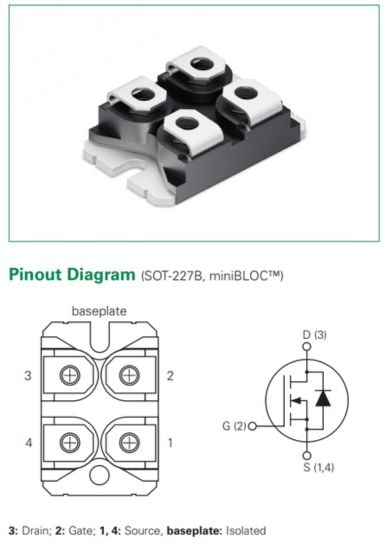
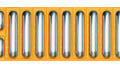
Package and pinout of IXTN500N20X4. Image used courtesy of Littelfuse
These devices offer on-state resistances (RDSon) of less than 3 mΩ, reduced by up to 63% compared to existing X4-Class MOSFETs. Meanwhile, the devices deliver current ratings as high as 500 A at 25°C, which Littelfuse claims is nearly twice of comparable solutions. They come in SOT-227B packages built with aluminum-nitride ceramic for thermal isolation, allowing for thermal resistances as low as 0.13 K/W.
Vishay’s MOSFETs with Improved Figure of Merit
A MOSFET’s Gate charge (Qg) significantly impacts its switching losses, as the charge must be replenished during each switching cycle. As a result, the product of RDS(on) and Qg, known as the figure of merit (FoM), is one of the most significant metrics for evaluating MOSFET performance. As lower RDS(on) decreases conduction losses and lower Qg minimizes switching losses, a lower FoM indicates reduced total losses.
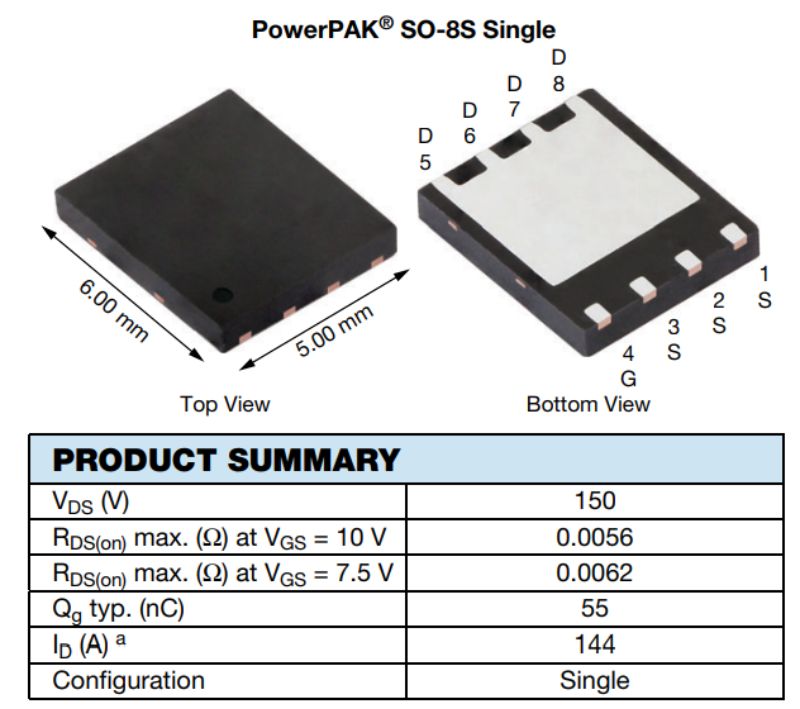
SiRS5700DP specs and package. Image used courtesy of Vishay
Vishay has introduced the SiRS5700DP, a 150 V TrenchFET Gen V N-channel power MOSFET designed for high-efficiency, high-density applications like telecom and computing systems. Housed in the PowerPAK SO-8S package, it achieves an on-resistance of 5.6 mΩ at 10 V and an RDS(on)⋅Qg FoM of 336 mΩ·nC. With a thermal resistance of 0.45°C/W, it supports continuous drain currents up to 144 A. Vishay states the device is best suited for applications like synchronous rectification, DC-DC conversion, and motor drive control.
A Path to Efficient Power Management
As industries demand more compact, energy-efficient solutions that can handle greater power densities, MOSFET technology must evolve for the next-generation systems. Emerging designs, like those incorporating innovative diode structures and enhanced thermal management, help address trade-offs and achieve new heights in efficiency and figure of merit. By making these technologies commercially viable, manufacturers are keeping the industry on a steady progression toward more performant and sustainable power systems.