Facebook
 Google
 GitHub
 Linkedin
Will Toyota Advance Hydrogen With Futuristic City?
Toyota and Japan take hydrogen missteps as they build a future utopian city.
In 2017, Toyota embarked on an ambitious project known as the Toyota Woven City. Located on the 175-acre site of a former auto assembly plant at the base of Mount Fuji, this futuristic prototype city started construction in 2021 to serve as a living laboratory for a hydrogen-based society.
The Woven City concept may excite renewable energy proponents, but is it practical? Is a hydrogen-powered city even feasible?
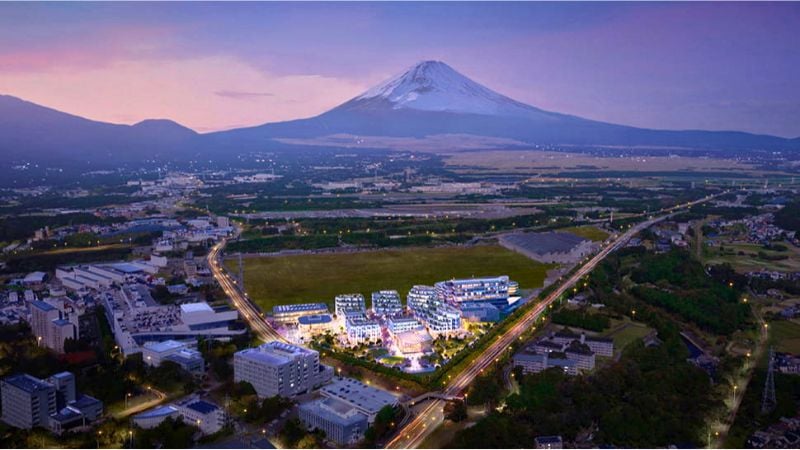
Woven City concept. Image used courtesy of Toyota Woven City
Why Hydrogen Is Appealing
Hydrogen's appeal as a renewable energy source stems from its high energy density and the clean nature of its combustion or when reaction in a fuel cell. When hydrogen reacts with oxygen within a fuel cell, it generates electricity and water, seemingly offering a perfect solution to the pollution problems associated with fossil fuels. This theoretical framework has driven significant investments and policy support in hydrogen technologies.
Toyota has been a prominent advocate of hydrogen fuel cells, investing heavily in developing hydrogen-powered vehicles. Toyota’s hydrogen fuel cell vehicle, the Mirai, was launched in 2014 with great fanfare, symbolizing Toyota's commitment to hydrogen. However, the Mirai struggled to gain market traction.
Japan has been equally enthusiastic about hydrogen, beginning in 2017 to position it as a cornerstone of its energy policy. The Japanese government has invested heavily in hydrogen technology, aiming to create a "hydrogen society" where hydrogen is a primary energy carrier. This vision includes hydrogen-powered transportation, residential heating, and even large-scale power generation.
However, the practical application of hydrogen as a clean energy source is fraught with challenges and misconceptions. In 2022, the Renewable Energy Institute of Japan report was highly critical of Japan’s hydrogen strategy and its policy of prioritizing the gray and blue hydrogen derived from fossil fuels like methane and brown coal.
Not the First Utopia
The Woven City is designed to be fully sustainable, utilizing hydrogen fuel cells to power homes, vehicles, and businesses. It isn’t the first utopian vision for an urban environment. In the 1960s and early 1970s, the Minnesota Experimental City (MXC) was a metropolis-sized dome city in Northern Minnesota designed as a self-contained city with streamlined transportation, recycled waste, and highly computerized social and commercial activity. The project initially garnered support from various sectors, including government officials, corporations, and others who were excited about the futuristic vision. However, skepticism grew about the radically new approach to urban living’s feasibility and desirability as the project details became more widely known. The public opposition eventually influenced the Minnesota state legislature, leading them to question the concept and abruptly defund the project in 1973.
Other proposed utopian cities include Arcosanti, designed by Italian architect Paolo Soleri in the 1970s. The experimental town in Arizona aimed to demonstrate how urban environments can be improved while minimizing destructive impact on the earth. In 2006, the United Arab Emirates (UAE) government initiated the Masdar City project in Abu Dhabi. They designed the city to be a sustainable, zero-carbon development powered by renewable energy. In South Korea, Songdo IBD is a smart city built from scratch on reclaimed land near Seoul, incorporating advanced technology and sustainable design principles.
Such projects have faced hurdles similar to those faced by the MXC regarding practical implementation, funding, or public acceptance. Creating experimental or utopian cities continues to captivate planners and visionaries, even as the challenges of realizing such ambitious projects remain significant.
Woven City
According to Toyota, Woven City will cost approximately $10.13 billion and feature residences, stores, plazas, and other amenities—essentially everything required for a fully functional city. While the Woven City project showcases Toyota's commitment to innovation and its vision for a hydrogen-powered future, it also underscores the challenges inherent in scaling such technologies. Woven City’s success will depend heavily on advancements in hydrogen production, storage, infrastructure, and integration of renewable energy sources to ensure truly green hydrogen. While this experiment highlights Toyota's proactive approach, it also serves as a microcosm of the broader issues facing the hydrogen economy, emphasizing the need for practical, scalable solutions in the quest for sustainable energy.
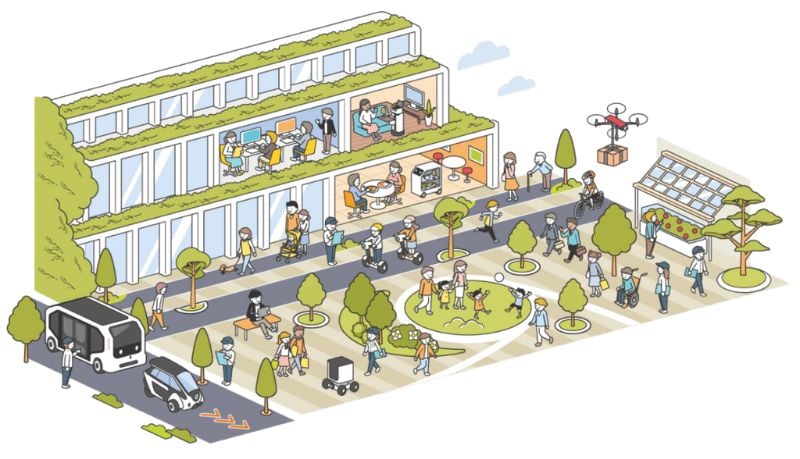
Illustration of Woven City. Image used courtesy of Toyota Woven City
Toyota's Woven City project, which heavily relies on hydrogen technology, is facing significant criticism based on the Renewable Energy Institute report.
- Misaligned focus: Hydrogen is targeted for applications where it's not the most efficient or practical solution. For example, using hydrogen for passenger cars and residential energy is not the best solution when battery electric vehicles and heat pumps are more energy-efficient and consumer-friendly alternatives. The report also criticized Woven City for relying on portable hydrogen canisters to power various applications inside and outside the home.
- Inefficient energy carrier: Hydrogen is considered a wasteful and inefficient energy carrier compared to batteries and direct electrification for many applications. This makes it less suitable for widespread use in urban settings.
- Consumer disinterest: Despite significant government spending on hydrogen programs in Japan, consumers are not adopting hydrogen technologies at the expected rate. Fuel cell vehicles are particularly unpopular, with sales projected to reach only about 1/40th of the government's target by 2030.
- Potential for higher emissions: In some cases, focusing on hydrogen could lead to higher emissions rather than reducing them, which goes against the decarbonization goal.
- Resource misallocation: About 70 percent of Japan's hydrogen strategy budget has been spent on concepts that could hinder the development of promising renewable energy solutions.
- Opportunity cost: The resources invested in Woven City and hydrogen technology could have been better spent refining electric vehicle offerings, which might have given Toyota a competitive edge in the EV market. Toyota has dragged its feet in developing battery-powered EVs, preferring to concentrate on gasoline-electric hybrid vehicles.
Practical Challenges of Hydrogen
Hydrogen’s reality as a clean energy source is complex. The primary issues lie in hydrogen production, storage, and distribution. Currently, most hydrogen is created by steam methane reforming, which relies on natural gas and emits significant amounts of carbon dioxide. Japan relies on importing hydrogen produced from fossil fuels, primarily from Australia. This undermines hydrogen’s environmental benefits and perpetuates dependency on fossil fuel-derived energy. Even though there are greener methods, such as renewable energy-powered electrolysis, these are currently not economically viable at scale.
Moreover, hydrogen is difficult to store and transport. Because of its low volumetric energy density, hydrogen must be compressed at high pressures or liquefied at very low temperatures, requiring substantial energy inputs. These storage and transportation challenges further diminish hydrogen's efficiency and environmental benefits.
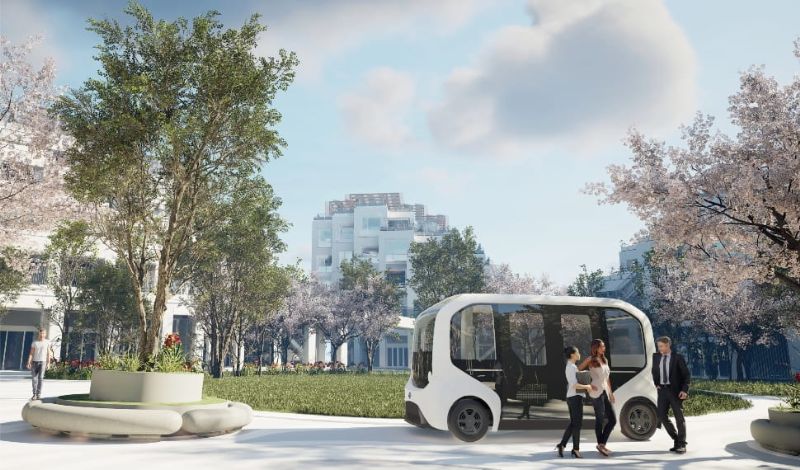
Hydrogen fuel cell vehicle. Image used courtesy of Toyota Woven City
Unlike electric vehicles, which can leverage existing electrical grids for charging, hydrogen vehicles will require a completely new refueling infrastructure. Building this infrastructure is both expensive and logistically challenging, particularly in regions with low population density or where renewable energy sources are not abundant.
The cost of hydrogen fuel cell vehicles will also remain high compared to battery electric vehicles (BEVs), which are becoming less expensive as lithium-ion battery costs come down. The complexity of fuel cell technology and the costs associated with hydrogen production and storage contribute to this price discrepancy. Consequently, consumers are more inclined to choose BEVs, which benefit from a more mature technology and infrastructure.
Ready To Move In?
Although the Woven City is reportedly nearing completion, the first residents won’t begin living there until sometime in 2025. Toyota says its experimental city will initially be home to around 360 people, primarily senior citizens and families. Eventually, the company plans to expand its population gradually to approximately 2,000. The residents will include company employees, such as technicians and researchers, who will observe the settlement and develop technologies like AI in a real-world environment.
While Toyota's Woven City aims to be a testing ground for new technologies, its heavy reliance on hydrogen for applications where other solutions are more practical and efficient has led many to question this approach’s wisdom. As the world transitions to cleaner energy, it becomes increasingly clear that more immediate and effective solutions, such as battery electric vehicles and renewable energy sources, offer a more practical path forward. Toyota and Japan’s experiences at Woven City may be a cautionary tale, emphasizing the need for a more practical, balanced, and realistic approach to green energy innovation.