Facebook
 Google
 GitHub
 Linkedin
Study: SE Asia Needs Cross-Border Transmission To Reach Net-Zero
An energy system optimization study modeled regional pathways allowing Southeast Asia to achieve net-zero greenhouse gas emissions in its electricity and hydrogen sectors by 2050.
An energy system optimization study suggests that Southeast Asia could reach net-zero greenhouse gas emissions in its electricity and hydrogen sectors by 2050, even as regional energy demand continues to grow.
The study in PNAS Nexus focuses on a part of the decarbonization problem that researchers often treat in fragments. Instead of modeling national power systems in isolation or assuming idealized balancing, the researchers built a regional, time-resolved optimization model that links electricity generation, hydrogen production, storage, and cross-border transmission.
This approach reflects the reality of Southeast Asia’s energy transition, where demand growth, uneven renewable resources, and varying levels of infrastructure development all shape what is technically and economically feasible.
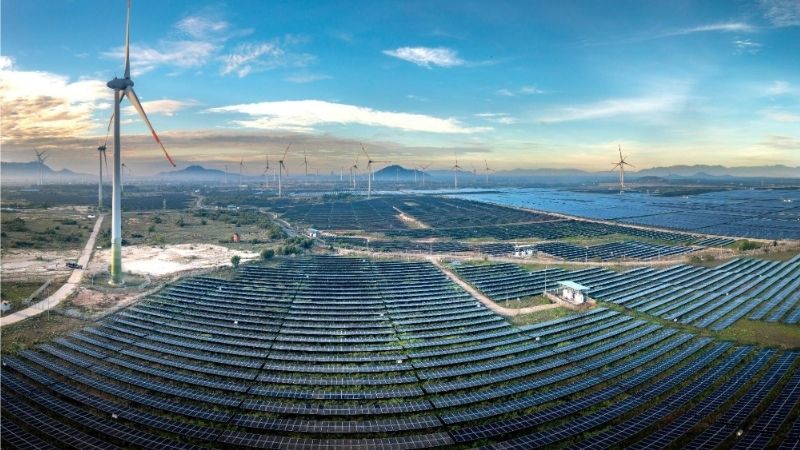
A solar and wind farm in Vietnam. Image used courtesy of Pexels
Modeling a Growing, Fossil-Heavy Energy System
Southeast Asia’s energy challenge is distinct from that of many industrialized regions. Electricity demand is expected to rise sharply through mid-century due to population growth, urbanization, and industrial expansion, while coal and natural gas still dominate much of the generation mix. Several countries also face land-use constraints that limit domestic renewable deployment, particularly for large-scale solar and wind.
The study models hourly energy production and consumption across 10 ASEAN countries, including Indonesia, Malaysia, the Philippines, Singapore, Thailand, Brunei, Vietnam, Lao PDR, Myanmar, and Cambodia.
The model developed in this study simulates electricity and hydrogen systems with hourly resolution from the present through 2050. Variable renewable energy sources such as solar and wind introduce fluctuations that cannot be captured with annual or even monthly averages. By resolving the system hour by hour, the model can assess how generation, storage, demand response, and transmission interact under realistic operating conditions.
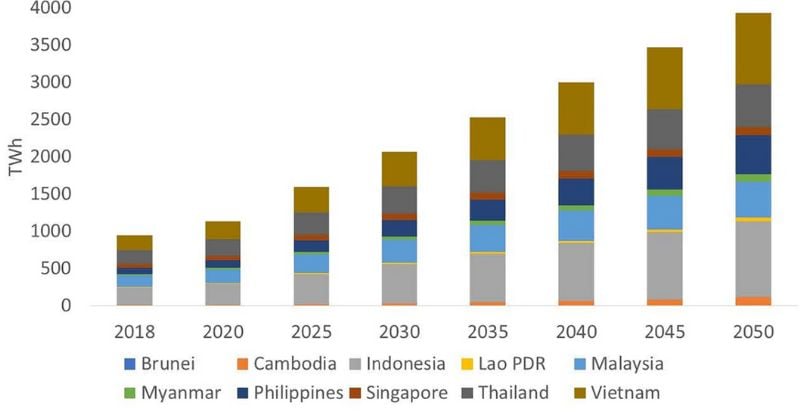
Estimated electricity demand of ASEAN countries. Image used courtesy of Zhong et al
The scope of this extends beyond electricity alone. Hydrogen is explicitly modeled as both an energy carrier and a storage medium, produced primarily via electrolysis using low-carbon electricity. Hydrogen demand is assumed to grow as it substitutes for fossil fuels in industry and other hard-to-electrify sectors. Including hydrogen allows the model to explore trade-offs between direct electrification and indirect energy use, as well as the role of hydrogen in absorbing surplus renewable generation.
Importantly, the model incorporates cross-border electricity trade through a proposed ASEAN Power Grid. Rather than assuming each country balances its own supply and demand independently, the optimization allows power to flow across national boundaries, subject to transmission constraints and costs. This regional coupling turns out to be a central lever in achieving net-zero outcomes.
The Role of Renewables
According to the modeled pathways, deep decarbonization of Southeast Asia’s electricity sector relies heavily on large-scale deployment of solar and wind, complemented by hydropower where available. Solar emerges as the dominant source of new generation capacity in most countries, reflecting high insolation levels across the region. Wind contributes more selectively, depending on local resource quality and land availability.
Energy storage becomes increasingly important as renewable penetration rises. Short-duration storage helps manage daily solar variability, while hydrogen production plays a dual role. Electrolyzers act as flexible loads that can absorb excess renewable electricity during periods of high generation, converting it into hydrogen that can be stored and later used when the electricity supply is constrained. This coupling reduces curtailment and smooths system operation at high renewable shares.
Cross-border transmission significantly reduces overall system cost in the net-zero scenarios. Countries with abundant renewable resources can export electricity to neighbors with less favorable conditions, lowering the need for redundant capacity.
The model shows that regional interconnection also reduces the amount of storage required, since variability can be averaged over a larger geographic area. Without expanded transmission, individual countries must overbuild generation and storage to maintain reliability, driving up costs.
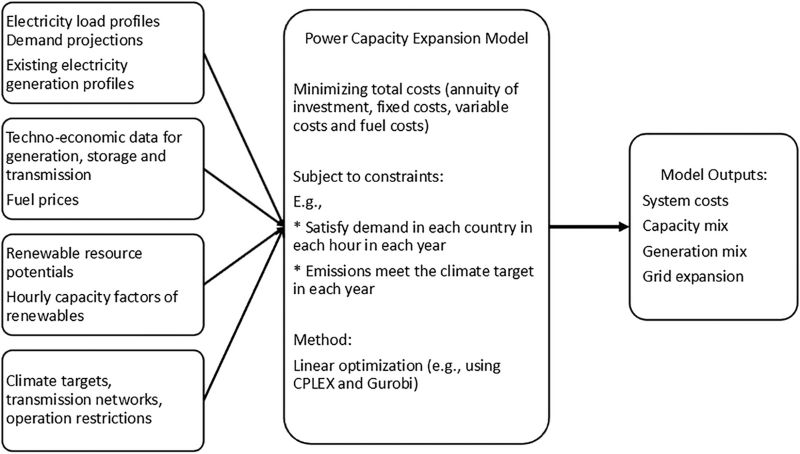
The study’s model. Image used courtesy of Zhong et al
Hydrogen trade is also part of the picture, though electricity trade dominates in the modeled scenarios. Hydrogen production tends to cluster in regions with strong renewable resources and available infrastructure, with distribution supporting industrial demand elsewhere.
Constraints and Costs
One of the more useful aspects of the study is what it does not rely on. The net-zero pathways do not assume breakthrough technologies or unrealistically low costs. Instead, the model uses cost trajectories for renewables, electrolyzers, and storage that align with existing projections. Fossil generation with carbon capture plays only a limited role, reflecting both cost and deployment uncertainties.
The study does highlight some notable infrastructure challenges. Achieving the modeled outcomes requires substantial investment in transmission lines, electrolyzers, and renewable capacity across multiple countries, coordinated over decades. Political alignment, regulatory harmonization, and financing mechanisms are not captured directly in the optimization, but they represent real-world constraints that could slow or reshape the transition.
Another limitation is that the analysis focuses on electricity and hydrogen, not the full energy system. Transport fuels, building heat, and certain industrial processes are outside the modeled scope. As a result, the net-zero results apply specifically to the sectors analyzed, rather than to economy-wide emissions.
Even with those caveats, the study provides a technically grounded view of how Southeast Asia’s energy transition could unfold under rising demand. By combining hourly resolution with regional coupling, it shows that net-zero pathways are not purely theoretical but depend on specific system choices. Renewable deployment alone is not sufficient; transmission, flexible demand, and hydrogen integration all play structural roles.