Facebook
 Google
 GitHub
 Linkedin
Battery and Hydrogen Research Tackles Efficiency and More
Research from around the globe pushes clean energy’s frontier with innovations in hydrogen bubble control, lithium-metal battery recycling, and seawater electrolysis stability.
In a trio of separate studies, researchers have unveiled solutions to long-standing technical bottlenecks in electrochemical energy systems.
Scientists at the University of Twente demonstrated how precise control of gas bubble dynamics on electrode surfaces can drastically improve hydrogen evolution efficiency. Meanwhile, at Worcester Polytechnic Institute, engineers have developed a safer, low-energy process to recycle reactive lithium-metal anodes. And in Hong Kong, a team at CityU has engineered a self-healing cathode capable of surviving 10,000+ hours of intermittent seawater electrolysis.
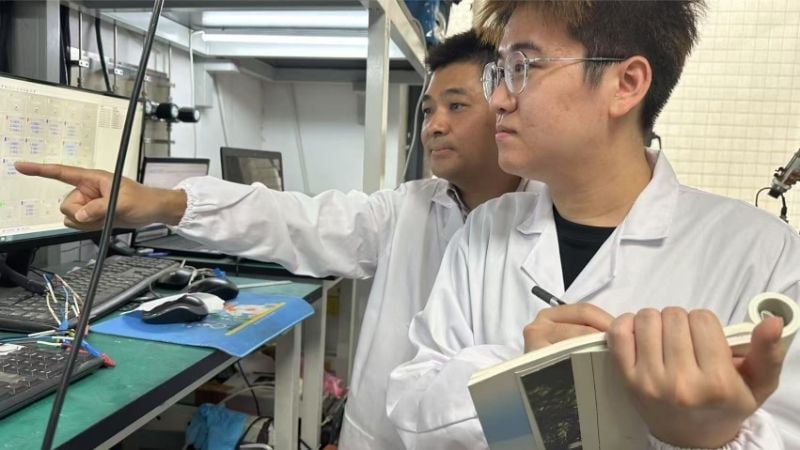
Researchers demonstrating cathode technology innovation. Image used courtesy of City University of Hong Kong
Bubble Control for More Efficient Hydrogen Production
Researchers from the University of Twente in the Netherlands claim to have advanced the field of electrochemical hydrogen production by revealing how precise control over bubble formation and coalescence on electrode surfaces can significantly impact electrolysis efficiency
Their study, published in Small, demonstrates that electrolytic hydrogen generation can be tuned by introducing patterned hydrophobic cavities into silicon electrodes. These engineered surface features create predictable nucleation sites for gas bubbles, reducing the randomness typically associated with electrolysis-induced bubble growth. By carefully adjusting the spacing of these cavities, the researchers found that they could influence the departure size, coalescence behavior, and growth rate of bubbles. Notably, when the cavities were positioned closer together, bubbles departed more frequently and in smaller sizes, which helped to reduce supersaturation in the surrounding electrolyte.
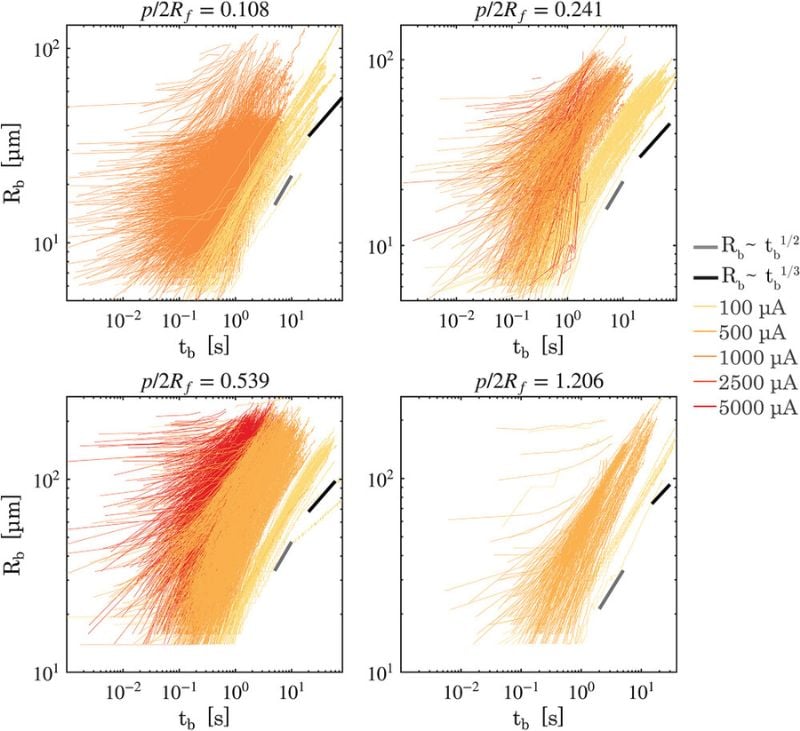
The bubble growth curves of bubbles. Image used courtesy of Raman et al.
This work highlights the complex interplay between gas dynamics and surface geometry in electrochemical systems. Traditionally, bubbles have been treated as unwanted obstructions that block active catalytic sites on the electrode, but this research repositions them as controllable entities that can assist mass transport if managed properly.
The team’s findings also indicate a trade-off: closer bubble spacing enhances mass transport and gas release but may increase surface coverage and reduce active electrode area. By mapping these effects using real-time imaging and modeling, the study provides a path forward for optimizing electrode designs in water-splitting systems. These insights could directly inform the development of next-generation electrolyzers for green hydrogen production, where every improvement in gas evolution efficiency translates into greater scalability.
Safer Recycling for Li-Metal Batteries
In two complementary studies, researchers at Worcester Polytechnic Institute (WPI) say they’ve addressed key technical hurdles in next-generation lithium battery design, one at the beginning of the battery lifecycle and the other at the end. First, the team tackled the challenge of safely recycling lithium-metal anodes, a reactive and fire-prone material typically discarded at the end of life. Published in Joule, their approach uses a self-driven aldol condensation reaction in commercial acetone to convert spent lithium metal directly into battery-grade lithium carbonate with a purity of 99.79%.
This solvent-based recovery process avoids energy-intensive steps and produces cathode materials that perform comparably to commercial products. The process improves material circularity and turns a hazardous waste stream into a feedstock for next-generation cell production.
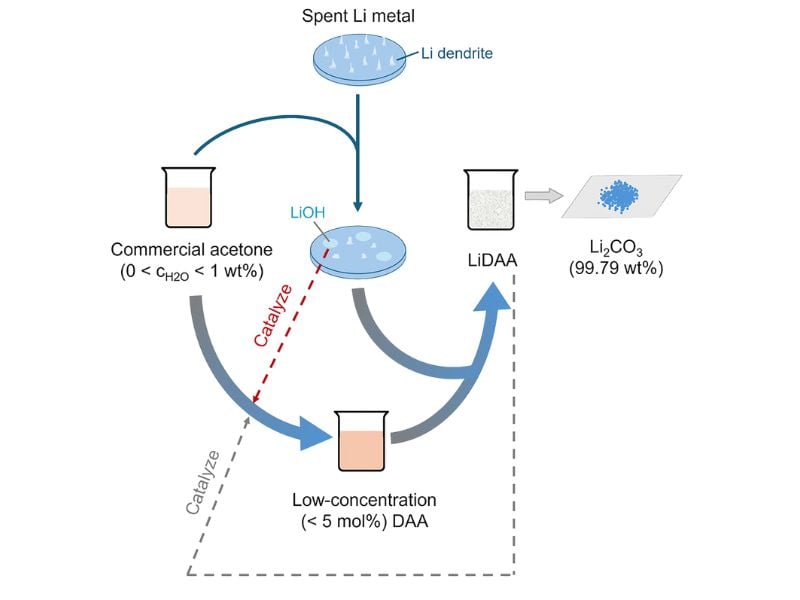
The researchers’ process. Image used courtesy of Zho et al.
On the design side, WPI’s work in Materials Today introduces a strategy to simplify all-solid-state battery architecture by eliminating the need for protective interlayers between solid electrolytes and lithium-indium anodes. The researchers achieved this by doping lithium-indium chloride electrolytes with iron, which enhanced both interfacial compatibility and ionic conductivity, leading to full cells that cycled over 300 times at 80% capacity retention, and symmetric cells with over 500 hours of stable operation. By addressing the chemical mismatch that has traditionally plagued halide-based solid-state systems, the study demonstrates a potential method for safer and more energy-dense battery technologies.
Resilient Cathode Design Boosts Seawater Electrolysis
A City University of Hong Kong research team has developed a self-healing cathode capable of enduring over 10,000 hours of intermittent seawater electrolysis, solving one of the most persistent durability challenges for green hydrogen production systems.
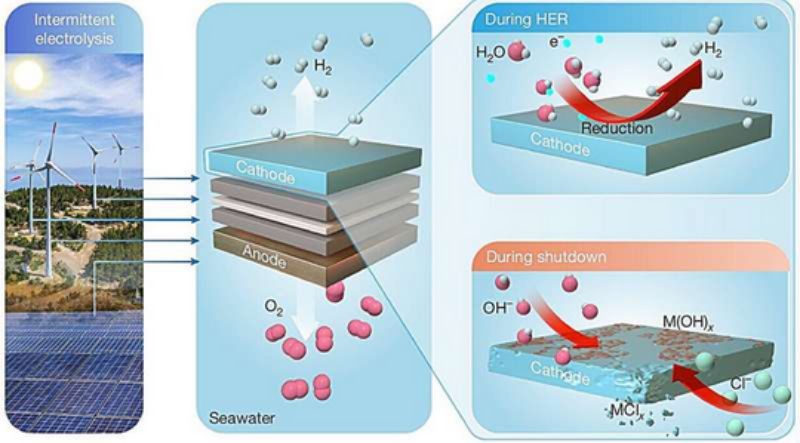
Cathode oxidation and corrosion under start-stop electrolysis cycles. Image used courtesy of Sha et al.
Their innovation targets degradation modes specific to alkaline electrolysis systems where cathodes frequently suffer from reverse currents, oxygen crossover, and corrosion during start–stop cycles caused by fluctuating solar or wind power sources. The cathode is engineered with a protective, self-repairing layer that mitigates these failure modes, significantly enhancing long-term operational stability under dynamic load conditions.
Notably, the cathode architecture not only withstands industrial current densities but also operates in natural seawater, bypassing the need for pure water in electrolysis, representing a key cost and infrastructure barrier for large-scale hydrogen production.
According to Liu Bin, who led the research, this design directly addresses real-world engineering conditions where electrolyzers must operate reliably alongside intermittent renewable energy inputs. The approach could extend to other catalytic systems, such as CO2 reduction and ammonia synthesis, where similar electrochemical stresses exist.