Facebook
 Google
 GitHub
 Linkedin
Low-Energy Use Carbon Capture Method Achieves 95% Purity
KAIST and MIT researchers have developed a fiber-based direct air capture system that achieves over 95% carbon dioxide purity using only 3 V input.
Direct air capture remains one of the most technically challenging approaches to climate mitigation. However, capturing carbon dioxide directly from ambient air, where concentrations hover below 420 ppm, requires advanced materials and precise energy management. While several systems have reached proof-of-concept, few offer a path to economic viability due to the energy-intensive regeneration stage, which often relies on high-temperature steam, large compressors, or bulky heat exchangers.
A new system developed by researchers at the Korea Advanced Institute of Science and Technology (KAIST) in collaboration with MIT’s Department of Chemical Engineering challenges this assumption. Published in Advanced Materials, their approach uses electrically conductive fiber sorbents to drive the regeneration process using direct Joule heating, eliminating external heat systems and enabling carbon capture at energy levels of just 3 V per fiber module.
This breakthrough significantly reduces parasitic energy losses, enabling high-purity CO₂ recovery with modular scalability. It also demonstrates an architecture fully compatible with low-voltage renewable sources like solar photovoltaics, pointing to a realistic path toward distributed, grid-independent DAC deployments.
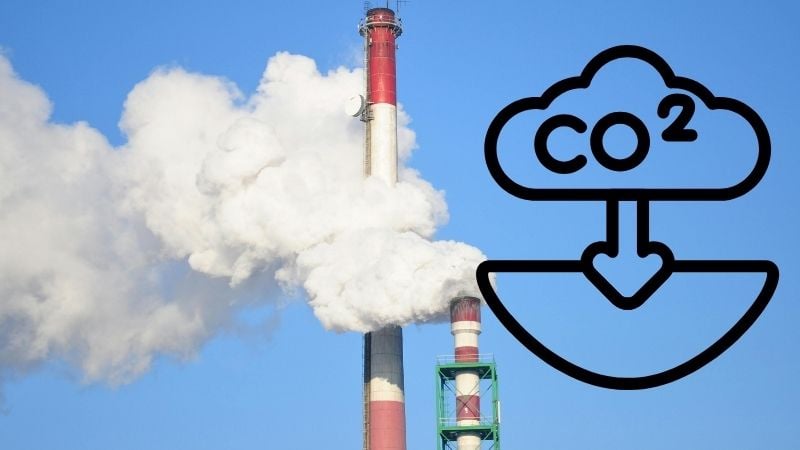
KAIST and MIT researchers have developed an efficient carbon capture method. Adapted from image used courtesy of Pexels
Electrified Fiber Sorbents and e-TVSA
The researchers used electrically driven temperature vacuum swing adsorption (e-TVSA) technology. The process builds on traditional TVSA principles—adsorbing CO2 at ambient conditions and desorbing it under low pressure and elevated temperature—but replaces conventional thermal regeneration with fiber-embedded resistive heating.
To achieve this, the team engineered porous polymeric fibers coated with a 3 µm-thick composite layer of silver nanowires and nanoparticles. This coating achieves two critical functions. It enables rapid, uniform Joule heating along the fiber and preserves the porous structure necessary for efficient gas diffusion. The team reported that fibers can reach 110°C within 80 seconds using just 3 V input, sufficient for complete CO2 desorption without requiring steam or contact heaters.
This localized heating ensures energy is delivered only where sorption occurs, avoiding losses associated with heating bulk material or carrier gases. Compared to conventional DAC systems, the design reduces heat loss by an estimated 20%, shortening adsorption-desorption cycles and maintaining structural integrity over repeated cycling.
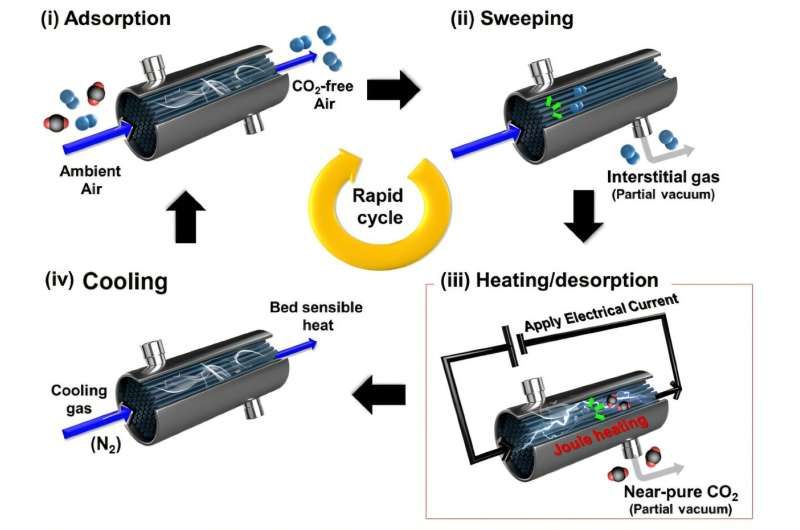
A schematic illustration of a complete cycle of e-TVSA. Image used courtesy of Lee et al.
Inherently Modular Design
The architecture is inherently modular. When multiple fibers are bundled and wired in parallel, the total electrical resistance drops below 1 ohm, enabling multifiber capture modules that maintain low voltage operation. Tests under ambient air conditions demonstrated over 95% CO2 purity in the recovered stream, sufficient for sequestration or further processing for synthetic fuels or industrial use.
This low-resistance, high-throughput modularity is crucial for scalability. Unlike traditional DAC systems that scale through industrial-scale blower units and heat exchangers, the fiber approach can be scaled by simply expanding fiber banks and powering them in parallel. It also allows for rapid startup and shutdown, making it ideal for integration with intermittent renewable sources like wind or solar.
The system’s all-electric operation aligns with global decarbonization efforts focused on electrification of everything, and the low power requirements make it a potential candidate for deployment in distributed or off-grid environments.
Professor Dong-Yeun Koh of KAIST emphasized the broader context of the innovation, stating that the conductive fiber-based DAC platform is flexible enough for industrial installations or urban integration, such as embedding into HVAC systems, public infrastructure, or buildings seeking carbon-neutral certification.