Facebook
 Google
 GitHub
 Linkedin
Smart Modeling: Planning for a Net-Zero Grid
EPRI’s generic models can assist grid managers in predicting how distributed energy sources will affect grid operations and capacity.
Over the last few decades, the number of distributed energy resources (DERs) in the grid has markedly increased, especially renewable and associated energy storage systems. Much of this integration is inverter-based wind and solar power, and these renewables are expected to grow further in the coming years.
Preemptive planning is important to define potential operating limits, evaluate how grid performance can be improved, and determine whether upgrades to the existing grid system are required to accommodate more DER assets. However, many conventional power system planning methods and tools don’t work well when factoring in DERs.
Many models only look at the physical characteristics of energy generation sources. As many grids become smarter, operators use more software and optimization methods that are not easily accounted for in traditional models. To address this challenge, the Electric Power Research Institute (EPRI) has been developing new power system generic models for net-zero grids.
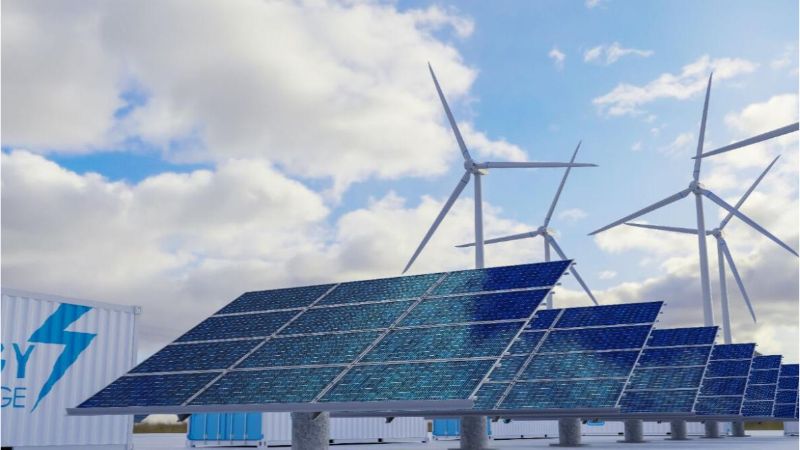
Distributed energy resources. Image used courtesy of Adobe Stock
DER Integration Needs New Tools
Grid operators need to plan for future demand growth. With the increasing movement towards net-zero grids, this planning often focuses on providing transmission services to renewable energy sources. These resources are usually located far away from load centers—often in remote and rural regions―and behave differently from traditional power generation systems. Different planning methods are required to accommodate both conventional power generation approaches and the increasing number of DERs and to ensure that consumers have reliable access to a sustainable electricity supply.
System planning approaches in the grid network are dynamic studies that focus on how the grid responds after an event has occurred. This allows operators to view the grid holistically and test whether certain grid events will lead to instability and potential issues. Achieving these model outcomes relies on accurate and robust mathematical models that can model each device within a network.
These models consider each device’s physical characteristics and the control systems. However, the increasing number of advanced and smart control algorithms used for DERs causes challenges in these dynamic studies. It’s difficult to accurately capture how these DERs behave when they are controlled by advanced algorithms instead of traditional control processes. The models also cannot account for how changing the algorithms will affect the devices’ responses.
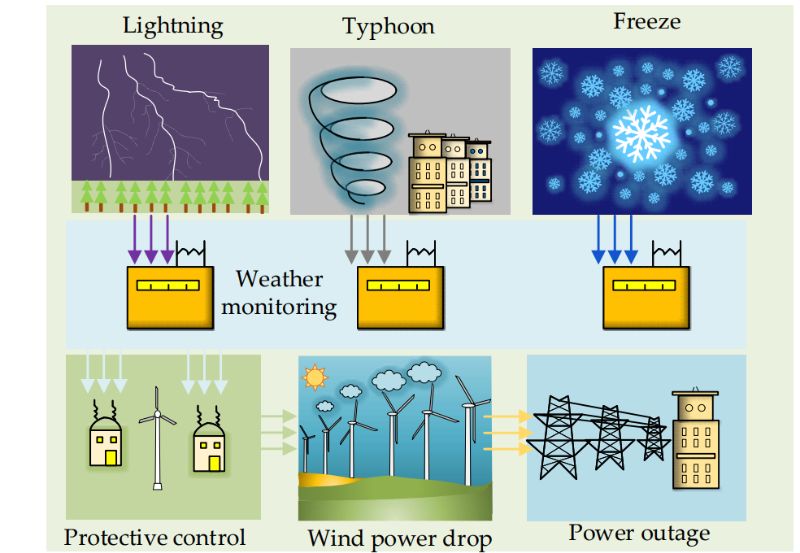
Weather conditions affecting DERs. Image used courtesy of Zhuo et al
Generic Models Overcome IP Challenges
Another aspect where current models struggle to paint an accurate picture is with IP-protected computer code. In these cases, the OEMs provide the most accurate models, as they have visibility of the IP. However, most planning studies are performed before OEMs are identified, and even in cases where the OEM is known, getting permission to access IP-protected models is a challenge.
In IP-related scenarios, generic models can be used without representing any OEM. Instead, they represent the equipment’s dynamic responses. Generic models of the control systems within synchronous machines are typically standardized models developed and validated over long periods. However, despite their appeal, no long development and validation cycles exist for inverter-based resources and high-voltage direct-current (HVDC) transmission.
Generic Models for Inverter-Based Resources and HVDC
To bridge the technical gaps in dynamic modeling approaches, EPRI has been working with OEMs, utility companies, industry working groups, national laboratories, and system operators to look at how generic models can be updated to apply to new energy systems encompassing an increasing number of DERs.
The Western Electricity Coordinating Council (WECC) Model Validation Subcommittee has approved several of EPRI's generic models. This industry-led forum decides which generic models can be used for WECC interconnection studies.
The generic models have been integrated into different commercial modeling tools to develop, parametrize, and benchmark generic WECC models for use with inverter-based resources. They have also helped the WECC develop the WECC composite load and HVDC generic models.
The models can be used to understand the general trend in forward-looking studies that involve DERs. However, it’s still important that the models are parametrized properly, as there are scenarios where these models can now be applied but other scenarios where they cannot, like any mathematical model.
_vs._inverter-based_system_(right)__1.jpg)
Conventional system (left) vs. inverter-based system (right). Image used courtesy of National Renewable Energy Laboratory
When used with different system operators, integrated utilities, and transmission owners, the EPRI model improved the numerical robustness of generic models in studies involving inverter-based resources. The model could predict the systems’ potential instability under different operating conditions. The models also showed that they could better predict loads during grid events and include HVDC models for offshore wind integration in their predictions.
Grid Capacity Needs to Improve To Accommodate More DERs
DERs have become important in the race to decarbonize the grid and to help supply power when the grid is experiencing an outage. However, in its current state, the increasing number of DERs entering the grid (with millions of DERs now connected), alongside traditional power generation technologies still connected, is causing local energy bottlenecks in the grid. Many power grids are already at full capacity and soon won’t be able to support extra renewable capacity unless the grid capacity is doubled over the next decade. By 2030, the number of DERs and electric vehicles connected to the grid could multiply exponentially. It’s crucial to optimize the current grid capacity to make space for more DERs and to increase the grid capacity significantly.