Facebook
 Google
 GitHub
 Linkedin
Self-Charging Drones Offer Utilities Continuous Line Maintenance
Nomadic Drones’ self-charging aerial tech lets drones live on the grid, offering nonstop inspection for power lines and helping utilities modernize faster.
Wildfires. Outages. Aging infrastructure. For utility companies across the world, especially in places like California, these topics aren’t just headlines. They’re daily challenges.
Monitoring the vast, often remote miles of transmission lines is costly and can sometimes be dangerous. Traditional inspection methods rely heavily on ground crews, helicopters, or bucket trucks, which are slow, expensive, and not always fast enough to prevent disaster. With climate risks growing and grid systems aging, utilities are increasingly in need of real-time visibility. But the big question remains: how do you scale that kind of around-the-clock oversight?
Watch a drone charge itself on power lines. Video used courtesy of Nomadic Drones
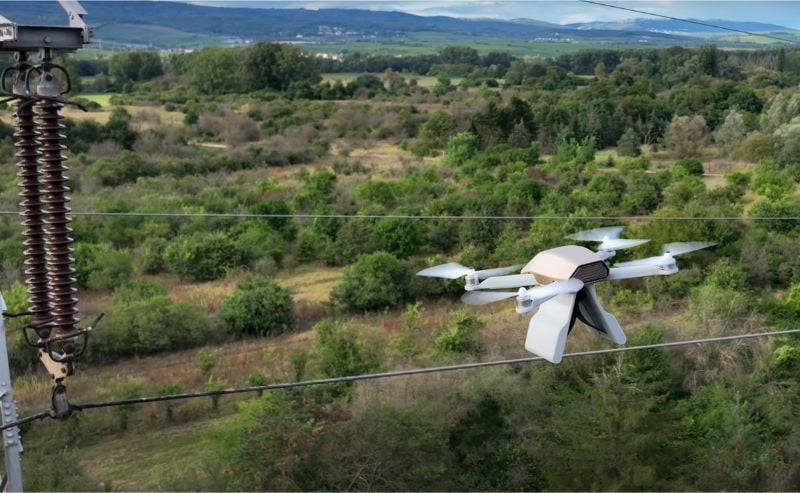
A startup called Nomadic Drones may have found the answer by giving drones a home in the infrastructure they’re monitoring. Their autonomous flying machines are designed to perch directly on high-voltage power lines and recharge using the electromagnetic field around them. That means they don’t have to return to a base or station between missions. They simply land, refuel from the grid itself, and take off again.
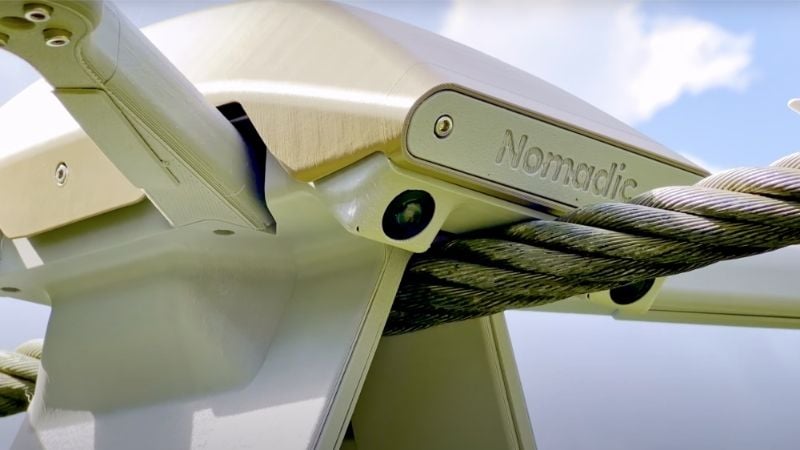
Drone charging on power line. Image used courtesy of Nomadic Drones
Drone Inspections and Charging
Each drone comes equipped with multiple sensors and high-resolution cameras. While perched, it serves as a stationary monitor, capturing data on everything from cable temperatures to line sag. Once charged, usually within about two hours, it continues its aerial patrol, requiring no hands-on human support.
Co-founder Andreas Moldskred said in a video that Nomadic’s goal is to automate inspections so operators know when and where repairs and replacements are needed. The automation allows line monitoring without having personnel on the ground.
A Startup Born from Wildfire and Innovation
The idea for Nomadic Drones took root in 2018, when Moldskred and fellow co-founder Lauritz Weil were students at UC Berkeley. That year, California experienced its deadliest wildfire season in history, burning over 1.6 million acres and killing more than 100 people. Seeing the destruction unfold around them, the pair asked a simple question: What if drones could help prevent this kind of disaster by watching over the grid?
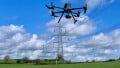
A drone inspecting infrastructure. Image used courtesy of Nomadic Drones
They noticed increasing interest in induction charging and imagined combining that with aerial mobility. After some early experimentation and positive feedback from utility providers, Nomadic Drones was officially born, eventually relocating to Munich, Germany, where they found early support from major European energy firms like Westnetz. Westnetz is one of Germany’s largest distribution system operators.
Testing in Europe, Eyeing a Return to California
Currently, the drones are undergoing stress testing in Europe, where Nomadic Drones has partnered with utilities to fine-tune its prototypes. Today’s models are made from lightweight plastic, but future versions will use more durable materials capable of surviving months outdoors, unattended. Back in the U.S., the team is preparing for field demonstrations with contractors working alongside Pacific Gas & Electric (PG&E). But regulations around autonomous drones, especially line-of-sight and restricted flight rules, pose hurdles. That said, power lines often run through isolated areas and restricted airspace, which may help ease deployment.
Still, the need is clear. Much of the U.S. grid is aging fast, and climate conditions, particularly extreme weather, are making maintenance harder than ever.
Automating the Inspection Pipeline
To make inspections simple, Nomadic Drones is building out a software platform that uses intelligence and machine learning to analyze the thousands of images and sensor readings each drone collects. The goal is to automate the traditionally slow process of reviewing grid data and writing reports.
By combining AI with detailed electrical system models, the software flags damage, decay, or early failure signs automatically, freeing up workers to act on problems, rather than hunt for them.
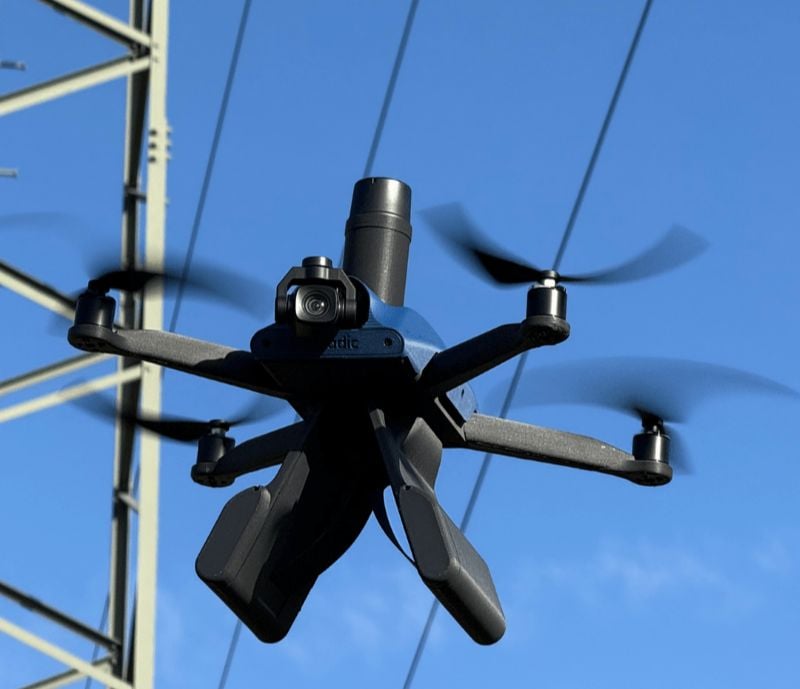
A Nomadic Drone. Image used courtesy of Nomadic Drones
The Long-Term Vision
Looking ahead, the company envisions a future where drones don't report back to base, they are the base. Instead of returning to a charging station, they’ll live on the grid itself, constantly recharging and monitoring from above. A large utility like PG&E might need anywhere from 100 to 1,000 drones for full-time coverage. Despite their aerial nature, the drones pose little risk. At just 4.4 pounds, a malfunction or crash wouldn’t damage transmission lines. Utilities have echoed this sentiment: the risk to infrastructure is low, and the upside, continuous grid oversight, is high.