Facebook
 Google
 GitHub
 Linkedin
Remote Monitoring Drone Team Gathers Real-Time Grid Data
Oak Ridge National Laboratory researchers have developed an automated drone inspection system that can quickly assess grid failures in remote areas.
The U.S. power grid is a labyrinth of equipment made of over 2 million miles of power lines and 11,000 different power plants. At some point, all of the grid’s components will either fail or need to be replaced from aging.
Grid maintenance is not just an issue of cost and labor. Timely maintenance and equipment updates can prevent dangerous failures. Grid failures can lead to fatal wildfires or blackouts, causing malfunctions in medical devices, cooling systems, and other critical equipment.
Oak Ridge National Laboratory (ORNL) researchers may have a powerful solution to this stubborn problem. They have introduced a groundbreaking automated drone inspection system for monitoring electric grids. This technology responds to unusual grid behavior by dispatching drones that use GPS coordinates to quickly assess the grid and stream real-time data to utility command centers.
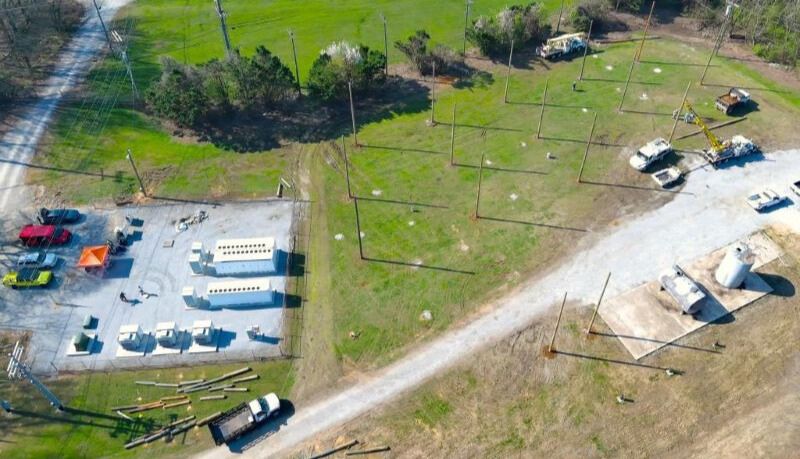
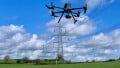
Training center where ORNL researchers test the drone tech. Image used courtesy of ORNL/Jason Richards
The Risks of a Poorly Maintained Grid
It’s easy to underestimate the costs and risks of an underserviced utility grid. A few old circuit breakers might not seem like an emergency. Still, when local negligence is multiplied by a national scale, it’s apparent that allowing the grid to age and fail without proactive prevention is dangerous and extremely costly.
Fires from grid failures alone cost billions, but fires are hardly the only cost associated with a poorly maintained grid. In 2024 and 2025, utility companies are expected to spend in excess of $165 billion to replace transmission lines and upgrade aging grid technology. These costs would have been significantly lower had replacements occurred in a timely and incremental manner. The expense is then passed onto consumers, as electricity prices rose 4.4% last year compared to the already steep 3% general inflation rate.
While these numbers show the costs and impact of a failing grid, it is critical to understand the technical challenges that lead to such failures.
The Challenges of Arc Detection and Rapid Response
In grids and transmission lines, an arc of superheated electricity refers to an electrical discharge that occurs when electricity "jumps" through the air between conductors or components, forming a plasma arc. This typically happens when insulation is compromised or when there is a gap between high-voltage components, causing electricity to find a lower-resistance path through the air. The arc can reach extremely high temperatures, sometimes over 35,000°F (19,000°C), hotter than the sun's surface. Arc faults and flashes are common, with a myriad of causes.
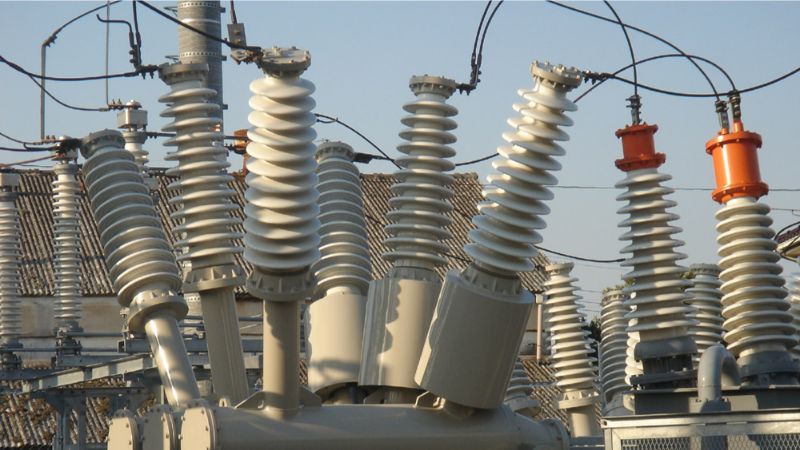
High voltage circuit breakers. Image used courtesy of Wikimedia Commons
Arcing faults can occur due to equipment failure, lightning strikes, or insulator contamination, and managing them is critical for grid reliability. Devices like circuit breakers and arc suppressors detect and interrupt arcs to prevent further damage.
However, arc suppressors are expensive to install and maintain, particularly across vast grid networks. They need regular calibration to stay accurate, and maintaining these systems can be logistically challenging in remote locations.
This is where the ORNL automated drone system comes in. With a fully remote method for monitoring, testing, and reporting back to substations, detecting arc faults, overheating, and other equipment failures will be faster and more feasible even in the remotest locations.
Drone Team Machine-to-Machine Communications
While some steps have been taken toward automating grid elements, ORNL’s system is completely novel and a bold step into a more efficient grid maintenance future, according to researcher Elizabeth Piersall. She emphasized that this system introduces new capabilities rather than simply optimizing previous ones.
The system relies on machine-to-machine communication. Previous attempts at automation included stationary sensors installed throughout the grid that provided real-time data updates. However, that data does not tell the whole story. When inspector and specialist drones communicate with one another, layers of information can be collected, and initial actions can be taken before a human is ever dispatched to the failure location.
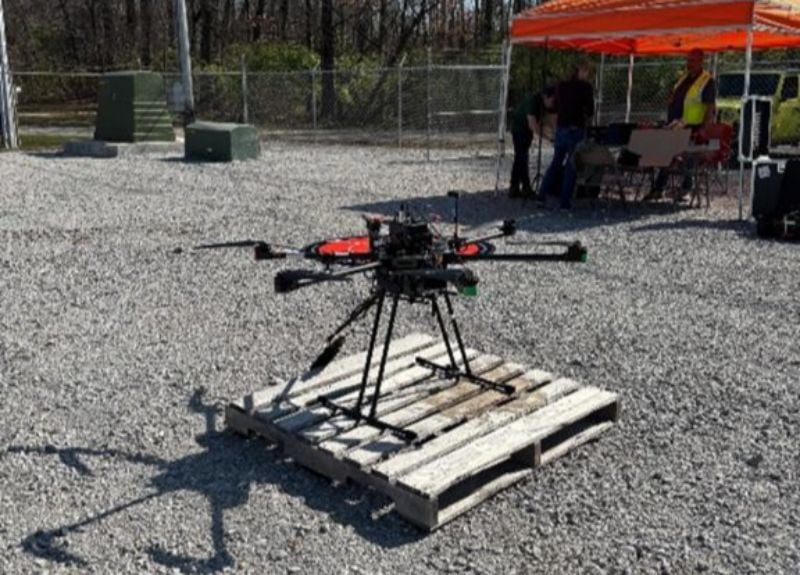
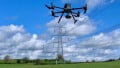
The ORNL system uses several drone types. Image used courtesy of ORNL/Emma Foley
The system relies first on a scout drone, which the team likens to an initial medical exam when someone shows up in the emergency room. The scout drone uses GPS technology and quantum-based communication to select and call specialist drones to the fault scene. These drones can collect additional data, capture video surveillance, and compile the information into a full and meaningful account of the grid failure.
The ORNL team has kept costs down by using commercially available equipment, but they have also built equipment for the project when necessary. When they encountered the steep $25,000 price tag for ultraviolet cameras, they invented a camera using a combination of visual/ultraviolet/invisible light sensors. This camera cost less than 1 percent compared to the commercial model and reduced the weight by 90%, thus increasing maneuverability and preventing battery depletion.
By creating a team of drones, the ORNL has helped grid maintenance take an automated step into the future.