Facebook
 Google
 GitHub
 Linkedin
Can Drones Transform Power Grid Monitoring and Maintenance?
A drone with embedded AI can detect grid problems, including small issues like power line insulation defects.
While renewable energy technology is the worldwide shift from fossil fuels, electricity demand is higher than ever. Experts estimate electricity demand could double or even triple in the coming years.
Drone maintenance in action. Video used courtesy of Farmers Electric Cooperative
The obvious solution seems like grid expansion. However, in addition to infrastructure growth, it’s essential to maintain and repair the existing grid to ensure it can function at maximum capacity. The U.S. grid frequently receives failing grades from the American Society of Civil Engineers assessments. Unfortunately, human and fiscal resources struggle to keep up with increasing energy loads.
The Hong Kong Productivity Council (HKPC) has created a drone that could alleviate the strain of maintenance by monitoring and detecting defects in grid infrastructure. Automating grid oversight can provide a critical leap forward for utility companies worldwide as they race to catch up to the renewable energy transition.
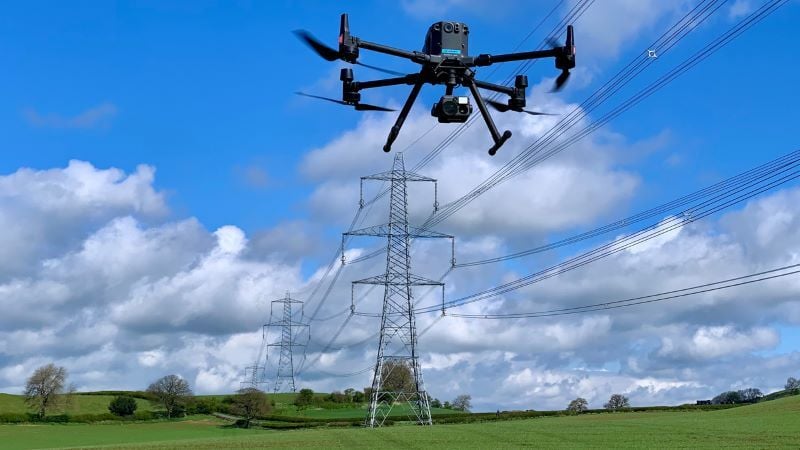
A drone performing transmission wire maintenance. Image used courtesy of National Grid
Grid Asset Challenges
The power grid comprises a sprawling infrastructure with countless components that must cooperate properly. Given such complexity, the potential for faults and breakdowns abound. Equipment failure is a top cause of power outages, only surpassed by weather impact.

Percentage ratio of outage causes in the United States. Image used courtesy of Texas A&M/Mladen Kezunovic
Equipment failures include common problems involving most of the grid's infrastructure, such as transformers, transmission lines, and substations. This equipment is typically over 40 years old, approaching or exceeding its designed lifespan. For example, about 70% of the grid's transformers are older than 25 years, increasing the likelihood of failures.
Aging infrastructure leads to common issues like equipment corrosion, insulation degradation, and microcracks in transmission lines, all of which increase maintenance costs. In recent years, the U.S. has spent a minimum of $51 billion on grid maintenance and upgrades, a figure expected to rise as equipment ages. Additionally, traditional maintenance methods require significant personnel, with field crews often needing to physically inspect and repair equipment, a labor-intensive and costly process.
How Drones Can Streamline Asset Management
The HKPC’s drone is named Power-hawk Inspector, which is fitting given its capabilities. This drone carries out basic, broad oversight, but it can also perform specialized maintenance. Drone automation is a step toward streamlined asset management, potentially replacing a significant result in a less costly and more efficient maintenance system.
Human inspectors can easily miss low-contrast grid problems, but the Power-hawk can handle these detection challenges. It can monitor issues such as loose connections in the grid, which might not cause immediate disruptions but can result in intermittent faults and overheating, gradually worsening the grid's performance. As these connections degrade, they may contribute to voltage sags and swells, where slight fluctuations in voltage stress sensitive electronics and other equipment.
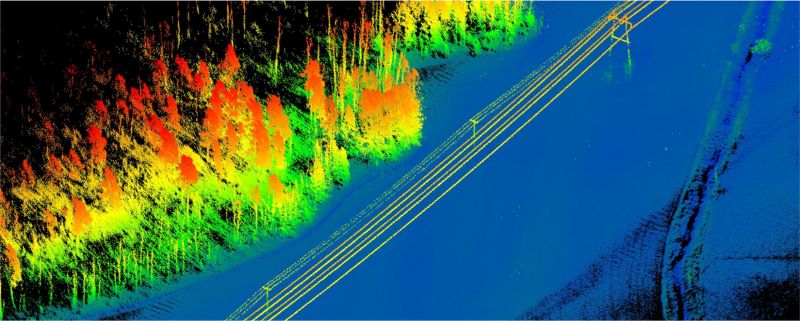
Concept of drone-based power line imaging. Image used courtesy of Matikainen et al.
Transmission line defect data shows most small objects as the source of defects, making the drone even more useful than error-prone human oversight.
A drone equipped with AI, like Power-hawk, can also find microcracks in transmission lines, adding another layer of vulnerability, as these tiny fractures can increase electrical resistance and create hot spots that could lead to failure. Power-hawk has a 90% recognition accuracy in finding loose connections, microcracks, or insulation irregularities. When inspecting 75.3 km of power lines, the drone was able to locate 13 defects with efficiency and precision, showing that significant labor relief is possible with this tech.
Future of Drone Maintenance
The engineering community is taking notice. The Power-hawk won a gold award at the Energy Smart Community Initiative (ESCI) awards program. In addition to its accuracy and high performance, the drone is highly mobile, lightweight, and easily disassembled.
Drone monitoring is being tested and developed for many applications, such as wind turbine maintenance. We might see power grid maintenance significantly improved by the intersection of machine learning and drone technology.