Facebook
 Google
 GitHub
 Linkedin
SAE J3400/2 Sets the Stage for Quicker, Smarter NACS Charging
Upgrades to the charging standard support 1,000 V operation, enable bidirectional charging, and align with high-voltage vehicle architecture.
The electric vehicle connector, once known simply as Tesla’s North American Charging Standard (NACS) plug, has undergone its biggest transformation yet. SAE J3400/2, the latest addition to the growing NACS family, enables faster, safer charging at up to 1,000 volts, which is double the previous limit, without sacrificing compatibility.
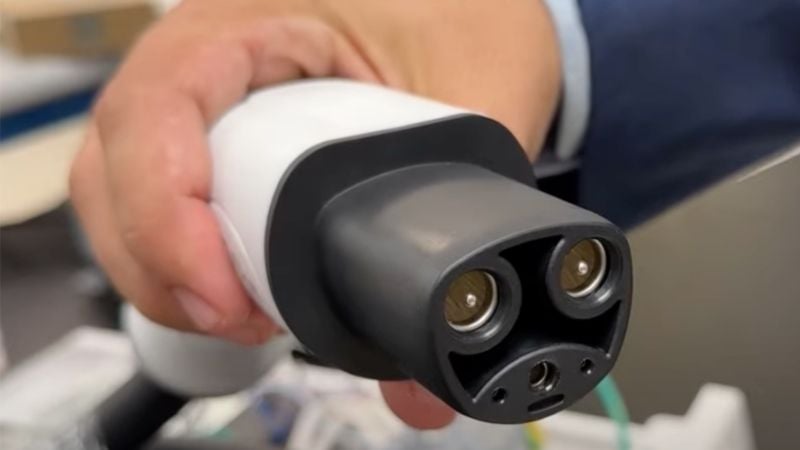
The SAE J3400/2 charging port. Image used courtesy of SAE
Higher Voltage, Less Resistance, Quicker Charge
The update centers on a seemingly simple change: removing material around the plug’s DC terminals. This increases creepage and clearance distances, which are key to preventing electrical arcing, allowing the connector to safely operate at 1,000 V. At this voltage, a 350 kW charger needs only 350 A, compared to 700 A at 500 V, slashing resistive losses and easing thermal strain.
According to Rodney McGee, SAE’s J3400 Task Force, the change allows isolation between the positive and negative terminals on the connector.
For engineers, doubling the voltage is a practical game changer. It allows significantly faster charging without increasing current, avoiding the downsides of heavier cables, greater heat generation, or active cooling systems.
Many EV platforms are already building around high-voltage systems. Lucid’s 924 V architecture, Hyundai’s 800 V E-GMP, and upcoming GM platforms all target these ranges.
Bidirectional Power Goes Mainstream
J3400/2 doesn’t just boost speed. It also lays the groundwork for vehicle-to-grid and vehicle-to-home power transfer by aligning connector specs with SAE’s cybersecurity protocols and CAN-based communications. Utilities gain a potential distributed energy asset, while EV owners get a resilience boost during outages or peak pricing events.
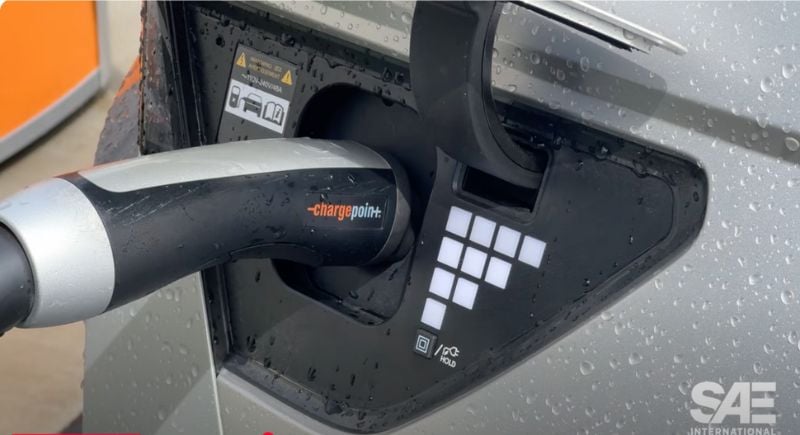
SAE J3400/2 connector in charging port. Image used courtesy of SAE
Despite the hardware tweaks, the updated plug still fits legacy 500-volt inlets. That means no stranded infrastructure, and no costly retrofits for most vehicles already on the road. Charging networks can gradually deploy 1,000-volt stations—some, like Tesla’s Superchargers, already have—while maintaining support for older EVs.
SAE J3400/2 includes detailed 2D and 3D mechanical models for OEMs and charger manufacturers, cutting design ambiguity and ensuring interchangeability. Combined with thermally upgraded plastics and mating cycle targets (10,000+ insertions), the update raises the bar for durability and manufacturability across the charging ecosystem.
What’s Next?
With heavy-duty EVs looming, SAE is also developing the Megawatt Charging System, which may borrow isolation strategies from J3400/2 as it pushes toward 1,250 V and 3,000 A. But for now, J3400/2 gives the light-duty sector a much-needed upgrade path: One that boosts performance without breaking compatibility.
As NACS becomes the dominant North American plug type with Ford, GM, and Volkswagen onboard, J3400/2 ensures it evolves with real-world demands: faster charging, grid connectivity, and secure, scalable deployment.