Facebook
 Google
 GitHub
 Linkedin
Nuclear Microbatteries: A Big Bang in a Tiny Package
The nuclear battery is 8,000 times more efficient than previous versions.
Nuclear-powered or atomic batteries, which use radioactive decay to create electrical energy, are a promising alternative to conventional storage solutions. Nuclear batteries potentially result in a longer-lasting energy storage solution. However, safety, efficiency, and cost concerns have hindered their widespread use.
Physicists and engineers from China have introduced a nuclear battery design that significantly improves efficiency and could overcome many obstacles that have limited previous versions. Their design could create a battery that lasts for decades.
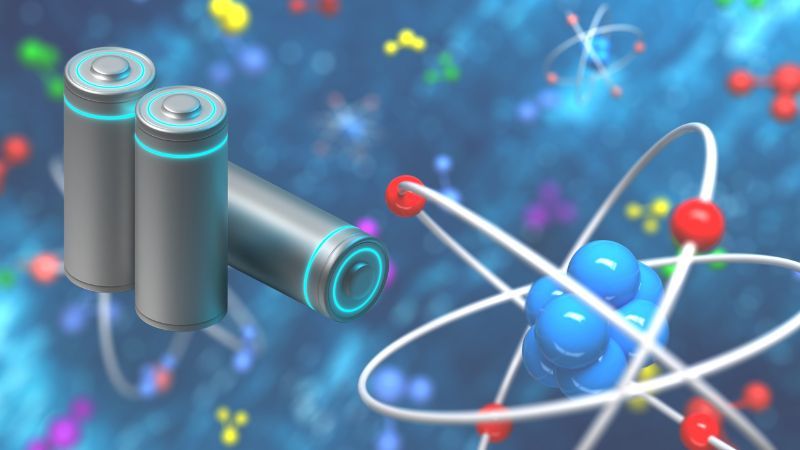
Can nuclear-powered batteries meet growing energy needs? Adapted from images used courtesy of Canva and Adobe Stock
The Quest for Eternal Energy
The energy sector has faced challenges in developing long-lasting, compact power sources for various devices. Conventional batteries are limited because they require frequent recharging or replacement, especially in remote or inaccessible locations.
A nuclear battery converts the energy released by radioactive decay directly into electricity. Radioactivity occurs when an unstable atomic nucleus releases energy through radiation emission, with the decay rate measured by its half-life.
Nuclear batteries utilize the natural decay of radioactive isotopes to generate power, potentially providing energy for decades without recharging or maintenance. Radioactive decay is unaffected by external conditions like temperature, pressure, or magnetic fields, thus providing a robust and unwavering power source.
Safety is the foremost challenge for practical use, as working with radioactive materials poses inherent risks and requires stringent containment measures. Efficiency has been another major obstacle, with early versions of nuclear batteries converting only a tiny fraction of the available energy into usable electricity. Finally, using rare and expensive radioactive isotopes raises questions about scalability and cost-effectiveness.
Nuclear Battery Breakthroughs
In a paper published in Nature, researchers described a nuclear battery that significantly surpasses the efficiency of previous designs, achieving up to 8,000 times greater efficiency.
Severe self-absorption in conventional micronuclear battery designs has always hindered efficient α-decay energy conversion, complicating the development of α-radioisotope micronuclear batteries. The researchers’ device employs a straightforward yet innovative architecture, utilizing Americium (Am) as its nuclear fuel source.
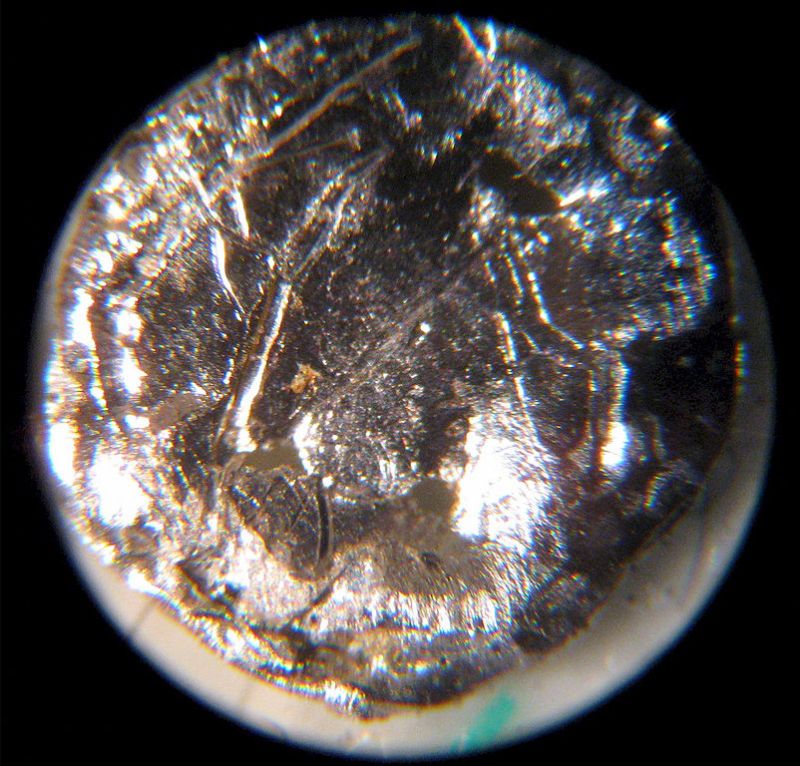
A microscopic view of Americium. Image used courtesy of Wikimedia Commons
Am is embedded within a crystal structure, which serves as a scintillator, converting the alpha particles emitted during radioactive decay into visible green light. This radioluminescent crystal is coupled with a photovoltaic cell, changing light into electrical energy.
The entire assembly is encapsulated within a quartz cell, providing containment for the radioactive material and preventing radiation leakage. Using Americium, with its half-life of 7,380 years, theoretically allows for decades-long operational lifespans. However, the researchers note that material degradation from radiation exposure would likely limit the practical lifespan well before the fuel source is depleted.
While the device boasts unprecedented efficiency for its class, the absolute power output remains modest. The researchers calculate it would require approximately 40 billion such units to power a standard 60-watt light bulb. Despite this limitation, the battery's compact size and long-term reliability make it particularly suitable for applications in remote sensing, deep space exploration, and other scenarios where frequent battery replacement is impractical or impossible.
Powering the Future
This advance in nuclear battery technology opens up possibilities for powering devices in extreme environments and for extended durations. As research continues, we may see these micropower sources integrated into a wide range of applications, from medical implants to deep space probes.