Facebook
 Google
 GitHub
 Linkedin
Mars Power Solution? All About Lithium Carbon Dioxide Batteries
Can the Martian atmosphere fuel an emerging battery technology?
Lithium-ion batteries have become the most commercially acceptable way to power everything from cell phones to electric vehicles and power grid battery backup systems. Lithium-ion batteries typically use metal oxides (nickel and cobalt oxide) as the cathode (positive electrode) material. The reaction involves the intercalation/deintercalation of lithium ions into/from the cathode structure to store and release electrical energy.
While lithium is fairly common, and its price has decreased markedly in the past decade, several emerging battery technologies are promising alternatives. Sodium-ion batteries, for example, are similar in structure to lithium-ion batteries but use sodium ions instead of lithium to carry the charge between the cathode and anode (negative electrode).
One technology, the lithium-carbon dioxide battery, may be the perfect choice for operating electronics on Mars. Scientists say the battery can use the Martian atmosphere as fuel.
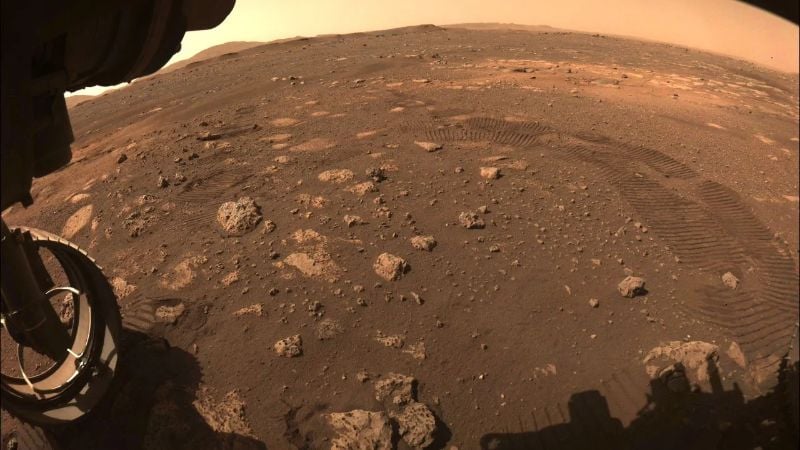
The surface of Mars through the Perseverance rover in 2021. Image used courtesy of NASA
Using Carbon Dioxide
A lithium-carbon dioxide (Li-CO2) battery is an emerging technology combining energy storage with carbon dioxide capture and utilization. The Li-CO2 battery’s anode is made from lithium metal. The cathode is typically a porous carbon material, while the electrolyte that transfers ions between the electrodes is an organic liquid.
The Li-CO2 battery operates through a reversible electrochemical reaction involving lithium and carbon dioxide. During discharge, the reaction 4Li + 3CO2 → 2Li2CO3 + C occurs as lithium ions from the anode travel through the electrolyte to the cathode. At the cathode, they react with CO2 to form lithium carbonate (Li2CO3) and solid carbon. The process generates electrical energy and, at the same time, captures and converts CO2.
When charging, the reaction is reversed, 2Li2CO3 + C → 4Li + 3CO2. As the lithium carbonate decomposes, it releases lithium ions that return to the anode and CO2, though some carbon may remain on the cathode.
In a 2019 report, University of Illinois at Chicago researchers were the first to show that lithium-carbon dioxide batteries could be designed to operate in a fully rechargeable manner.
Li-CO2 batteries have a theoretical energy density of 1,876 Wh/kg, about seven times higher than conventional lithium-ion batteries. During discharge, the battery can capture and convert CO2 into solid forms (Li2CO3 and solid C), and this dual functionality means that they may contribute to reducing atmospheric carbon dioxide levels.

A type of Li-CO2 battery. Image used courtesy of MIT
While promising, Li-CO2 batteries face several challenges. Accumulating discharge products (such as carbon) can lead to rapid battery failure, though recent research has demonstrated up to 500 consecutive charge/discharge cycles. The CO2 conversion is energetically demanding, requiring efficient catalysts to improve reaction rates. Finding stable electrolytes that can withstand the reactive environment is crucial for long-term performance. Ongoing research is focused on developing advanced cathode materials, electrolytes, and catalysts, such as molybdenum disulfide (MoS2,) to overcome these challenges and improve the overall performance and practicality of Li-CO2 batteries.
Batteries To Work on Mars?
Mars' atmosphere comprises approximately 95.32 percent carbon dioxide, which provides an abundant fuel source for Li-CO2 batteries. This high concentration of CO2 makes Mars an ideal environment for these batteries, as they can directly utilize the atmospheric gases for energy storage and generation. Overall, Mars is a fairly inhospitable place. Its atmosphere is 95.32% carbon dioxide, 2.7% nitrogen, 1.6% argon, 0.13% oxygen, and 0.08% carbon monoxide. It also has extreme day-to-night temperature fluctuations of about 60°C.
Li-CO2 batteries might be attractive as an efficient energy storage system for long-term Mars missions in various ways.
- High energy density: These batteries offer a theoretical energy density up to seven times higher than conventional lithium-ion batteries, which is crucial for space missions where weight and volume are critical factors.
- Continuous power supply: When combined with solar energy collection on the Martian surface, Li-CO2 batteries could provide a reliable and renewable power source for extended missions.
- Temperature resilience: The battery system has demonstrated efficient operation even at low temperatures (0°C), which is important given Mars' cold climate.
- Extended operation: Tests have shown that these batteries can achieve a charge/discharge cycle life of 1,375 hours, equivalent to about two months of continuous operation on Mars.
While promising, several challenges must be overcome. The average surface temperature on Mars is around -65°C, which could significantly impact battery performance. As temperature decreases, electrolyte viscosity increases, potentially reducing the rate of CO2 utilization at the cathode. The low atmospheric pressure on Mars compared to Earth may affect the battery's performance and will require additional engineering solutions. Other aspects of the harsh Martian environment, including dust storms and radiation, may pose challenges to the battery's long-term durability that will need further study.
China Simulates Mars
Researchers at the Department of Thermal Science and Energy Engineering, University of Science and Technology of China, published a paper in the journal Science Bulletin detailing their proof-of-concept for applying lithium-carbon dioxide batteries in Martian environments.
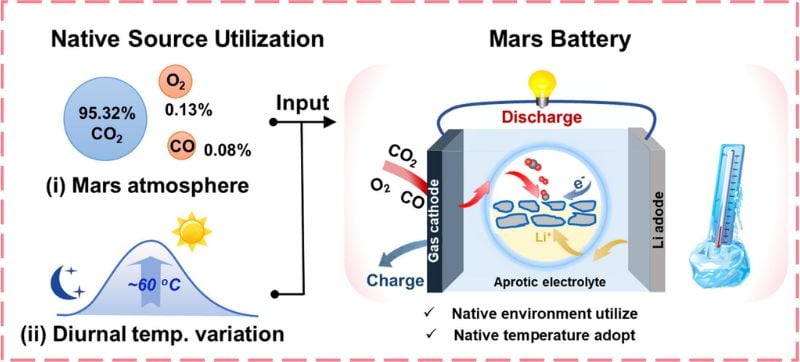
The Mars battery. Image used courtesy of the University of Science and Technology, China
When exposed to a realistic Mars atmosphere, the Mars battery exhibited an energy density of 373.9 Wh/kg with a cycle life of 1350 hours, even when operating at 0°C. A pouch battery with a size measuring 2 cm × 2 cm was developed, and cell-level energy density of up to 765 Wh/kg and 630 watt-hours/liter (Wh/L) were measured under Martian conditions. It was also discovered that the trace amounts of oxygen and carbon monoxide in the Mars atmosphere acted as reaction catalysts, accelerating the carbon dioxide conversion kinetics.
Due to its electrochemical performance and its environmental adaptability to the harsh Martian atmosphere, lithium-carbon dioxide batteries show great potential as the next generation of power sources on Mars.