Facebook
 Google
 GitHub
 Linkedin
Promises and Problems of Lithium-Carbon-Dioxide Batteries
Lithium-carbon-dioxide batteries have the potential to improve sustainability and recapture carbon from the atmosphere, but technical problems must be solved first.
In the quest for sustainable energy solutions, lithium-CO2 (Li-CO2) batteries have emerged as a technology with the potential to revolutionize both energy storage and environmental conservation. However, the path to commercializing this promising technology is fraught with technical challenges, from the development of efficient catalysts to the optimization of operating conditions.
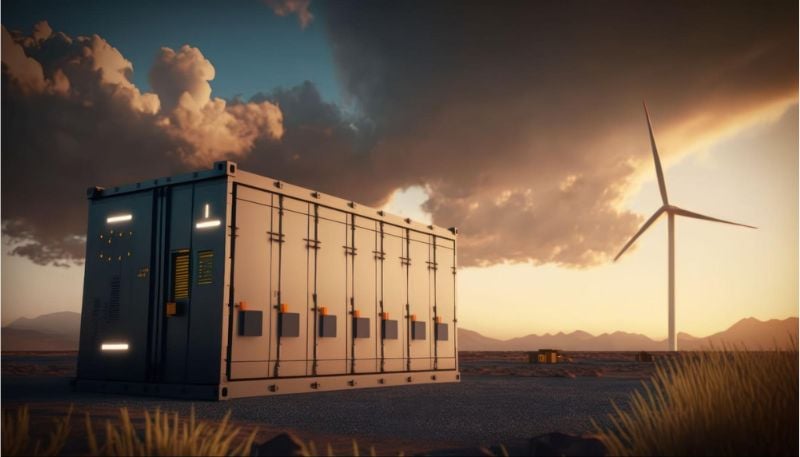
Battery storage for renewable energy. Image used courtesy of Adobe Stock
Recent research from the University of Surrey, Imperial College London, and Peking University offers a new potential way to solve these challenges, bringing us a step closer to harnessing the full potential of Li-CO2 batteries.
Li-CO2 Batteries
As an emerging form of battery, the lithium-CO2 (Li-CO2) is uniquely promising.

A rechargeable Li-CO2 battery. Image used courtesy of Li et al.
Unlike conventional lithium-ion batteries that rely solely on lithium and other materials like cobalt or manganese for energy storage, Li-CO2 batteries join lithium with carbon dioxide (CO2). Lithium-CO2 batteries operate through a unique electrochemical reaction that combines lithium ions and carbon dioxide to form lithium carbonate during the discharge phase. This reaction is reversible during charging, allowing for the release of CO2 and lithium ions back into the system. The anode in these batteries is typically made of lithium metal, while the cathode often comprises porous carbon materials that facilitate the adsorption of CO2 and its subsequent reaction with lithium ions.
These batteries are promising because they offer a high theoretical energy density of 1,876 Wh kg−1. However, the significant benefit of Li-CO2 batteries is that they have the potential to make a dual contribution to the fight against climate change by capturing CO2 directly from the atmosphere or industrial emissions.
Li-CO2 Technical Challenges
Despite their promising dual functionality of energy storage and carbon dioxide capture, Li-CO2 batteries face a myriad of technical challenges that researchers are striving to overcome.
One of the most significant hurdles is the development of efficient catalysts to facilitate the electrochemical reactions between lithium ions and CO2. The catalysts are crucial for both the reversible formation of lithium carbonate during discharge and its decomposition during charging. Traditional methods for synthesizing these catalysts have proven to be slow, inefficient, and costly, making the rapid advancement and commercialization of Li-CO2 batteries a challenging endeavor.
Another technical challenge lies in the cycle life of these batteries. The formation of lithium carbonate, while essential for the battery's operation, can lead to electrode passivation over time. This passivation reduces the battery's efficiency and shortens its operational lifespan, necessitating frequent replacements or maintenance. Researchers are exploring various materials and coatings to mitigate this issue, but a definitive solution remains elusive.
Finally, operating conditions, such as temperature and pressure, also present challenges. The kinetics of the electrochemical reactions are highly sensitive to these parameters, affecting both the battery's performance and its ability to capture CO2 effectively. Optimizing these conditions for maximum efficiency without compromising the structural integrity of the battery is a complex task that requires intricate engineering solutions.
Research Tackles Challenges
To address some of these challenges, researchers from the University of Surrey, Imperial College London, and Peking University have recently published their findings on improving Li-CO2 technology.
Specifically, one of the most pressing issues has been the slow and inefficient development of catalysts that facilitate the electrochemical reactions within the battery. To tackle this, the researchers introduced a cutting-edge "lab-on-a-chip" electrochemical testing platform that has revolutionized the way catalysts are developed and tested. The new platform allows for the simultaneous evaluation of multiple variables, including electrocatalysts, operational conditions, and CO2 conversion rates.
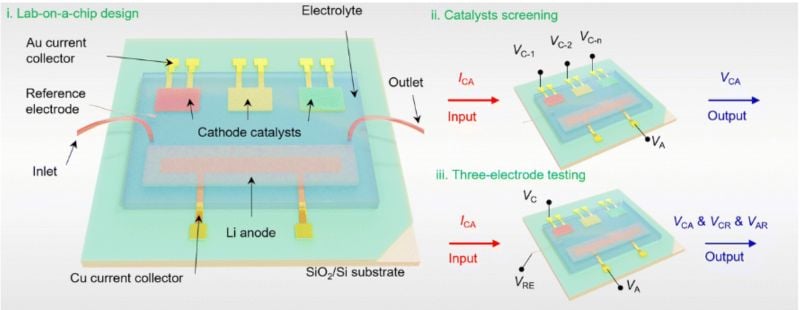
The lab-on-a-chip design. Image used courtesy of Wang et al.
By employing this tool, the researchers were able to rapidly screen a variety of materials such as platinum, gold, silver, copper, iron, and nickel to identify those that could serve as efficient catalysts. This accelerated approach not only speeds up the R&D cycle but also offers a more cost-effective and controlled method compared to traditional ways of synthesizing catalysts.
The lab-on-a-chip platform also provides insights into optimizing the operating conditions of the battery, such as temperature and pressure, which are critical for both energy storage and CO2 capture. By enabling real-time monitoring and adjustments, the platform allows for fine-tuning these parameters to maximize efficiency and minimize energy losses due to overpotential.
Moreover, the platform's versatility extends beyond Li-CO2 batteries. It can also be applied to other energy storage and conversion systems like metal-air batteries, fuel cells, and photoelectrochemical cells. This makes it a universally applicable tool for advancing a range of technologies crucial for environmental sustainability.