Facebook
 Google
 GitHub
 Linkedin
High-Speed X-Ray Looks Inside Battery Cells During Testing
Fraunhofer EMI’s one-of-a-kind system films thermal runaway inside large prismatic cells at up to 1,000 frames per second.
The Fraunhofer Institute for High-Speed Dynamics, Ernst-Mach-Institut (EMI), has developed a high-speed X-ray system that makes dynamic processes inside large-format prismatic battery cells visible in real time.
Until now, cell manufacturers and vehicle integrators wanting to study what happens inside a failing battery have had to rely on simulations, destructive testing, and indirect measurements. Fraunhofer EMI's system replaces that inference with direct observation.
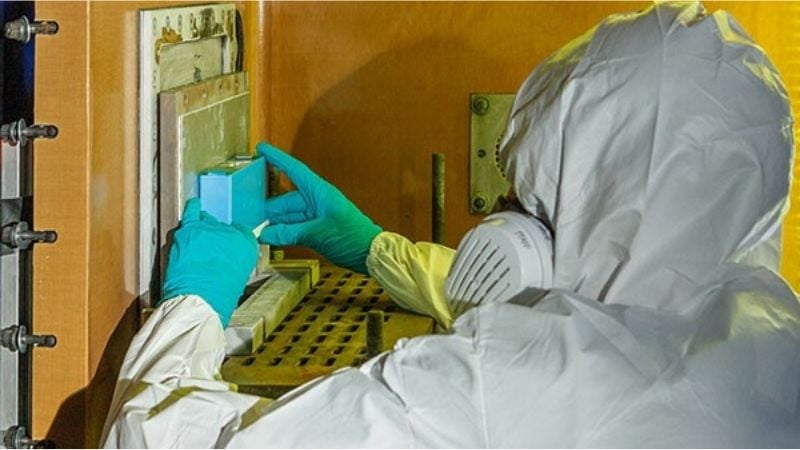
The unique high-speed X-ray system can peer inside prismatic cells for the first time. Image used courtesy of Fraunhofer EMI
Watching a Cell Fail in Real Time
The system pairs high-performance X-ray hardware with a purpose-built battery test chamber and a sensor suite that simultaneously captures temperature, pressure, voltage, and gas flow. Recording up to 1,000 images per second, it resolves processes such as gas formation, material displacement, and crack propagation inside the cell at high resolution. These events have previously remained hidden from view inside a sealed metal can.
According to researchers, the method “fundamentally changes” the field’s understanding of battery design and safety by enabling researchers to peek inside a battery cell in fractions of a second.
Large-format prismatic cells are also challenging X-ray subjects because their dense electrode stacks and metal housings attenuate the beam. That causes the events of interest, such as internal short circuits and electrode deformation, to unfold in milliseconds. Capturing them requires both high photon flux and very short exposure times. EMI's background in high-speed diagnostics for impact and explosion research was particularly valuable in developing the X-ray.
Engineering Around Thermal Runaway
A key engineering milestone was the development of a protective chamber that shields the sensitive X-ray components from the conditions generated during lithium-ion thermal runaway, including jets of hot gas, ejected electrode material, and fire. That protection lets researchers run cells all the way to failure, such as in nail penetration tests, while the imaging chain keeps recording.
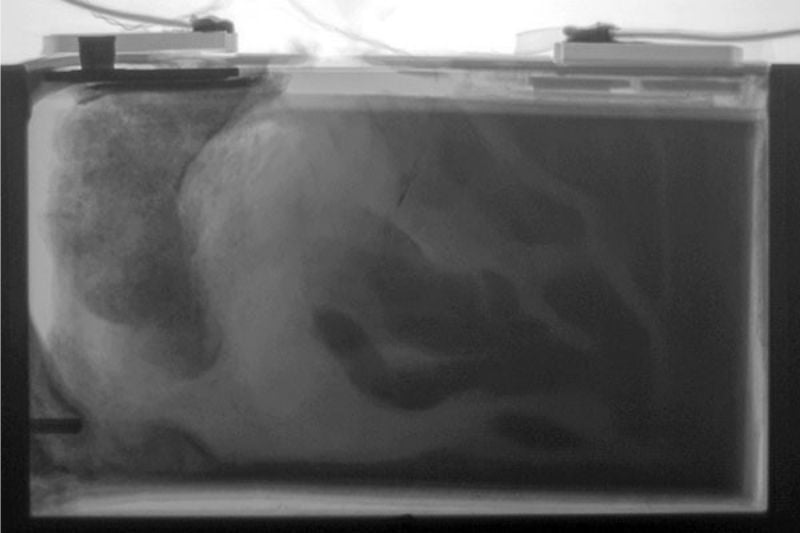
Still image from an X-ray video recorded during a nail penetration test of a prismatic lithium-ion cell. Image used courtesy of Fraunhofer EMI
The technology has already moved beyond the lab demonstration stage, with Fraunhofer EMI having used it for several German automakers, including VW and Audi, to characterize material ejection during thermal runaway and propagation behavior in multi-cell configurations. The resulting data lets engineers assess cell designs based on directly observed processes rather than assumptions, and it feeds back into simulation models to improve their accuracy, with direct value for product development and certification work.
Regulators are raising the stakes on exactly the failure modes the system observes. China's GB 38031-2025 battery safety standard, which took effect in July, requires EV packs to exhibit no fire and no explosion even after a cell enters thermal runaway. Meeting requirements like that demands a detailed understanding of how runaway initiates and propagates between cells, the kind of understanding that direct imaging can supply faster than iterative destructive testing.
Industrializing the Technology
Next, Fraunhofer EMI will transfer the system into PowerCo's industrial environment. Fraunhofer EMI will contribute its expertise in materials research, battery abuse testing, and high-speed imaging. PowerCo, meanwhile, will bring production requirements and access to real-world cell types. PowerCo, part of the Volkswagen Group, is building three cell factories with a combined capacity of up to 200 GWh per year: in Salzgitter, Germany; Valencia, Spain; and St. Thomas, Canada.
According to the institute, initial results from the collaboration are already feeding into the development of optimized production cells at PowerCo. The system is designed as a modular platform that can scale to different cell formats and new cell chemistries, an important hedge as the industry's chemistry mix continues to shift.
Cell safety validation at that scale is typically a bottleneck of destructive teardowns and lengthy test campaigns, and an in-house, in-situ X-ray capability lets the company compress that loop as new cell generations move from development to production.