Facebook
 Google
 GitHub
 Linkedin
From Vineyard to Batteries: Grape Acid Aids in Metals Recycling
Tartaric acid from grapes, a wine-industry discard, offers a low-cost, environmentally friendly option for cobalt and nickel extraction from lithium-ion batteries.
The global push toward electric vehicles and clean energy has created a surging demand for cobalt and nickel, critical metals used in lithium-ion batteries. The problem is that extracting and recycling them is typically an expensive, chemically intensive, and environmentally harmful process.
Now, researchers at Johns Hopkins University have found a solution using tartaric acid, a natural byproduct of winemaking.
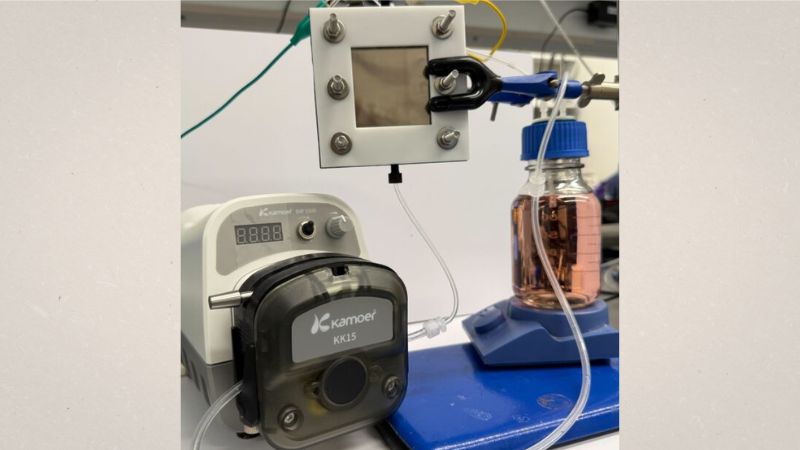
The researchers’ setup. Image used courtesy of Johns Hopkins University
The Recycling Problem
As millions of lithium-ion batteries reach the end of their useful lives, the need for efficient and safe recycling has never been greater. The Global Battery Alliance estimates that by 2030, approximately 11 million tons of lithium-ion batteries will reach the end of their useful lives. Currently, only around 5% of spent batteries are estimated to be recycled. Most are instead discarded in landfills, where toxic materials can leach into soil and groundwater.
One of the biggest barriers to recycling these batteries is the difficulty of separating cobalt and nickel. Positioned next to each other on the periodic table, the two metals have nearly identical chemical properties and are commonly found together in battery cathodes.
Conventional recycling methods typically rely on solvent-based extraction, a complex, multi-step process that uses large volumes of harsh organic solvents, produces hazardous waste, and drives up operational costs.
Electrowinning, which uses electricity to deposit dissolved metals onto electrodes, offers a cleaner and potentially more efficient alternative. However, because cobalt and nickel precipitate from solution at nearly the same electrical voltage, selectively recovering one from the other remains a major technical challenge.
Tartaric Acid Breakthrough
A Johns Hopkins team set out to improve electrowinning using bio-derived organic acids. After screening 13 candidates, they identified tartaric acid, a naturally occurring compound in grapes and a common byproduct of winemaking, as the standout performer.
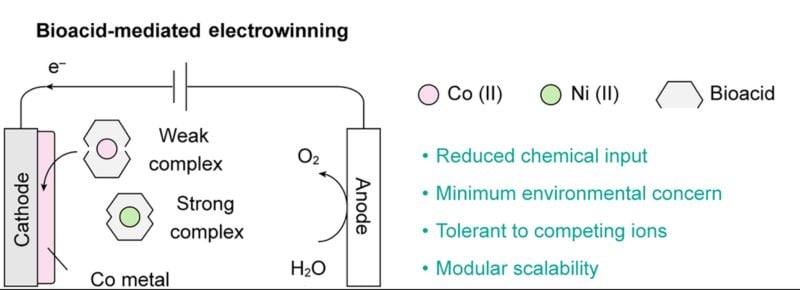
The bioacid-mediated electrowinning process. Image used courtesy of Li et al.
The key lies in tartaric acid's molecular structure. The acid possesses two hydroxyl groups on its carbon chain that allow it to form a unique dinuclear complex with metal ions. This structure causes it to bind nickel ions much more strongly, effectively keeping them in solution at voltages where cobalt readily deposits onto the electrode.
The two metals, which once stubbornly co-precipitated, can now be drawn out one at a time.
In small-batch tests using real nickel-cobalt-manganese battery leachate, the team recovered cobalt at over 99% purity. Scaling up to a continuous-flow system, they achieved 95.1% cobalt recovery and 96.5% nickel recovery, rivaling or exceeding conventional methods without the environmental burden.
A Universal Strategy
What makes this development especially significant is its transferability. The approach offers a universal strategy to separate critical metals needed for the energy transition. It also addresses a practical bottleneck within the recycling industry since it works on dilute and complex mixtures, the very conditions found in real battery waste streams.
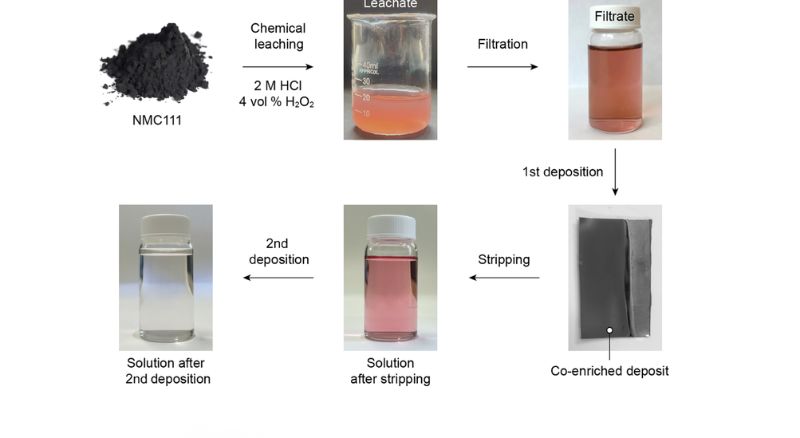
The process of recycling cobalt from NMC111 powder. Image used courtesy of Li et al.
The team is now advancing toward larger-scale systems and testing the process against more complex scrap streams containing additional competing ions.
The method is particularly well-suited for "urban mining," recovering valuable materials from discarded electronics and spent batteries rather than digging for virgin ore. For countries with limited mining resources, this pathway to domestic metal supply could be impactful.
Building Toward a Circular Economy
The research’s implications extend beyond battery recycling. The team suggested the bioacid-mediated electrowinning strategy could be adapted to separate other pairs of chemically similar critical metals, opening doors for sustainable resource recovery across electronics, aerospace, and industrial manufacturing.
As the clean energy transition accelerates, the pressure on cobalt and nickel supply chains will only intensify. The Johns Hopkins breakthrough demonstrates that sustainable, cost-effective, and scalable answers may already exist in nature.