Facebook
 Google
 GitHub
 Linkedin
Electrifying Cement: MIT Supercapacitor Could Power the Future
Using simple materials, researchers from MIT have created a cement that can store electrical energy.
Humans have used cement for thousands of years, with the earliest known use dating back around 12,000 years ago. Likewise, carbon black has been around for millennia—the Dead Sea Scrolls of the 3rd Century B.C.E. were written using ink made from the substance.
Massachusetts Institute of Technology (MIT) researchers have combined these ancient materials to create a cement supercapacitor to store electrical energy.
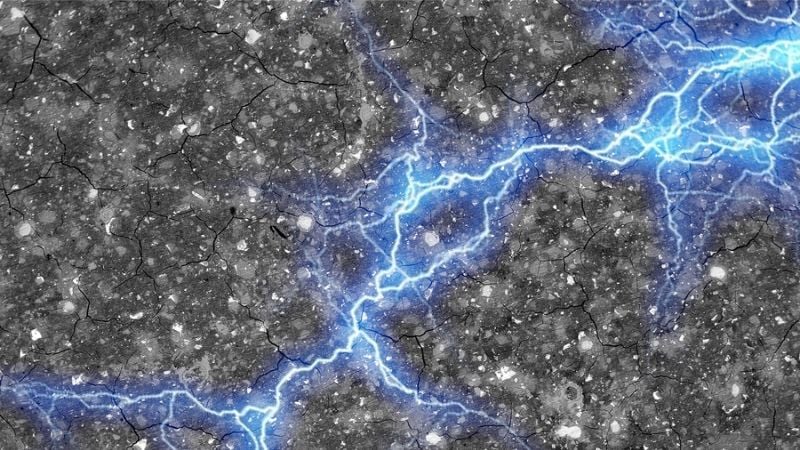
Energy-storing supercapacitor from cement and carbon black. Image used courtesy of MIT
Supercapacitors
Capacitors are fundamentally straightforward devices comprising two electrically conductive plates saturated in an electrolyte and separated by a membrane. When voltage is applied across the capacitor, positively charged ions from the electrolyte accumulate on the negatively charged plate, while negatively charged ions gather on the positively charged plate. The membrane between the plates prevents charged ions from migrating across, resulting in an electric field between the plates and charging the capacitor. These plates can retain the charges for an extended period and release them rapidly when required.
Supercapacitors are simply capacitors that can store exceptionally large charges. The total surface area of a capacitor's conductive plates determines its power storage capacity.
Unlike a battery, which takes in, stores, and then returns electrical energy slowly, supercapacitors charge and discharge rapidly. While this energy storage aspect is less useful for computing devices or electric vehicles (EVs) requiring steady energy over a long period, the capacitor could be used to provide a rapid boost to an EV battery on a wireless roadway or to store excess electrical energy from solar panels in the concrete foundation of a residential home.
In general, supercapacitors have significant potential in aiding the transition to renewable energy and addressing the need for large-scale energy storage. They offer a cheaper alternative to traditional batteries, which rely on limited materials like lithium in their construction.
Super Cement
The key innovation in the MIT team’s new supercapacitors lies in creating a cement-based material with a remarkably high internal surface area, thanks to its dense, conductive material in an interconnected network. This is achieved by incorporating carbon black, a highly conductive substance, into a cement powder and water mixture. As the mixture cures, water forms a branching network of openings, and carbon migrates into these spaces to create wire-like structures with a fractal-like design, resulting in an extensive surface area within a small volume. Soaking this concrete material in an electrolyte, such as potassium chloride, causes charged particles to accumulate on the carbon structures. Two electrodes made from this material separated by a thin insulating layer form a powerful supercapacitor.
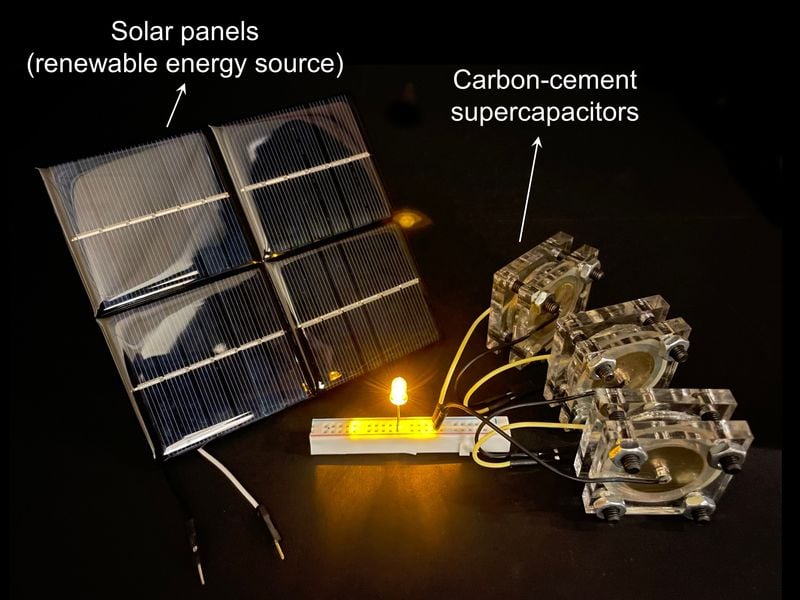
Concept of the concrete supercapacitor used with solar energy. Image used courtesy of MIT
The researchers found that these supercapacitors could store energy efficiently, similar to how rechargeable batteries work, storing and releasing electrical current as needed. The carbon black forms a connected conductive network as the mixture sets, with only a small amount (3% by volume) required for effectiveness. This process is reproducible, cost-effective, and uses readily available materials.
For example, a 45-cubic meter block could store about 10 kilowatt-hours of energy, enough for the average daily household usage. This material retains the concrete's strength, making it feasible for structural applications such as house foundations, which could store and supply energy generated from solar panels or wind turbines.
Demonstrated Success
The MIT team has successfully demonstrated the process by creating small supercapacitors to light up LEDs. They plan to scale up to larger versions, including a 45-cubic-meter model to power a house. They also discovered a tradeoff between energy storage capacity and structural strength: increasing carbon black content boosts storage but slightly weakens the concrete. The optimal mix for structural uses, such as foundations or wind turbine bases, is around 10% carbon black.
Potential applications extend to concrete roadways that store solar energy to charge electric vehicles wirelessly. The system's scalability allows for various uses, from isolated homes powered by solar panels to vehicle-charging roads. The energy-storage capacity is directly proportional to the electrode volume, and the mixture can be adjusted for different charging and discharging rates based on the application requirements.