Facebook
 Google
 GitHub
 Linkedin
What’s Driving Energy Storage in 2024?
According to the EIA, battery storage capacity will nearly double this year, underscoring the increasing importance of energy storage in supporting renewable energy integration and grid stability.
The rapid rise of solar and wind projects throughout the U.S. has created a booming energy storage market. The Energy Information Administration (EIA) estimates that battery storage capacity will nearly double this year as developers plan to add over 14 GW to the grid’s existing 15.5 GW. More than 6 GW of battery storage came online last year, a 70% increase year-over-year.
A central trend underlying the ongoing storage expansion is the need for dispatchable capacity to offset intermittent generation from variable renewable energy resources. Battery storage systems, generally designed to maximize power or energy capacity, can be paired with wind or solar plants to provide a consistent supply of firm capacity and ancillary transmission support like frequency regulation, reactive power, and spinning reserves.

An MN8 Energy battery storage facility. Image used courtesy of MN8
Declining battery prices also feed recent market growth. Large stationary storage providers are entering multi-year battery cell supply agreements while tapping low prices from Chinese suppliers. Average lithium-ion battery pack prices fell by 14% in 2023, and the stationary storage sector saw even higher drops of -17%, according to the National Renewable Energy Laboratory (NREL).
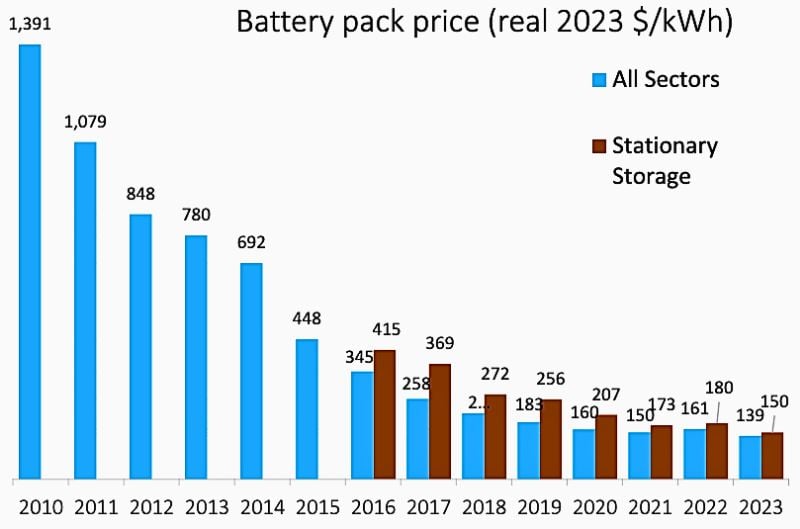
Average battery pack prices from 2010 to 2023. Image used courtesy of NREL (Page 48)
US Battery Storage Pipeline and Investments
Grid-scale storage is expanding across the U.S. Wood Mackenzie tracked record capacity additions in the fourth quarter of 2023, topping 3.9 GW and 11 GWh. That’s a whopping 358% increase year-over-year, including +113% from the most recent record set in the third quarter. The residential market also grew with 218.5 MW, slightly surpassing the last quarter’s 210.9 MW record.

Charts from Wood Mackenzie’s latest U.S. Energy Storage Monitor report. Image used courtesy of Wood Mackenzie (Pages 6 and 7)
Nearly 9 GW of battery capacity was deployed nationwide last year, up 90% from 2022, and Wood Mackenzie predicts 59 GW will be added by 2028. Analysts cited the continued decline in battery prices, mainly due to softening EV demand and the oversupply of battery-grade lithium raw materials, outpacing demand projections.
New federal incentives are another market driver. The Inflation Reduction Act (IRA) introduced an investment tax credit (ITC) for standalone storage projects with at least 5 kWh of capacity. Previously, only batteries co-located with solar could qualify for tax credits. The base credit covers 6% of the investment, though developers can increase this amount by five times through meeting wage and apprenticeship requirements and another +10% for domestic content and manufacturing.
On the consumer side, the IRA also incentivizes residential battery storage equipment purchases, offering a 30% tax credit for systems with at least 3 kWh of capacity.
A Department of Energy (DOE) Office of Policy leader recently told a conference audience that energy storage deployments are expected to quadruple since the IRA’s passage in 2022. The DOE now projects 200 GW of storage capacity by 2040, compared to 50 GW before the IRA.
Texas Adds Much-Needed Storage Capacity
Enel North America, Texas’s largest utility-scale energy storage operator, started building its Ables Springs Solar + Storage project near Dallas. Combining an 186 MW solar array with a 115 MW/169 MWh battery storage system, the plant will generate 320 GWh annually for 30,000-plus households. It’s expected to come online later this year.
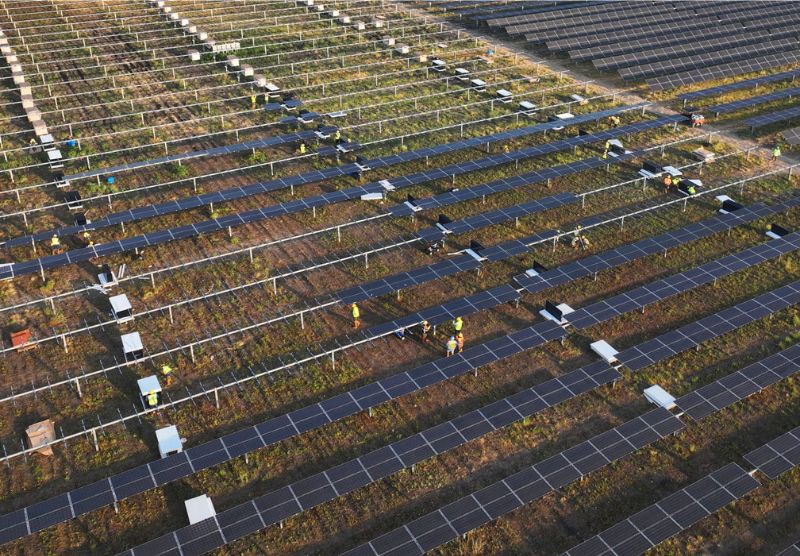
The Ables Springs Solar + Storage Plant in Texas recently started construction. Image used courtesy of Enel North America
Ables Springs Solar + Storage is just the latest slate of battery resources joining the Texas grid, boosting Enel’s statewide portfolio totaling 8.3 GW of wind and solar and 1 GW of large-scale storage. The EIA recently estimated Texas would add 6.4 GW of battery storage capacity in 2024, beating the second-highest state (California, anticipating 5.2 GW). About 90% of the state's load is operated by the Electric Reliability Council of Texas (ERCOT), which currently has 5.2 GW of installed battery storage capacity. It aims to tap into additional dispatchable resources to balance the 38.8 GW of wind and 22 GW of utility-scale solar in its mix.
Enel tripled its Texas storage capacity in 2023 when extreme heat and population growth caused spikes in demand, thus tightening grid conditions. In a heatwave last September, ERCOT issued a Level 2 Energy Emergency Alert after its operating reserves fell below 1.7 GW and couldn’t recover within 30 minutes. As ERCOT urged Texans to conserve electricity, Enel’s seven battery storage systems supplied 525 MWh to help ERCOT avoid rolling blackouts. ERCOT also called upon 145 MW of load relief from the company’s demand response portfolio.
New Hampshire to Add Storage Capacity at Retired Coal Plants
New England is set to be coal-free in the next few years, as New Hampshire’s last coal-fired stations announced plans to retire by 2025 and 2028. With 560 MW of capacity coming offline, plant operator Granite Shore Power announced an agreement with the Environmental Protection Agency to redevelop the sites into renewable energy hubs. The plan includes a battery energy storage system at one of the power stations, supporting peak demand for the region’s new offshore wind sites in the Gulf of Maine and near Martha’s Vineyard.
The plants’ early retirement makes New England the second region to eliminate coal after the Pacific Northwest. Several states are quickly phasing out fossil fuels in favor of renewables. According to the EIA, 22 GW of coal-fired generating capacity has retired over the last two years, and another 2.3 GW is scheduled for 2024. However, that pace is expected to slow as upcoming retirements will primarily be aging units averaging 54 years, about a decade older than those operating today.
New Investments
Investors are infusing more cash into energy storage projects, with several large developers bagging multi-million-dollar funding rounds.
Of note, Lightshift Energy raised $100 million from Greenbacker Capital Management to fund a multi-gigawatt battery storage expansion across the U.S. The Virginia-based company has over 20 battery projects under contract, with a 4 GW pipeline.
New York-based MN8 Energy, a Goldman Sachs spinoff and one of the largest independent storage producers nationwide, secured a $325 million investment round from infrastructure investor Ridgewood Infrastructure and commodity trading firm Mercuria Energy Group. The company has over 270 MW of battery storage and 3.2 GW of solar across 875 projects.