Facebook
 Google
 GitHub
 Linkedin
Carbon-Capture ‘Mars’ Batteries Move Closer to Reality
Scientists boosted lithium-carbon dioxide batteries’ performance and life cycle, showing promise for use on Mars and Earth.
While space agencies contemplate sending astronauts to Mars, scientists are searching for ways to power electronic devices amid the Red Planet’s harsh atmosphere. Carbon dioxide comprises about 95.32% of the atmosphere, with nitrogen, argon, oxygen, and carbon dioxide making up most of the remainder. Wide temperature swings (60°C between day and night) and radiation are also obstacles.
Scientists have already demonstrated proof-of-concept that lithium-carbon dioxide batteries may be ideal. The batteries can use the available CO2 in Mars’ atmosphere as a cathode reactant to store energy. However, the batteries suffered from instability and inefficiency. Now, University of Surrey researchers have used a cesium phosphomolybdate (CPM) catalyst to increase stability, store more energy, and boost the number of life cycles.
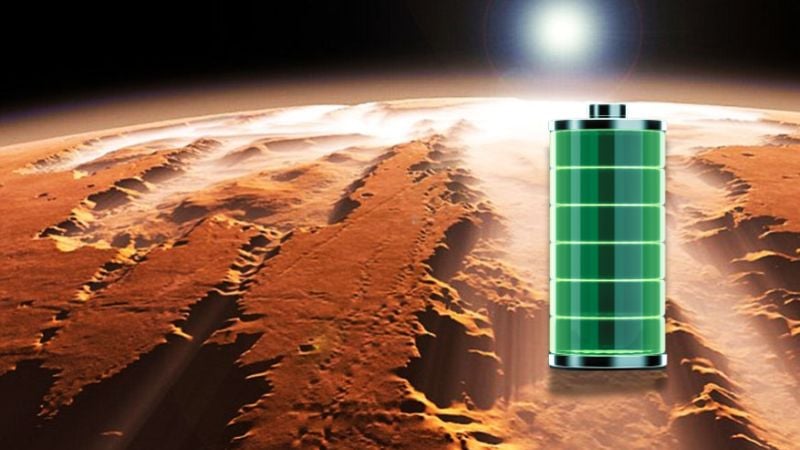
Can a lithium-carbon dioxide battery function efficiently in Mars’ atmosphere? Adapted from image used courtesy of Lawrence Livermore National Laboratory
How Li-CO₂ Batteries Work
A reversible electrochemical reaction involving lithium and carbon dioxide powers the battery. When discharging, the reaction 4Li + 3CO2 → 2Li2CO3 + C takes place, with lithium ions from the anode traveling through the electrolyte to the cathode. At the cathode, the ions react with CO2 to form lithium carbonate (Li2CO3) and solid carbon. The process generates electrical energy in the form of electrons while at the same time capturing and converting CO2.
During charging, the reaction is reversed, 2Li2CO3 + C → 4Li + 3CO2, and as the lithium carbonate decomposes, it releases lithium ions that return to the anode and CO2 that can be captured and stored in Earth-bound applications, or released back into the Martian atmosphere.
The Cesium Catalyst
The University of Surrey team used a cesium catalyst, which is a Keggin-type polyoxometalate, addressing two major challenges.
- Reduced overpotential: CPM lowers the extra energy required for charging (overpotential) from ~1.4 V to 0.67 V, making reactions more efficient. This is akin to flattening an energy "hill" that previously hindered recharging.
- Enhanced stability: The catalyst’s porous structure provides an ideal surface for Li₂CO₃ formation and decomposition, enabling over 100 cycles without significant degradation.
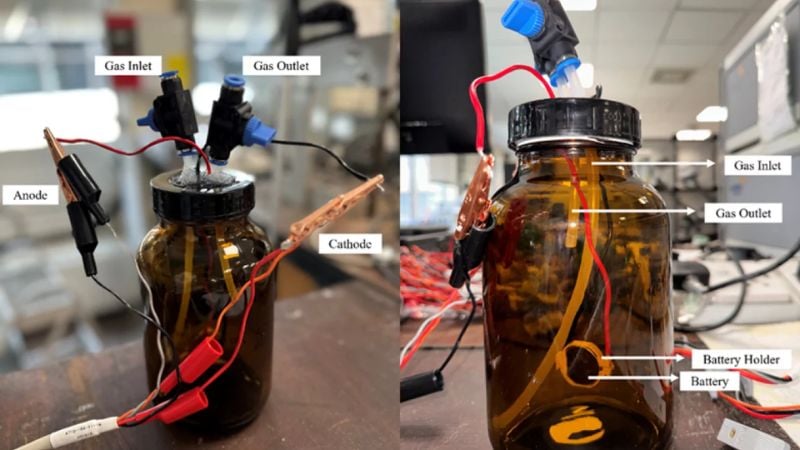
The researchers’ model. Image used courtesy of the University of Surrey
The CPM improved energy density, storing up to 2.5 times more energy than conventional lithium-ion batteries. It could operate reliably for 100+ cycles, a marked improvement over earlier prototypes, but still an area needing further improvement for commercialization.
CPM’s porous structure provided an ideal surface for lithium carbonate formation and decomposition, streamlining the battery’s “breathing” mechanism. Lab experiments confirmed stable operation at 50 mA g⁻¹ with 97.3 percent coulombic efficiency, demonstrating feasibility for industrial-scale applications.
CPM can replace expensive platinum-group catalysts, using affordable, scalable materials. The CPM material is low in cost and can be manufactured at room temperature, making it a practical alternative to the expensive and rare noble metals, such as ruthenium and platinum, that others have used to catalyze the reaction.
Applications and Environmental Impact
Beyond producing electricity as a battery, the lithium-carbon dioxide battery could provide a method for CO2 capture. Roughly 1 kg of CPM can absorb ~18.5 kg of CO₂, potentially offsetting emissions from vehicles or industrial sources. As noted, this type of battery could function on Mars, where CO₂ comprises 95 percent of the atmosphere.
Challenges and Future Directions
While promising, Li-CO₂ batteries still trail commercial lithium-ion tech in cycle life, where 1,000+ cycles will be needed for commercialization. Researchers aim to refine CPM further, testing under varied CO₂ pressures and exploring alternatives to cesium. By prioritizing abundant materials and simplified chemistry, the Surrey approach promises to help bridge the gap between lab innovation and real-world deployment.