Facebook
 Google
 GitHub
 Linkedin
Battery Research Targets Performance, Recycling, and Dendrites
Advances in anode design, materials recovery, and dendrite behavior are addressing key limitations in modern battery systems.
Research is advancing battery technology in three critical areas: performance, recycling, and safety. Recent studies point to better anode materials, more efficient recovery of battery components, and insights into how dendrites form and cause failure.
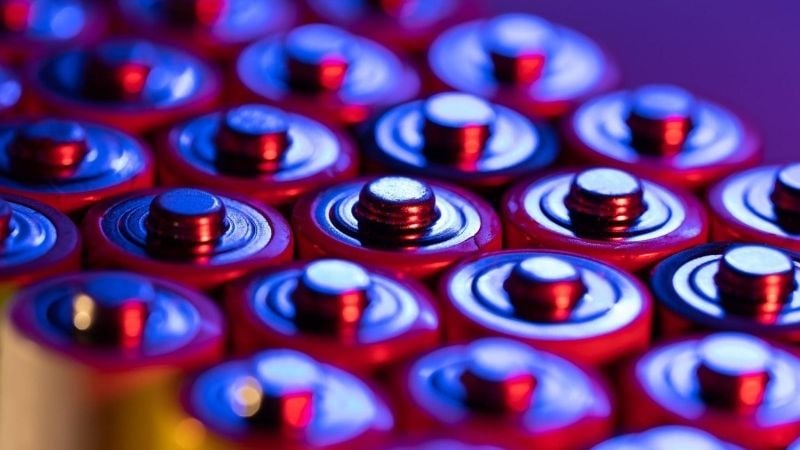
Lithium-ion battery materials analyzed in a Rice University study on plasma-assisted recycling. Image used courtesy of Rice University/Jorge Vidal
An Improved CNT-Silicon Hybrid Anode Structure
University of Surrey researchers unveiled a redesigned lithium-ion battery anode that combines silicon with vertically aligned carbon nanotubes (CNTs). The design aims to address one of silicon’s longstanding problems: while silicon can store far more lithium than graphite, it undergoes significant volume expansion during charging, leading to cracking, loss of electrical contact, and degradation.
The study demonstrates a promising silicon-CNT anode design that could, in principle, enable higher-capacity and more durable lithium-ion batteries. The team's solution is a Vertically Integrated Silicon-Carbon Nanotube (VISiCNT) structure, where dense carbon nanotubes are grown directly on copper foil and then coated with silicon, creating a conductive scaffold that better tolerates expansion.
The researchers reported the VISiCNT architecture delivered both high energy storage capacity and improved cycling stability, two properties that can be difficult to achieve simultaneously in anode materials.
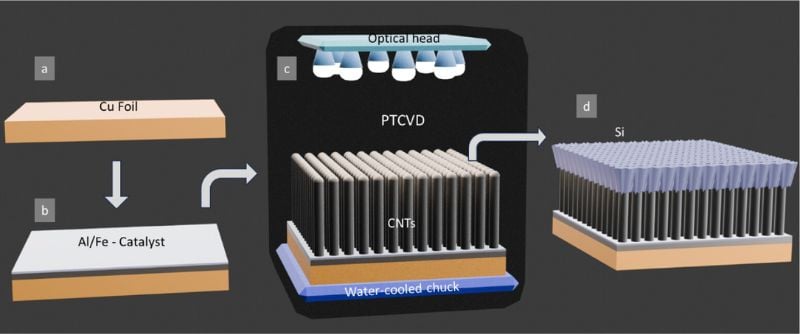
Schematic illustration of the fabrication pathway for the VISiCNT anode architecture. Image used courtesy of Ahmad et al.
The architecture delivered reversible capacities above 3500 mAh/g in some versions, which is close to silicon’s theoretical limit and far above graphite’s typical capacity. The study also reports good cycling stability, especially for shorter nanotubes with relatively higher defect density, though low material loadings achieved the highest capacities.
The design also has manufacturing benefits. The nanotubes were grown directly on copper foil at a reported rate of 21 µm per minute, which the researchers described as potentially compatible with roll-to-roll battery manufacturing processes.
The paper appeared in ACS Applied Energy Materials.
Microwave-Induced Plasma Treatment for Material Recovery
Rice University researchers have developed a new method for recycling lithium-ion batteries that replaces harsh chemicals and high heat with a short plasma treatment followed by recovery using mild, room-temperature solvents.
The process begins by exposing black mass (the shredded mixture of battery materials) to microwave-induced plasma for about 15 minutes. This alters the materials’ structure, making their components easier to separate.
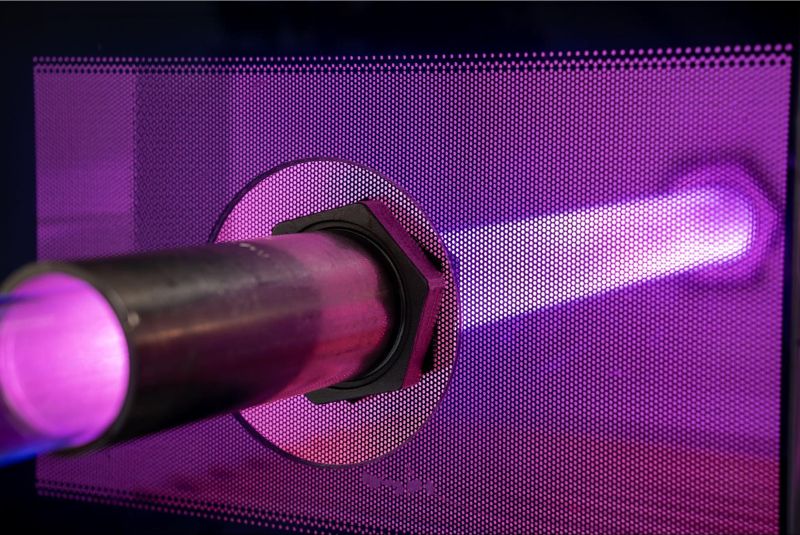
A custom plasma reactor developed for the study. Image used courtesy of Rice University/Jorge Vidal
After this pretreatment, manufacturers can recover valuable materials such as lithium, nickel, cobalt, and manganese using relatively gentle solutions, such as citric acid. The process also regenerates graphite, a major component of battery anodes that's usually damaged or discarded in conventional recycling. The recovered graphite can be reused with high performance as an anode material in new lithium-ion batteries.
The method achieves recovery rates of nearly 95% for metals and selectively extracts lithium from water. Compared to conventional recycling approaches, which rely on energy-intensive processes and strong acids, this plasma-based method improves recovery efficiency while reducing chemical use and energy demand.
The researchers explain their work. Video used courtesy of Rice University Advanced Materials Institute
MIT Study Sheds Light on Dendrite Formation in Batteries
A research team from the Massachusetts Institute of Technology has uncovered new insights into how dendrites develop and grow inside batteries. These needle-like structures pose a serious safety risk because they can penetrate the electrolyte and cause internal short circuits.
Using a technique to directly measure stress during battery operation, the researchers found that dendrites can grow at significantly lower stress levels than previously believed. Contrary to conventional expectations, faster dendrite growth was associated with lower stress, indicating that electrochemical reactions weaken the electrolyte and make it more prone to cracking.
Dendrite behavior remains a key challenge in advancing next-generation batteries, particularly those using lithium metal and solid-state systems. MIT's findings show dendrite formation is driven by both mechanical forces and by chemical changes that weaken the electrolyte. According to the researchers, this suggests that improving strength alone isn't enough and that greater chemical stability will be needed.