Facebook
 Google
 GitHub
 Linkedin
A Slower Burn: Are Solid-State Batteries a Safer Alternative?
University of Wisconsin researchers found that solid-state batteries experience thermal runaway, but at a significantly slower rate than traditional lithium-ion batteries.
Solid-state batteries are presumed safer than traditional batteries, but the truth is, nobody really knows for certain. Since these batteries are still in development, they haven’t been tested in real-world situations.
Researchers at the University of Wisconsin-Madison set out to simulate actual conditions that solid-state batteries (SSBs) might face in commercial applications, such as an electric vehicle crash. Their analysis demonstrated that, yes, solid-state batteries will experience thermal runaway and catch fire—but at a much slower rate than other batteries.
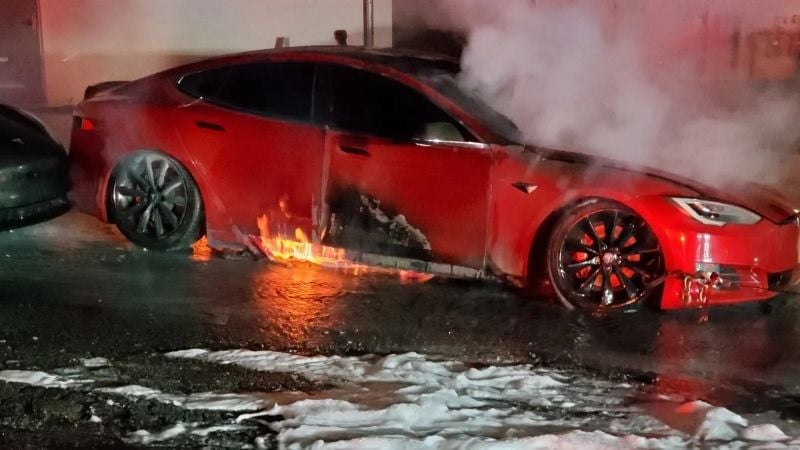
An electric vehicle fire. Image used courtesy of U.S. Fire Administration
Testing Battery Architectures Under Direct Heat
To begin, the UW-Madison engineers built multiple solid-state battery prototypes using different electrolyte formulations and internal structural designs. They compared five different types of battery technologies:
- Conventional lithium-ion with liquid electrolyte
- Lithium metal with liquid electrolyte
- Lithium metal polymer battery with PEO polymer electrolyte
- Quasi-solid-state battery with dense ceramic separator and liquid catholyte
- All-solid-state battery (ASSB) with dense ceramic separator
To simulate an EV crash or other extreme thermal event, they placed each fully assembled battery cell directly inside a continuous propane flame. Typically, the high external heat would trigger cell degradation, leading to thermal runaway and rapidly spreading fire.
As expected, all the batteries with liquid electrolytes ignited within the 15-second duration of immersion in the flame—but so did the ASSB. Yet, the ASSB was slower to catch fire, and it took longer for the flames to spread. They set out to understand how and why.
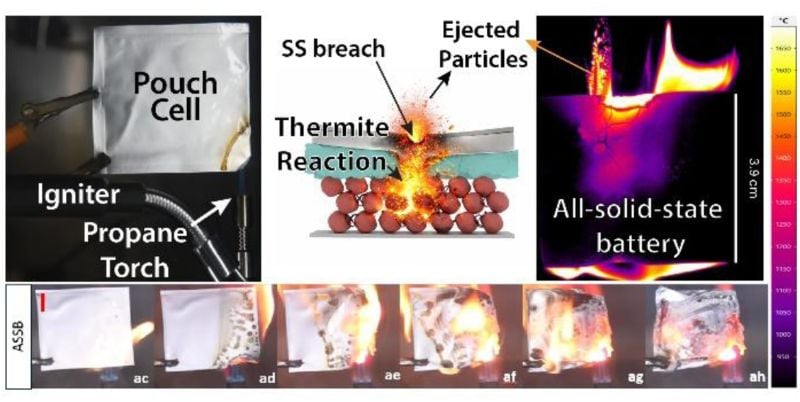
The experimental process, imaging, and photos. Image used courtesy of Fakkema and Kazyak
During the burn, the researchers used high-speed optical imaging cameras to track flame propagation rates across cell surfaces while recording the ejection of gases and hot particles. They recorded how long each prototype burned and the amount of heat generated. Using high-speed imaging, they recorded the flame propagation across the battery cell.
These quantitative metrics allowed direct comparison between solid-state configurations and standard liquid-electrolyte lithium-ion cells.
Following combustion, researchers used electron microscopy and chemical spectroscopy to analyze structural degradation and compositional changes in the solid electrolyte matrix.
Flame Propagation and Electrolyte Material Performance
The researchers concluded that the ASSB demonstrated lower heating rates and longer burn times than the other prototypes, indicating that combustion and thermal propagation were significantly delayed. They attributed the difference to the ceramic solid electrolytes and separator, reasoning that slower oxidation reduces the speed at which thermal runaway spreads from cell to cell within a battery pack.
The ceramic separator stayed mostly intact throughout the combustion, providing a physical barrier that separated the cell’s components. This, in turn, delayed the lithium oxidation reaction that leads to thermal breakdown.
Implications for the Slow Burn
The researchers concluded that battery fire is caused by the interplay between several factors, including the flammable materials, the oxygen availability, and the lithium oxidation reaction. The solid electrolytes used in the study, along with the ceramic separator, slowed the fire propagation and lowered the heating rate.

The ASSB compared to other prototypes tested. Image used courtesy of Fakkema and Kazyak (Click to enlarge)
This finding is significant because reduced combustion speed can alter the degradation timeline during a sustained fire. The researchers noted that the slower burn can “buy critical time” for implementing safety measures. For example, in an EV crash, lower heat generation provides a critical time window for vehicle occupants to exit safely before catastrophic failure occurs.
Battery fires are becoming increasingly alarming, especially as grid-scale battery energy storage systems proliferate. These massive facilities can contain thousands of shipping-container-sized units packed with batteries. When under stress, these units can catch fire, spread easily, and burn for long periods. The 2025 fire at the Moss Landing storage facility in California illustrates the problem. That fire burned for nearly five days, destroying some 50% to 80% of the storage units and causing evacuations of about 1,200 people.
Although manufacturers are shifting toward relatively safer chemistries such as lithium-iron-phosphate and sodium-ion, implementing solid-state batteries could offer an even more effective way to mitigate the fire risk. However, the scientists noted that the optimal materials and engineering for the ASSB will need further investigation.
The study appeared in the Journal of Materials Chemistry A.