Facebook
 Google
 GitHub
 Linkedin
Are EVs Safer Than Tests Imply?
Crash data presents a confusing picture of electric vehicle safety.
Are electric vehicles safer in a crash than traditional vehicles powered by conventional internal combustion engines? Are some EVs safer or less likely to get into an accident than other EVs? What about fire—are EVs more likely to catch fire in the event of an accident?
Watch a Tesla crash test in action. Image used courtesy of Insurance Institution for Highway Safety
These questions would seem straightforward. However, the first two could be tough to answer clearly. While information about EV fires is definitive, safety issues of EVs vs. gas vehicles are still under debate.
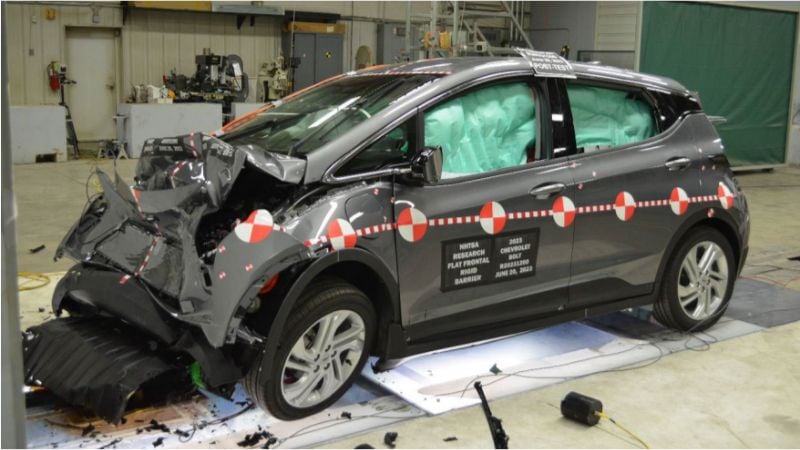
EV crash test. Image used courtesy of National Highway Traffic Safety Administration
Primary Sources for EV Safety
The National Highway Traffic Safety Administration records and analyzes vehicle crash data in the U.S. In addition to managing safety recalls, performing crash tests (resulting in the Star Rating system), and producing safety ratings for all new vehicles, NHTSA maintains a Fatality Analysis Reporting System that allows online research into vehicle fatalities, broken down by a variety of factors including location, type of accident, and type of vehicle. NHTSA also maintains the Bureau of Transportation Statistics.
Another primary source for vehicle safety data is the Insurance Institute for Highway Safety. Insurance industries support this independent, nonprofit organization, which aims to reduce deaths, injuries, and property damage from motor vehicle crashes. It also supports the Highway Loss Data Institute, which evaluates human and economic losses resulting from ownership of individual vehicle makes and models.
What About EV Fires?
Using Bureau of Transportation Statistics data, an insurance organization called AutoinsuranceEZ examined the incidence of vehicle fires. The data showed that gasoline-powered vehicles (ICE) had an incidence of 1,530 fires per 100,000 vehicles. Hybrid vehicles came in at 3,475 fires per 100,000, while EVs reached just 25 fires per 100,000 vehicles. The study used 2020 data, but more recent data suggest EVs are between 20 to 80 times less likely to gp up in flames than ICE vehicles. The liquid organic solvents used in the electrolytes of EV batteries burn intensely, and the resulting EV fires can be difficult to extinguish. Still, the data suggests that the occurrence of an EV fire is quite rare.
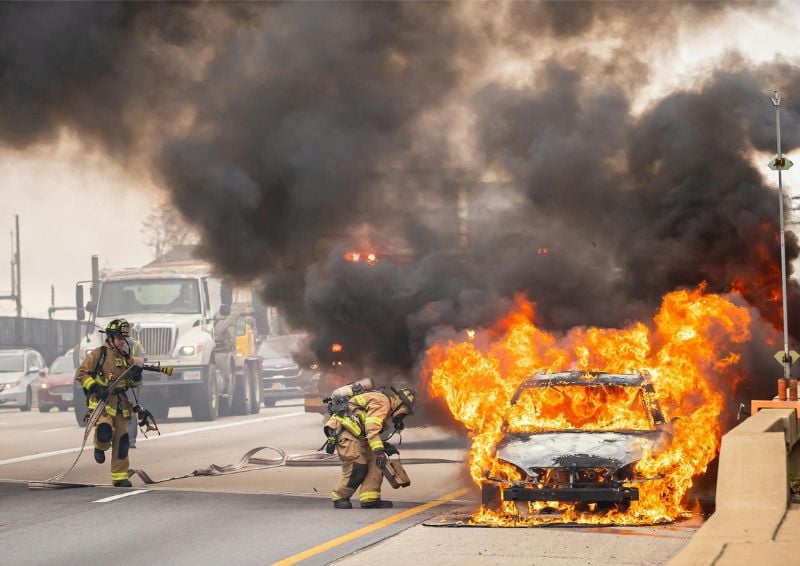
Studies show EVs are less likely to catch fire than ICE vehicles. Image used courtesy of Pexels
Whose Interests?
The automotive research firm iSeeCars.com used fatality data from the NHTSA’s Fatality Analysis Reporting System from the model years 2018-2022 to identify the most dangerous vehicles on U.S. roads today. After significant improvements in U.S. highway fatality rates, the past five years have seen higher rates of accidents and fatalities than the previous 12 years. At present, the rate of fatal accidents is 2.8 per billion miles.
iSeeCars produced a list of new car models with a fatal accident rate at least two times higher than average. The company claimed that five vehicles—the Hyundai Venue (13.9 fatal crashes per billion miles traveled), Chevy Corvette (13.6), Mitsubishi Mirage (13.6), Porsche 911 (13.2), and Honda CR-V Hybrid (13.2) are the deadliest on U.S. roads. The Tesla Model Y (10.6) was sixth on the list, while the Tesla Model S (5.8) was twenty-first on the list of most dangerous.
iSeeCars went further and proclaimed Tesla to have the highest fatal accident rate of all car brands (5.6), followed by Kia (5.5), Buick (4.8), Dodge (4.4), and Hyundai (3.9).
Tesla immediately took exception to its ranking, with Tesla VP of Vehicle Engineering Lars Moravy responding on the social media platform X that the company may have used a bad determination of the number of miles Tesla owners drive. According to Tesla, the Model Y has been driven by over 7 billion total miles, and the Model 3 around 19 billion miles. iSeeCars indicated that the miles driven were estimated from a proprietary company database, with over 8 million vehicles included. If iSeeCars underestimated the total miles for Tesla or any other manufacturer, the fatal accident rate would be calculated as higher than it actually is. Without knowing the denominator in the calculation (the number of miles driven), it is difficult to draw any meaningful conclusions from the iSeeCars report.
Law Firms
Personal injury law firms have taken great interest in publishing studies on EV safety on social media. In the first part of 2024, such a law firm produced a list of EVs available in the U.S. and listed their total fatal crashes per 1000 cars between 2019 and 2023. The Barnes Firm, whose study received significant play on social media, indicated that the Nissan Leaf was the worst, with 2.16 crashes per 1,000 cars. However, the study added all the number of fatal crashes between 2019 and 2023 (26 fatal crashes) and divided it by the number of sales for just 2023 (12,026 sales).
At best, this is a questionable practice to determine a fatal crash rate and would seem to be a major flaw in the company’s analysis. The law firm rated the Kia Niro second (1.82), the Hyundai Ioniq third (1,57), followed by the Tesla Model X (1.08), the Audi e-tron (0.87), the Tesla Model S (0.76), the Tesla Model 3 (0.75), and the Chevrolet Bolt (0.55). The Ford Mustang was ranked among the best, with just two fatal accidents and 39,458 vehicles sold, for a rate of 0.05 crashes per 1,000 cars. Only the Hyundai Kona beat the rate at 0.03 crashes per 1,000 vehicles.
Other personal injury law firm websites highlighting EVs imply that their “timely analysis” of EV crash risks is an area for further study. Yet, these analyses lack rigor. Most firms strongly emphasize that “if you or a loved one has suffered a serious injury” due to an EV crash, you should contact one of their “experienced EV accident attorneys” to pursue “the maximum amount of damages from all liable parties.”
What Does the IIHS Say?
In 2023, the IIHS examined the safety of EVs. An initial concern during crash testing of EVs was the potential for battery fires. Since the IIHS started crash testing EVs in 2011, and after 55 EV crash tests, it has experienced zero fires. That’s not to say EVs never catch fire, but the incidence of vehicle fire is significantly lower than gasoline-powered vehicles.
The IIHS's biggest concern during EV collisions is vehicle weight. Because of their heavy battery packs, EVs weigh significantly more than traditional vehicles. During a collision, a heavier vehicle will push the lighter one backward, transmitting higher forces to the people in the lighter vehicle. This could result in greater damage to the lighter vehicle and more severe injuries to its occupants.
This phenomenon is not limited to EVs. The proliferation of large SUVs and giant pickup trucks on U.S. streets and highways results in greater injuries to occupants of smaller passenger cars when they collide with these supersized vehicles. Fewer injuries are reported to those in the larger, heavier vehicles.
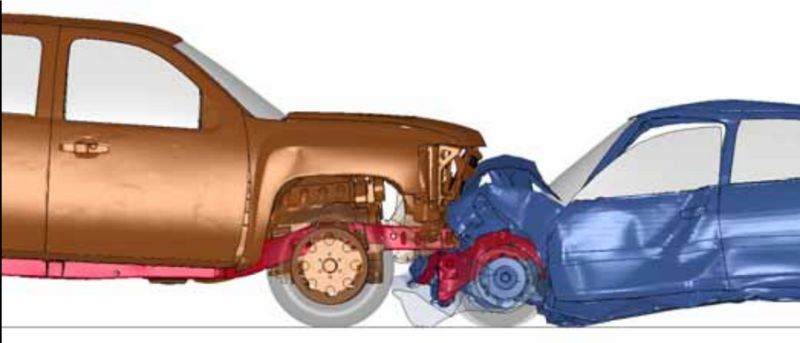
Crash between SUV and sedan. Image used courtesy of NHTSA
An EV’s extra weight can be expected to afford greater protection to its occupants in a multi-vehicle crash but at the expense of people in lighter vehicles that are involved in the collision.
Initially, many EVs were small commuter-type cars with small battery packs and limited range. As U.S. consumers demanded larger EVs that could travel 300 miles on a single charge, the result has been much larger vehicles with significantly heavier battery packs.
As battery technology improves, packs are becoming lighter. With better fast-charging capability and charger infrastructure, the need for such a long range between charges decreases, allowing for lighter battery systems. However, consumer expectations of that magic 300-mile range will make it difficult to walk back, and the growing number of EVs on U.S. highways will result in a growing disparity in vehicle weights.
Vehicle crash data tends to take two to four years to compile, so the most recent crash data is from 2020 to 2022. Electrification was getting started at that period, so specific EVs aren’t represented in lists of the best or the least crash-worthy vehicles. As more EVs reach the U.S. market, actual real crash data will become available, and results will become more trustworthy.