Facebook
 Google
 GitHub
 Linkedin
3 Battery Breakthroughs Tackle Performance and Sustainability
Japanese researchers have created materials for lithium-air, lithium-ion, and aqueous batteries that promise cleaner, faster, and more recyclable energy storage systems.
From chemically recyclable polymers to water-based solid electrolytes and high-power lithium-air cells, a new wave of battery research is redefining what's possible in energy storage. Engineers from Japan's leading institutions have unveiled three innovations that address longstanding trade-offs in battery design: power vs. energy, performance vs. recyclability, and manufacturing complexity vs. sustainability.
Research could lead to longer-lasting, more efficient, and sustainable batteries. Adapted from images used courtesy of Canva
1. Organic Polymer Makes High-Performing, Recyclable Aqueous Batteries
Tohoku University researchers and their collaborators have developed a redox-active polymer based on hydroquinone-substituted polyallylamine (PDA) that shows high promise for use in recyclable, aqueous-based secondary batteries.
Unlike many traditional organic redox materials, which suffer from poor compatibility with water due to hydrophobicity, the polymer combines hydrophilic amino groups with electroactive hydroquinone units, enabling effective operation in water-based electrolytes. By optimizing the degree of substitution and leveraging electrostatic repulsion within the polymer, the team achieved nearly 100% of the theoretical charge capacity (197 mAh/g) with high coulombic efficiency, excellent rate performance (up to 60 C), and over 99% capacity retention after 100 cycles.
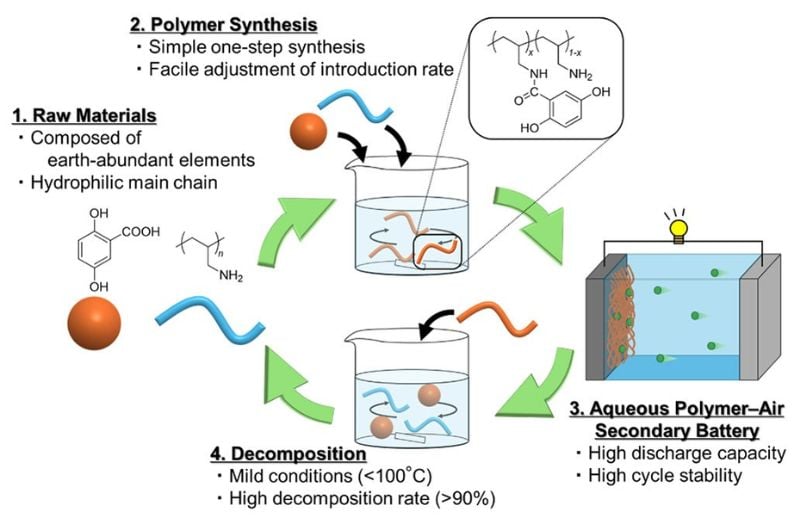
Schematic of a recyclable aqueous battery. Image used courtesy of Tohoku University/Kouki Oka
The researchers also successfully applied the material in a polymer-air secondary battery using a Pt/C catalyst cathode and 0.5 M H2SO4 electrolyte, without requiring a separator. Beyond its electrochemical performance, the polymer offers a notable environmental advantage: it is chemically recyclable. Using 15M sulfuric acid hydrolysis, the polymer can nearly completely decompose back into its raw components within 72 hours.
This addresses a key challenge in battery sustainability by making used and end-of-life management cleaner and more circular. Overall, the study presents a viable molecular design strategy for integrating typically hydrophobic redox materials into safe, high-performance, and fully recyclable aqueous batteries, with clear applications in grid storage and other stationary systems.
2. Water-based Electrolyte Enables Ambient Battery Fabrication
Institute of Science Tokyo researchers have developed a borate-water-based quasi-solid electrolyte named 3D-SLISE (3D-Slime Interface Quasi-Solid Electrolyte), which enables safe, low-energy lithium-ion battery fabrication under ambient conditions. By blending amorphous lithium tetraborate (a-Li2B4O7) with LiFSI, carboxymethyl cellulose, and water, the researchers created a gel-like matrix that supports 3D ion conduction.
This structure eliminates the need for traditional dry rooms, glove boxes, or high-temperature processing, reducing manufacturing complexity and cost. The batteries assembled using this electrolyte delivered a stable voltage of 2.35 V, over 400 cycles at a 3C rate, and featured high ionic conductivity (2.5 mS/cm) and low activation energy (0.25 eV), supporting fast charge/discharge at room temperature.
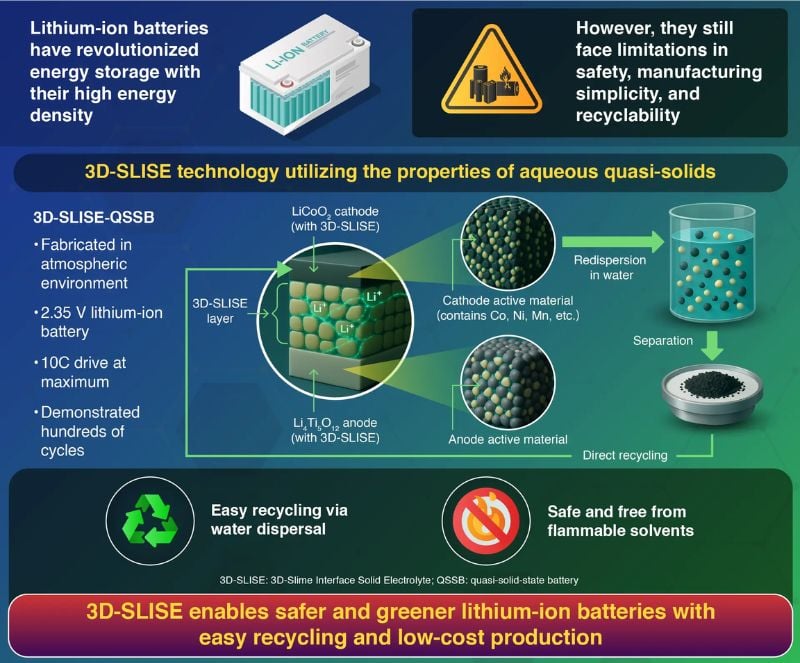
3D-SLISE advantages. Image used courtesy of Institute of Science Tokyo/Shiratori et al.
Beyond performance, 3D-SLISE introduces an elegant solution to battery recycling. Since the electrolyte is entirely water-based and avoids fluorinated binders like PVDF, simply soaking the electrodes can recover the active materials. This eliminates the need for pyrolysis or acid leaching and enables direct reclamation of valuable components like LiCoO2 and Li4Ti5O12, making the system inherently circular.
Combining ambient fabrication, high-rate capability, and clean recyclability, 3D-SLISE offers a practical and scalable path toward sustainable lithium-ion battery production, particularly for applications like portable electronics and stationary storage systems where safety and environmental impact are critical.
3. Porous Carbon Nanotube Boosts Lithium-Air Batteries
Japan’s National Institute for Materials Science (NIMS) and Seikei University have significantly improved lithium-air batteries’ power output by developing a highly porous carbon nanotube-based air electrode. These next-generation batteries already offer energy densities up to 10 times higher than conventional lithium-ion cells, but have been limited by sluggish oxygen reaction kinetics, resulting in low current output. By optimizing electrode porosity and combining it with a low-viscosity amide-based electrolyte, the team achieved a tenfold increase in current density, unlocking power levels sufficient to enable hovering in small drones.
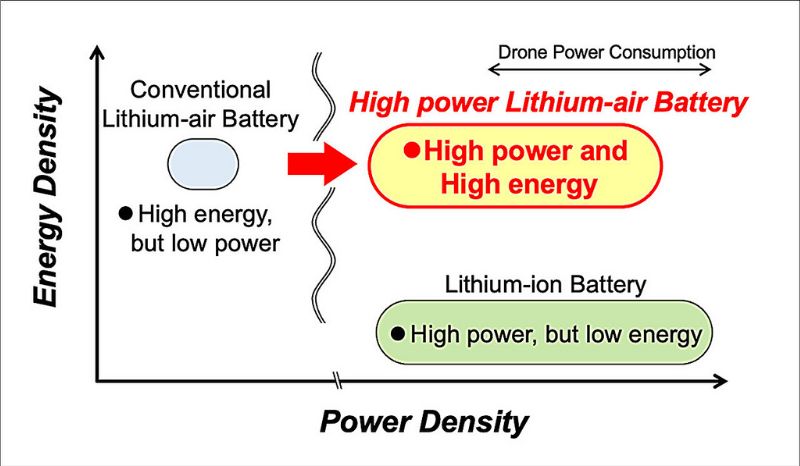
Relationship between battery energy density and power density. Image used courtesy of National Institute for Materials Science/Akihiro Nomura
This development bridges the often conflicting energy and power density demands in battery design. While lithium-air cells have always promised extended runtime due to their high energy capacity, their inability to deliver sufficient peak power has limited practical use.
The porous electrode design increases oxygen accessibility and reaction surface area, dramatically improving power delivery without sacrificing energy storage. Published in the Journal of Power Sources, this breakthrough could pave the way for lightweight, high-capacity batteries for drones, microrobots, and other mobile systems where energy and instantaneous power are critical.