Facebook
 Google
 GitHub
 Linkedin
The Crucial Role of Si IGBTs in Automotive
As the automotive industry shifts to higher-voltage architectures for electric vehicles, silicon IGBTs remain crucial for applications requiring lower switching frequencies and minimal conduction losses.
This article is published by EEPower as part of an exclusive digital content partnership with Bodo’s Power Systems.
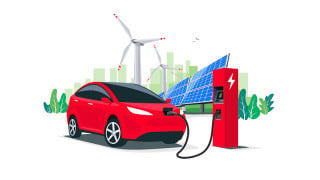
The automotive industry embraces sustainability, with battery electric vehicles (BEV) at the forefront due to their high efficiency and zero tailpipe emissions. In 2023, global sales of BEVs and plugin hybrid electric vehicles (PHEV) reached 13.6 million, a 31% increase from 2022. Projections suggest this number will accelerate in the coming years.
Despite this growth, challenges persist. Excessive costs, long charging times, and limited driving ranges continue to hinder widespread adoption. To address these issues, manufacturers are introducing 800 V BEV systems. This higher voltage architecture enables faster charging, significantly reducing charging time costs.
Silicon Is not Dead
Since the early years of mass adoption of electric vehicles, silicon carbide (SiC) and other wide bandgap (WBG) technologies have been recognized as promising candidates for BEV subsystems. The higher bandgap and significantly greater breakdown voltage of WBG materials compared to silicon enable higher current densities, higher switching frequencies, and reduced overall losses. These benefits allow system designers to achieve improved efficiency, smaller volumes, and reduced weight, particularly in applications that allow for high switching frequencies. Consequently, as demonstrated in numerous studies, SiC has emerged as the dominant technology in traction inverters, with some exceptions.
The maturity of silicon manufacturing processes, the abundance of available options, the lower costs, the simpler gate drive methods, and the robustness of the devices still make silicon power MOSFETs and IGBTs viable alternatives for WBG technologies. It is up to skilled designers to select the appropriate device. At the same time, it is our responsibility as suppliers to offer a comprehensive range of options to meet diverse needs and preferences.
In applications where low switching frequencies are required or sufficient, both conduction losses and the simplicity of thermal design are crucial factors. The high power density inherent in WBG devices can introduce challenges in thermal management. At the same time, the larger die area of silicon IGBTs and MOSFETs can facilitate easier thermal management in these scenarios.
Electric vehicles incorporate complex circuitry with multiple subsystems that do not demand high switching capabilities from semiconductor technology.
Applications
An illustration of a generic battery distribution unit (BDU) in an EV is shown in Figure 1.

Figure 1. Battery Distribution Unit. Image used courtesy of Bodo’s Power Systems [PDF]
PTC heaters in the thermal management subsystem, pre-charge circuit, and discharge circuit do not necessarily require higher switching frequencies. Instead, these require low conduction losses, high surge current capability, and rugged semiconductors for high reliability.
Thermal Management
Unlike internal combustion engine (ICE) vehicles, which inherently produce copious amounts of wasted energy in the form of heat, electric vehicles are much more efficient. A consequence of that efficiency is they do not produce sufficient waste heat to heat the vehicle cabin.
In electric vehicles, there are two important requirements related to thermal management:
- EV battery conditioning
- Cabin heating in cold ambient conditions
In cold ambient temperatures, PTC heaters and heat pumps are utilized to condition the battery for optimal performance, with the generated heat also serving for cabin heating. A typical circuit configuration for PTC heaters is shown in Figure 2.

Figure 2. PTC heater circuit. Image used courtesy of Bodo’s Power Systems [PDF]
The switching frequency of IGBTs in this application ranges from tens to hundreds of hertz. Low on-state voltage drop, ruggedness (short circuit capability), and good thermal performance of the semiconductor are critical factors for this application.
Discharge Circuit
DC-link capacitor discharge requirements in 800 V BEV systems
Critical safety protocols in high-voltage battery electric vehicles necessitate the discharge of DC-Link capacitors under two distinct operational scenarios:
- Normal operation shut down
- Emergency situations like post-collision or critical fault detection
These discharge mechanisms are fundamental safety features designed to mitigate the risk of electrical shock to vehicle occupants and service personnel while also preventing potential fire hazards. The application typically carries an Automotive Safety Integrity Level B (ASIL-B) classification based on manufacturer risk assessment protocols.
In 800V BEV architectures, the nominal battery voltage falls within voltage class B (60 V 1500 V). Per ISO 6469-4 4 safety regulations, the system must ensure rapid voltage reduction in emergencies. Specifically, the bus voltage must be reduced to and maintained below 60 V dc within a 5-second window following vehicle stoppage post-collision.
A typical discharge circuit is shown in Figure 3.

Figure 3. DC-link capacitor discharge circuit. Image used courtesy of Bodo’s Power Systems [PDF]
The DC link capacitor can be discharged through an IGBT. When required, the IGBT is turned on, and all the energy in the capacitor can be discharged via an Rdis resistor in series with the IGBT. Rugged IGBTs with a high surge current capability are important for this application.
Pre-Charge Circuit
Pre-charge circuits are commonly utilized in electric vehicles, including battery management systems and onboard chargers, as well as in industrial applications like power supplies and power distribution units. In electric vehicles, the controllers not only handle the high capacitive electrical components but also ensure smooth and efficient motor operation by controlling power flow to the motor. High-voltage positive and negative contactors in pre-charging circuits safely connect and disconnect the power supply to capacitors, preventing excessive inrush currents during startup. They ensure controlled charging and maintain system safety by isolating components when necessary. Without a pre-charge circuit, welding can occur within the contactor during closure, leading to brief arcing and potential damage.
One of the pre-charge circuit topologies is shown in Figure 4.

Figure 4. Pre-charge circuit. Image used courtesy of Bodo’s Power Systems [PDF]
In the circuit above, there are two high current, high voltage contactors, S1 and S2, a separate pre-charge switch, T1, and a DC link capacitor, C1, connected in parallel with a load, such as a traction inverter. Initially, both high-current contactors, S1 and S2, are open, isolating the HV battery from the load at both terminals. Pre-charging begins by closing switch T1 (1300 V A5A IGBT) along with the HV negative contactor S1, allowing the DC link capacitor to charge to a voltage equal to that of the battery. After the pre-charging process, switch T1 opens, and the HV positive contactor S2 closes. Because the DC link capacitor was charged before closing the HV positive and negative contactors, there is no significant inrush current. 1300 V A5A IGBTs boast high surge current capability, which makes them suitable for this application.
Figure 5 shows the BDU demonstration board by Littelfuse incorporating a 1300 V A5A IGBT.

Figure 5. Littelfuse BDU demonstration board. Image used courtesy of Bodo’s Power Systems [PDF]
1300 V A5A Trench IGBTs
To meet the evolving demands of 800 V BEVs, Littelfuse is introducing a series of 1300 V Trench Discrete IGBTs, shown in Figure 6. These devices are engineered for applications emphasizing reduced conduction losses (Pcond), good thermal behavior, and ruggedness. The A-Class IGBTs in this series feature an optimized low collector-emitter saturation voltage (VCE(sat)), which enhances their performance in low-frequency switching. These IGBTs exhibit short circuit robustness up to 10 µsec. This characteristic is particularly beneficial for critical BEV systems such as PTC heaters, essential for cabin heating and battery conditioning. Further, these IGBTs are applicable in precharge and discharge circuits.

Figure 6. 1300 V A5A Product Line-up. Image used courtesy of Bodo’s Power Systems [PDF]
The series includes single IGBTs in 15 A, 30 A, 55 A, and 85 A collector current at a case temperature of 110 °C. The package options are SMD TO-263HV, TO-268HV, and through-hole TO-247. The SMD packages, being HV versions, offer enhanced creepage and clearance compared to the conventional three-pin TO-263 and TO-268 packages.
Features and Benefits
Higher Breakdown Voltage BVCES: The 1300 V breakdown voltage is tailored for 800 V BEV architectures, suitable for passenger vehicles and heavy-duty trucks. This 1300 V rating provides a buffer for the DC link voltage, which fluctuates according to the battery’s state of charge, particularly where a 1200 V rating may pose challenges.
Wider range of currents IC: Collector currents ranging from 15 A to 85 A at 110°C meet the requirements of both passenger and heavy-duty vehicles across various applications.
Minimized Conduction Energy Losses Econd: This series features one of the lowest VCE(sat) values available in 1300 V IGBTs, effectively minimizing conduction losses. This characteristic not only enhances efficiency but also alleviates thermal design challenges.
Short Circuit Capability tSC: The 1300 V IGBTs are engineered to handle short circuit conditions for up to 10 microseconds, making them suitable for automotive applications that require robust performance and enhanced reliability.
Packages: Surface mount discrete packages include TO-263HV, TO-268HV, and the through-hole TO-247. The high voltage (HV) versions of these SMD packages improve creepage and clearance distances compared to standard 3-pin variants.
Takeaways
Silicon IGBTs remain crucial for applications requiring lower switching frequencies and minimal conduction losses as the automotive industry shifts to higher voltage architectures in electric vehicles. Littelfuse’s 1300 V A-Class Trench IGBT family meets the specific needs of 800 V BEV subsystems, particularly in PTC heaters, discharge circuits, and pre-charge applications. These IGBTs have low VCE(sat), short circuit capability, and a wide current range. The availability of both SMD and through-hole packages, featuring enhanced creepage and clearance, offers design flexibility.
This article originally appeared in Bodo’s Power Systems [PDF] magazine and is co-authored by Faheem Zahid, Product Marketing Manager, and Jose Padilla, Sr. Director of Product Management, Littelfuse.