Facebook
 Google
 GitHub
 Linkedin
Introducing the Loss Cost Factor: A New Benchmark for Magnetic Material Selection
In this article, we introduce a figure of merit called the Loss Cost Factor (LCF), which integrates technical performance and cost factors of magnetic materials into a single parameter.
This article is published by EEPower as part of an exclusive digital content partnership with Bodo’s Power Systems.
Article co-authored by Magment’s Ibrahim Ellithy.
Comparing magnetic material grades across various vendors and technologies can be challenging. While technical performance, specifically magnetic properties for power applications, is one critical consideration, cost differences also significantly influence selection decisions.
In this article, we introduce a figure of merit called the Loss Cost Factor (LCF), which integrates these factors into a single parameter. The LCF enables a fair, consistent, and straightforward comparison across diverse magnetic materials, simplifying the material selection process.
The LCF serves as a practical decision-making tool, enabling engineers and designers to efficiently evaluate and select magnetic materials based on a balanced consideration of performance and cost. This article demonstrates the application of LCF through a comparative analysis of relevant magnetic material types.
The energy transition towards electrification, digitalization, and sustainability demands increasingly efficient and economically viable power management solutions. At the heart of these solutions lies the critical role of magnetic materials, integral components of transformers, inductors, and wireless charging systems.
Choosing the most suitable magnetic material has always presented challenges due to the complexity of balancing technical performance, such as magnetic losses, thermal management, and durability, with economic considerations, including material cost and availability.
Addressing these challenges, Magment introduces the Loss Cost Factor (LCF), a novel benchmarking parameter designed to streamline and simplify the selection of magnetic materials. By integrating critical performance and cost variables into one coherent metric, the LCF provides engineers and designers a practical, standardized method to assess different magnetic materials objectively.
his advancement is particularly significant for applications requiring precise trade-offs between cost-efficiency and performance, such as solid-state transformers (SSTs) and wireless charging infrastructure, where incremental improvements in material choice can significantly impact overall system efficiency, reliability, and lifecycle cost.
The introduction of LCF represents a meaningful step forward in power component design, empowering stakeholders in the power electronics industry to make informed decisions with enhanced clarity and confidence. This article explores the concept of LCF in-depth, demonstrating its practicality through comparative analyses and highlighting the superiority of Magment’s proprietary magnetic concrete, MC60, relative to other available soft magnetic composites.
1. Loss Factor
A straightforward way to characterize the losses of a magnetic material is the loss factor that can be calculated by [1]:
\[\frac{tan\delta}{\mu}=\frac{\mu_{0}P_{V}}{\pi fB^{2}}\,\,\,(1)\]
Image used courtesy of Magment and Bodo’s Power Systems [PDF]
Note that equation (1) is given in units of 10^-6 as explained in [1]. For soft magnetic composites, the loss factor displays a maximum that is associated with coercivity and equivalent irreversible susceptibility as explained in [2].
2. Power Component Design
The component loss can be expressed in terms of the loss factor as follows:
\[P_{C}-\frac{\pi}{\mu_{o}}\frac{tan\delta}{\mu}fB^{2}V_{e}\,\,\,(2)\]
Note that, different from Steinmetz-like heuristic approaches, the flux density has an exponent of 2 rather than an unphysical “2+x”. In designing a power device with a given inductance L, number of turns, and current I, B amounts to:
\[P_{C}-\frac{\pi}{\mu_{o}}\frac{tan\delta}{\mu}f\frac{(LI)^{2}}{N^{2}}\frac{le}{A_{e}}\,\,\,(3)\]
To maximize loss and cost efficiency in design, the product tand/µ*le/Ae needs to be minimized. The geometrical factor le/ Ae scales with the inverse cubic root of the effective volume [3].
\[P_{core}\approx\frac{\pi}{\mu_{o}}\frac{tan\delta}{\mu}f\frac{(LI)^{2}}{N^{2}}\frac{1}{\sqrt[3]{V_{e}}}\,\,\,(4)\]
3. Core Cost
The cost of a core can be calculated from the material’s cost per kg and the core weight:
\[C_{core}=c_{\,mat}\,\rho_{\,mat}\,\,\,(5)\]
Substituting for Ve in equation (4), the figure of merit for the combined loss and cost is:
\[LCF=\frac{tan\delta}{\mu}\sqrt[3]{c_{\,mat}\,\rho_{\,mat}} \propto P_{core}\sqrt[3]{C_{core}}\,\,\,(6)\]
The best combination of loss factors, material density, and material cost yields the best choice.
4. Soft Magnetic Composite with µ=60
Applying this concept to a series of different material grades with the same permeability from the leading powder core vendors [4-6] along with MC60 as a function of flux density yields the following curves, as shown in Figure 1.
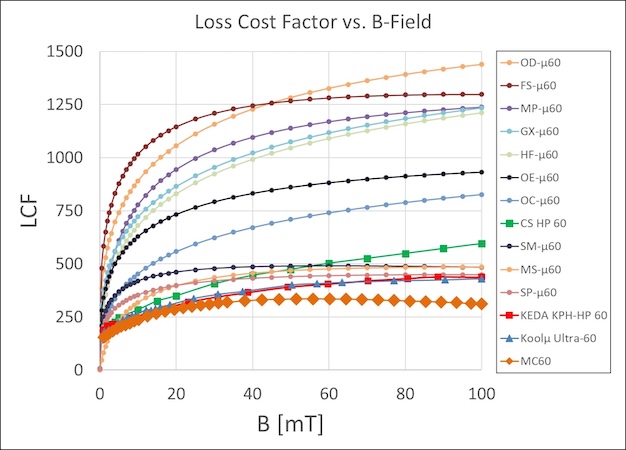
Figure 1. Loss Cost Factor vs. flux density for various powder cores and magnetic concrete with permeability µ=60. Image used courtesy of Magment and Bodo’s Power Systems [PDF]
Table 1 shows the values at B=100 mT and the ratio to the lowest LCF. Magnetic Concrete MC60 has by far the best performance of any other soft magnetic composite material in the marketplace.
Table 1.
|
VENDOR |
GRADE |
LCF@100 mT |
Ratio to lowest |
|
Micrometals |
OD-µ60 |
1438 |
4.36 |
|
Micrometals |
FS-µ60 |
1298 |
3.94 |
|
Micrometals |
MP-µ60 |
1238 |
3.75 |
|
Micrometals |
GX-µ60 |
1235 |
3.75 |
|
Micrometals |
HF-µ60 |
1211 |
3.67 |
|
Micrometals |
OE-µ60 |
932 |
2.83 |
|
Micrometals |
OC-µ60 |
827 |
2.51 |
|
Chang Song |
HP 60 |
607 |
1.84 |
|
Micrometals |
MS-µ60 |
485 |
1.47 |
|
Micrometals |
SM-µ60 |
484 |
1.47 |
|
Micrometals |
SP-µ60 |
449 |
1.36 |
|
KEDA |
KPH-HP 60 |
446 |
1.35 |
|
Magnetics |
Koolu Ultra-60 |
431 |
1.31 |
|
MAGMENT |
MC60 |
330 |
1.0 |
Applications of MC60
The introduction of the LCF provides a meaningful, application-relevant metric for comparing magnetic materials across manufacturers. Magment's material grade consistently demonstrated the lowest LCF across the full operating range, highlighting its superior performance, particularly for solid-state transformers, as well as for wireless charging.
This positions Magment's solution as the most efficient choice, offering tangible benefits in thermal management, energy savings, and system reliability. Figure 2 illustrates Magment’s MagPower utilizing MC60 for data center electrification. With the rise of AI and cloud computing, MagPower is ideally suited for the growing data center market, which is projected to require transformers to power an additional 110 GW by 2030” [8].
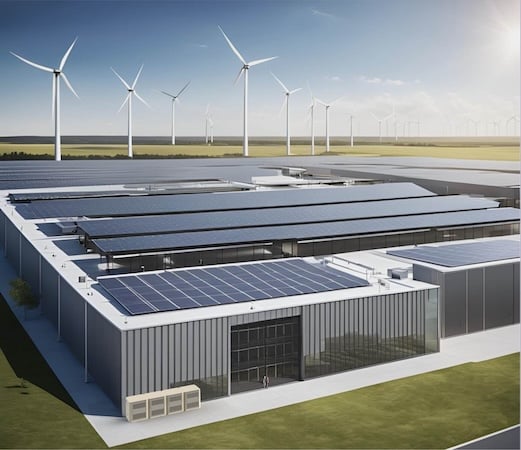
Figure 2. Data center powered by MagPower. MagPower is a solid-state transformer utilizing MC60. Image used courtesy of Magment and Bodo’s Power Systems [PDF]
Additionally, Figure 3 shows the four main application verticals served by MagPower.

Figure 3. Markets served by MagPower. Image used courtesy of Magment and Bodo’s Power Systems [PDF]
Conclusion
The introduction of the LCF by Magment marks a significant advancement in magnetic materials selection, effectively bridging the longstanding gap between technical performance metrics and economic feasibility. By synthesizing complex, multi-dimensional performance parameters into a straightforward, actionable metric, LCF simplifies the decision-making process, facilitating more informed and precise material selections.
Through comprehensive comparative analyses, Magment’s MC60 magnetic concrete consistently emerges as the optimal choice, exhibiting the lowest LCF across various operational conditions. This performance translates directly into tangible benefits, notably in critical applications such as solid-state transformers and wireless charging infrastructure. MC60 not only improves thermal management and enhances energy efficiency but also significantly bolsters overall system reliability, essential for the demanding requirements of contemporary and future electrical grid and mobility infrastructure.
At Magment, innovation is driven by the commitment to deliver solutions that not only meet but exceed current industry standards, paving the way toward a more sustainable and economically sound energy infrastructure. By leveraging magnetic concrete technology, Magment provides industries a strategic advantage, ensuring robust performance while addressing broader environmental and economic goals.
Looking forward, the adoption of metrics like the LCF will likely become increasingly prevalent, as the industry continues to seek clear, quantifiable approaches to evaluate emerging materials and technologies. In this evolving landscape, Magment remains at the forefront, dedicated to continuous innovation, superior product development, and contributing significantly to the global movement towards a more efficient, resilient, and sustainable electrical infrastructure.
References
[1] Ibrahim Ellithy, Mauricio Esguerra, and Rewanth Radhakrishnan, “Development of soft magnetic composites cast from ferrites and construction binders with lowest core loss”, AIP Advances 15, 035205 (2025), https://pubs.aip.org/aip/adv/ article/15/3/035205/3338414/Development-of-soft-magneticcomposites-cast-from
[2] J. Taurines, F. Martin, P. Rasilo, and A. Belahcen, “Thermodynamically consistent magnetic hysteresis model—application to soft and hard magnetic materials including minor loops”, IEEE Transactions on Magnetics 60, 1–9 (2024).
[3] Mauricio Esguerra, Stephan Ahne, Gerhard Ott, and Philipp Seng, “New Generation of Application-Tailored Soft Ferrites”, Proc. High Frequency Magnetic Materials Conference, (Santa Clara, 1999).
[4] Micrometals: “Curve Fit Formulas and Values“, https://www. micrometals.com/design-and-applications/design-tools/
[5] Magnetics: “Curve Fit Equation Tool“, https://designtools.maginc.com/
[6] Chang Song Corporation, https://www.changsung.com/
[7] KEDA, https://www.kdm-mag.com/products/details-toroidal-1557.html
[8] International Energy Agency. (2025). Energy and AI [Special report]. IEA. https://www.iea.org/reports/energy-and-ai
This article originally appeared in Bodo’s Power Systems [PDF] magazine and is co-authored by Mauricio Esguerra, CEO, and Ibrahim Ellithy, Materials Development Department, both Magment GmbH.