Facebook
 Google
 GitHub
 Linkedin
Examining GaN HEMTs as an Alternative to Silicon
This article examines high electron GaN mobility transistors as an alternative to SiC in power electronics.
This article is published by EEPower as part of an exclusive digital content partnership with Bodo’s Power Systems.
When it comes to energy efficiency and miniaturization, traditional silicon devices have their limits. GaN transistors, especially high electron mobility transistors, represent a revolutionary alternative, enabling new dimensions in power electronics thanks to their high performance and efficiency.

Image used courtesy of Bodo’s Power Systems [PDF]
The high electron mobility transistor (HEMT) is a relative newcomer in the world of mass-produced power-switching devices. Unlike its traditional doped silicon counterpart, HEMTs are heterojunction devices built using two semiconductor materials with distinct bandgap voltages. First demonstrated in the late 1990s and early 2000s, HEMTs use a unique band diagram that results in a conceptual gas of majority electron carriers within the undoped low bandgap material. The resulting structure enables operation at extremely high frequencies due to the lack of scattering dopant atoms. The exact characteristics of the HEMT are dependent on the constituent materials and can be tailored for higher frequency or higher power applications. For example, GaN HEMTs, shown in Figure 1, are particularly well-suited for voltage converter applications and other high-power switching topologies due to their extremely low on-state resistance.
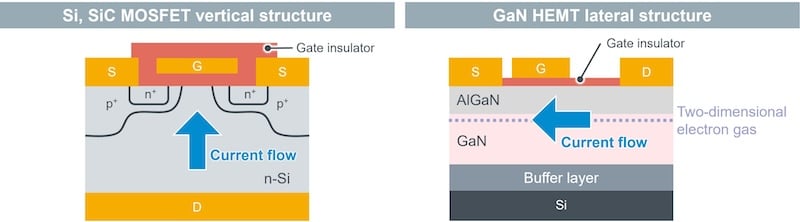
Figure 1. Doped silicon transistor cross section compared to GaN HEMT. Image used courtesy of Bodo’s Power Systems [PDF]
In extremely high-power applications, especially when frequencies are low, insulated gate bipolar transistors (IGBT) have commonly been used. More recently, Silicon Carbide (SiC) MOSFETs have gained traction in this high-power space, offering increasingly high-frequency switching up to the megahertz boundary. As shown in Figure 2, when even higher switching speed is required at moderate power levels below 1000 VA, high electron mobility transistors are the most efficient solution. Some common examples of this requirement include power supplies for data center servers, consumer AC adapters, automotive 48 V DC/DC converters, and LiDAR laser drivers.
One of the greatest challenges regarding the widespread adoption and mass production of GaN HEMTs over the last two decades has been the difficulties associated with gate driver design. The complex circuit requirements and the associated reliability issues demanded a solution before GaN HEMTs could gain traction in the market. Rohm solved these problems by offering a dedicated gate driver chip series to simplify circuit design and ensure the highest performance. With these developments, GaN HEMTs from Rohm established themselves on the market, and the stage was set for even higher voltage devices.
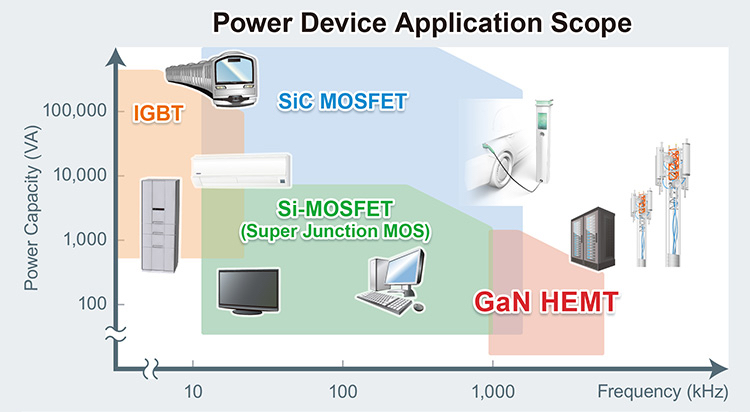
Figure 2. Power and frequency application space for IGBTs, SiC MOSFETs, and GaN HEMTs. Image used courtesy of Bodo’s Power Systems [PDF]
GaN HEMT Applications
The sweet spot of GaN HEMT operation is characterized by very high-frequency switching and moderately high power levels. This combination leads to a very specific set of application spaces that are growing more important and gaining a commensurate market share of the electronics industry. Three of the most common examples are motor power circuits, LiDAR pulsed laser drivers, and niche RF output stages.
Motor drives are typically built from a series of voltage converters. As shown in Figure 3, an AC source is first converted to a high-voltage DC and then converted back to a variable frequency or variable voltage set of AC waveforms to drive the motor itself. In an electric vehicle, the high-voltage DC bus could be used directly.
The final DC/AC output stage is an ideal application for GaN HEMTs, where the switching frequency might hover between 40 kHz and 100 kHz and the load currents can be substantial.
When compared to other technologies like silicon MOSFETs and IGBTs, GaN HEMTs are more efficient, more compact, and generally less expensive to implement.
Another GaN HEMT application gaining broad market visibility is the laser driver stage for LiDAR systems, particularly those used in autonomous driving applications. To create pulses of light for LiDAR, these lasers must be driven by a semiconductor switch. The quality of the switch directly affects the resolution of the LiDAR image and is typically characterized by turn-on time, peak current, and switching loss. Compared to traditional silicon devices, GaN HEMT switches exhibit extremely fast speeds and up to 65 percent lower power loss. This yields enhanced LiDAR performance in terms of image quality while simultaneously improving efficiency and thermal complexity.
The market for GaN devices in RF applications is mainly driven by radar applications, along with the development of shared electronics and antennas. Radar is commonly implemented using a high-power, wide-band traveling wave tube. GaN HEMTs are quickly replacing this unreliable, short operational life device by applying pulse RF signals. As with the previous examples, the GaN HEMT solution yields higher reliability, improved efficiency, and better high-frequency response.

Figure 3. Simplified block diagram of a typical motor drive. Image used courtesy of Bodo’s Power Systems [PDF]
Discrete High-Voltage GaN HEMTs
The ability to switch high voltages is critical for both size and efficiency. For the same power, higher voltage tolerance will yield lower current, in turn reducing on-state losses and minimizing physical device size. Overall, the higher voltage HEMT will have greater application across a wider variety of power supply topologies and offer competitive advantages in size and performance. To this end, Rohm has further developed its HEMT voltage capability to include discrete GaN devices up to 650 V and plans to roll out a broad portfolio over the next four to five years. These high-voltage transistors are trending toward lower on-state resistance and smaller, design-friendly DFN packages. They all feature a high drain-source voltage tolerance of 650V, extremely fast switching times, and zero reverse recovery time.
Rohm’s lineup of GaN devices also features integrated ESD gate protection in every package, making them incredibly robust while simplifying the gate driver circuit design and minimizing the component count.
HEMT Power Stage Devices
In addition to discrete GaN HEMTs, Rohm offers specialized power stage devices with integrated gate drivers. The power transistor, the driver circuit, supporting circuitry, ESD protection, and EMI management are integrated into a single package. This not only saves space but also improves efficiency and enhances environmental immunity, including thermal robustness (Figure 4).
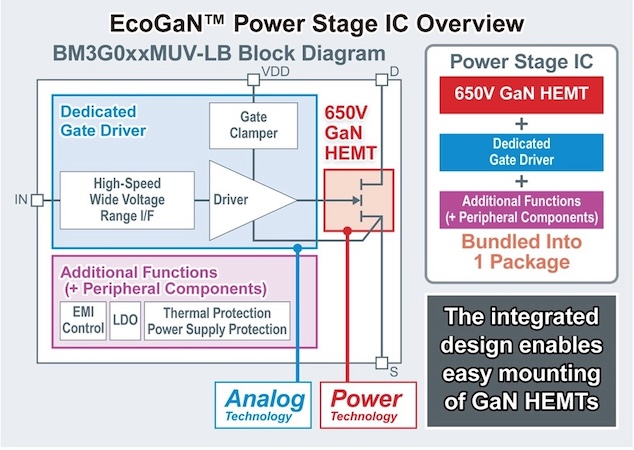
Figure 4. Power stage IC combining GaN HEMT and gate driver. Image used courtesy of Bodo’s Power Systems [PDF]
The BM3G015MUV-LB and BM3G007MUV-LB are the flagship power stage devices in the product portfolio and feature a wide input voltage range of 2.5V to 30V, an extremely low 15 ns propagation delay, adjustable slew rate, and low quiescent current. These devices are particularly well-suited for a variety of power supply switching topologies, including flyback, LLC, interleaved PFC, and totem-pole PFC. As shown in Figure 5, switching can be realized with a single external part, increasing voltage performance while minimizing physical volume. This also enhances thermal performance by enabling the designer to optimize the PCB with greater freedom, and gains of up to 20 percent in total output power have been measured in common power supply designs.
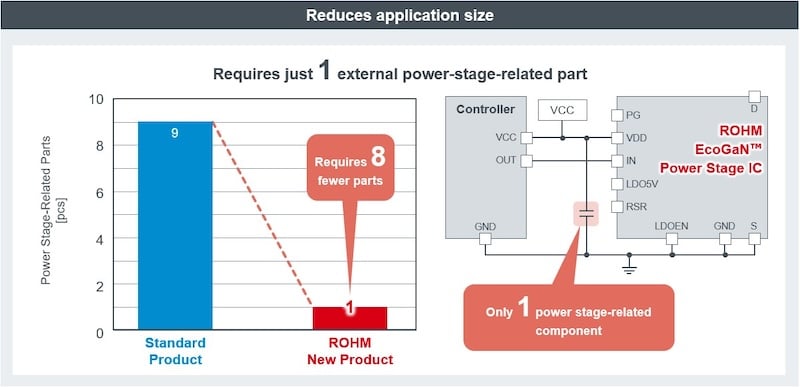
Figure 5. BOM advantage using power stage devices. Image used courtesy of Bodo’s Power Systems [PDF]
HEMT System in Package
Similar to the power stage devices, Rohm’s system-in-package (SiP) products integrate multiple parts of a complex system to reduce the part count, simplify design, and enhance functionality. SiPs are typically application-specific and contain parts selected and optimized for a particular design topology. For example, Rohm is developing several high-voltage GaN SiPs for flyback voltage converters (BM3GQ12A3MUV-LB and BM3GQ12A2MUV-LB) and PFC power supplies (BM3GF01MUV-LB and BM3GF02MUV-LB). These SiPs integrate the power GaN HEMT, the controller, gate driver, sensing resistors, supporting amplifiers, and LDOs, along with a variety of other controls and utility functions. Again, reducing the discrete part count enhances freedom to optimize the thermal performance of the PCB, which in turn boosts the overall system performance.
Takeaways
Recent advancements in Rohm’s EcoGaN transistors have yielded a broad portfolio of power HEMTs and an extensive roadmap for future development. From 650 V discrete transistors to complex power stages and SiP products, Rohm has provided a foundation for HEMT adoption across the gamut of high-frequency power applications. Their 650 V GaN HEMT has achieved the industry’s highest class Figure of Merit, offering unparalleled switching loss reduction compared to conventional GaN devices and increasing power supply efficiency.
Rohm has developed a vertically integrated manufacturing solution for its GaN devices, starting with the raw wafer creation and ending with the final product packaging to guarantee the highest levels of quality while ensuring a stable and predictable supply chain.
This article originally appeared in Bodo’s Power Systems [PDF] magazine.