Facebook
 Google
 GitHub
 Linkedin
Can Digital Twins Ease Offshore Wind Woes?
Cloud-based tools enhanced with artificial intelligence could reduce delays plaguing offshore wind farm construction.
Constructing offshore wind farms often experiences severe delays, costing wind developers financial losses.
One high-profile delay was SSE Renewables' Dogger Bank. This project was postponed for a year due to multiple factors, including supply chain problems, adverse weather conditions, and vessel shortages. Another example is Ørsted, which had to cancel two coastal New Jersey projects in 2023 due to vessel shortages. Japan’s first commercial-scale offshore wind farm was also delayed due to weather, and its first floating wind farm has been postponed due to defective components.
The Global Wind Energy Council has predicted supply chain problems will continue to delay wind projects worldwide. However, coupling cloud-based digital tools with advanced artificial intelligence (AI) algorithms could be the answer to ensuring the new infrastructure is built on time and doesn’t go over budget.
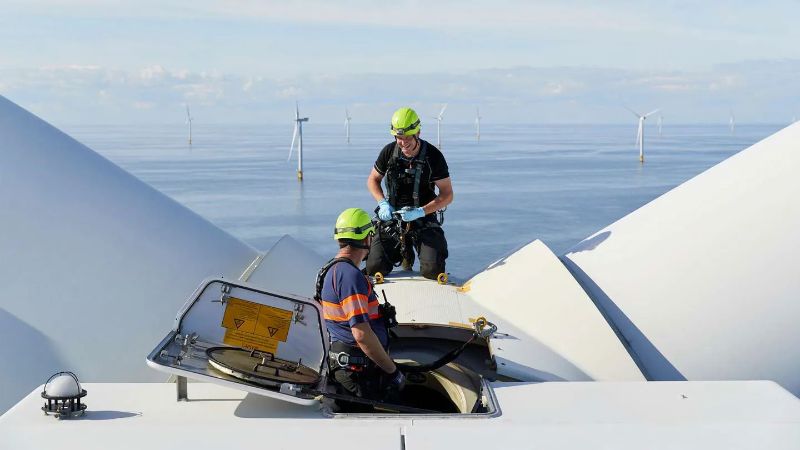
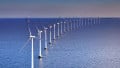
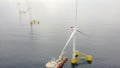
Offshore wind farm in Denmark. Image used courtesy of Ørsted
The Need for Cloud-Based Technology
Many construction operations rely on simple documents and spreadsheets to plan and strategize offshore projects. Moving a large amount of data around these spreadsheets requires manual work, making it difficult to see strategy change impacts throughout a project. In-house software systems are designed to use the data better but are often centralized around progress reporting and do not respond to delays.
Offshore wind technologies are more complex than ever. When coupled with skill shortages, infrastructure constraints, and supply chain problems, many layers of uncertainty and complexity manifest during each construction project.
Cloud-based simulation technologies can enable developers to quickly generate digital simulations of an ongoing construction project. These technologies allow developers to incorporate new parameters, data, and scenarios, such as vessels arriving late or bad weather, within minutes rather than weeks. This creates a more streamlined design process that can adapt to ever-changing circumstances throughout a project. Cloud-based technologies allow for the integration of any delays into the simulation, enabling different schedules and construction progress to be continuously updated.
Combining Digital Simulation Tools with AI
Digital tools can be combined with AI to provide advanced simulations and data analysis capabilities. These enhanced tools improve the construction process by removing redundant and suboptimal workflows, reducing errors (typically made by human analysis), reducing costs, maximizing online hours, reducing downtime, eliminating inefficient information silos, and providing complete visibility over the entire operation.
The digital twin is one example of a cloud-based AI tool. Digital twins accurately simulate the physical offshore wind farm and keep the construction progress updated (within the virtual environment) in real time when it is fed new data about delays, new objectives, or any factors in the design. By inputting new data instantaneously, designs can be altered immediately to give engineers and construction personnel more control of project progress. Each phase’s anticipated completion date can be easily communicated to those involved, including suppliers, developers, construction workers, partners, and stakeholders.
Video used courtesy of Hightopo
Digital twins are most impactful when paired with AI algorithms, such as machine and deep learning algorithms, that can handle the data analysis side and behave as the “reasoning” behind the simulation. Much data goes into offshore wind construction design, and these algorithms combine all this data to produce feasible outcomes. AI-enabled digital twins also have use post-construction because once a facility is up and running, they can provide ongoing predictive maintenance operations.
Using cloud-based tools and AI provides a much higher degree of security over data compared to using spreadsheets. The data within a project is often sensitive, and if passed between multiple spreadsheets and documents, it can usually become lost. A cloud-based platform enables each user or company to input their data to protect sensitivity and prevent it from being lost. Having a central platform to hold the data makes communicating outcomes easier than manual methods.
AI algorithms combined with cloud-based digital tools, such as digital twins, give developers much more control and transparency throughout the project. This reduces risk, keeps projects on track, provides smoother project delivery, and allows suppliers and contractors to react quickly to construction delays. Streamlining these factors and processes helps to save time and money on any complex offshore wind farm construction project.
Digital Tools Buffer Delays
Offshore wind farm construction faces various delays and challenges, but remote digital tools enable everyone to communicate effectively by allowing real-time data to be inputted, analyzed, and simulated. These factors help to keep the construction project on track, reduce the potential impact of delays by reacting fast (including knock-on effects), and reduce the financial implications associated with unscheduled delays.