Facebook
 Google
 GitHub
 Linkedin
Using Solar Energy, Researchers Grow Copper Nano Flowers for Clean Fuel
The method produces clean chemicals and fuels made from carbon dioxide, water, and glycerol without any additional carbon emissions.
Researchers at the University of Cambridge and the University of California, Berkeley, have recently developed a photoelectrochemical (PEC) system that efficiently converts carbon dioxide (CO2) into C2 hydrocarbons using solar energy.
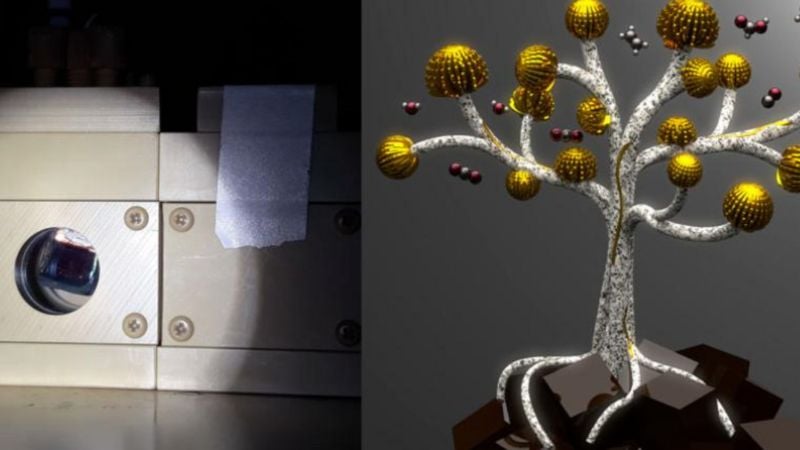
The device uses a light-absorbing perovskite "leaf" and a copper "nanoflower" catalyst to turn carbon dioxide into useful molecules for energy production.
Ethylene, the world’s most widely produced organic chemical, requires fossil-derived feedstocks such as natural gas and naphtha, for industrial production. The PEC technology presents a sustainable alternative by using sunlight to drive CO2 reduction directly, eliminating the need for energy-intensive hydrogen production.
Copper ‘Flowers’ Bloom, Making Clean Fuel
The Cambridge researchers leveraged perovskite-based PEC devices to directly synthesize C2 hydrocarbon from CO2. The team faced the challenge of achieving high Faradaic efficiency and sufficient photovoltage to drive hydrocarbon formation while overcoming the high overpotentials associated with CO2 reduction.
To this end, the team employed a lead halide perovskite photo absorber coupled with a copper nanoflower (CuNF) electrocatalyst to enhance selectivity toward ethane and ethylene. The fabricated perovskite photocathodes achieve a 9.8% Faradaic yield for C2 hydrocarbon production at 0 V versus the reversible hydrogen electrode (RHE). The research also identified a strong dependence of hydrocarbon selectivity on the catalyst's geometric surface area, indicating that local current density governed product distribution.
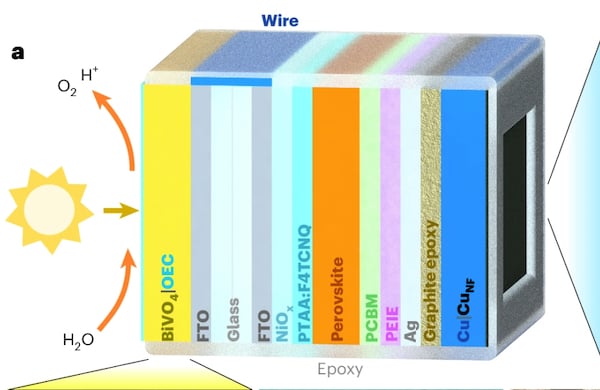
The architecture of the tandem PEC device. Image used courtesy of Nature
The team replaced the oxygen evolution reaction (OER) with the glycerol oxidation reaction (GOR) to reduce the photovoltage requirement by 1 V and enable more efficient CO2 conversion. By then integrating perovskite photocathodes with silicon nanowire photoanodes, the PEC devices achieved a partial C2 hydrocarbon photocurrent density of 155 µA cm-2, yielding a 200-fold improvement over conventional perovskite–BiVO4 artificial leaf systems.
By electrochemically reducing the CuO “nanoflowers,” the team could synthesize the CuNF catalyst. This process produced a hierarchical porous structure that increased local pH and suppressed competing hydrogen evolution. CO2 reduction experiments in a 0.1 M KHCO3 solution showed ethylene and ethane formation at a threshold of −0.5 V versus RHE, with optimal selectivity occurring at −0.9 V versus RHE. The perovskite-based system delivered a high open-circuit voltage (1.08 V ± 0.03 V).
What Is Photoelectrochemical CO₂ Reduction?
PEC CO2 reduction is a method for converting carbon dioxide into valuable hydrocarbons using sunlight as the primary energy source. This process integrates light absorption, charge separation, and catalysis within a single device—a sustainable pathway to replace fossil-derived chemicals.
C2 hydrocarbons like ethylene and ethane serve as feedstocks for plastics and fuels, yet their industrial production currently relies on fossil resources. By using PEC technology to drive CO2 reduction, these hydrocarbons can be synthesized directly from atmospheric or industrial CO2, thereby creating a closed-loop carbon cycle.
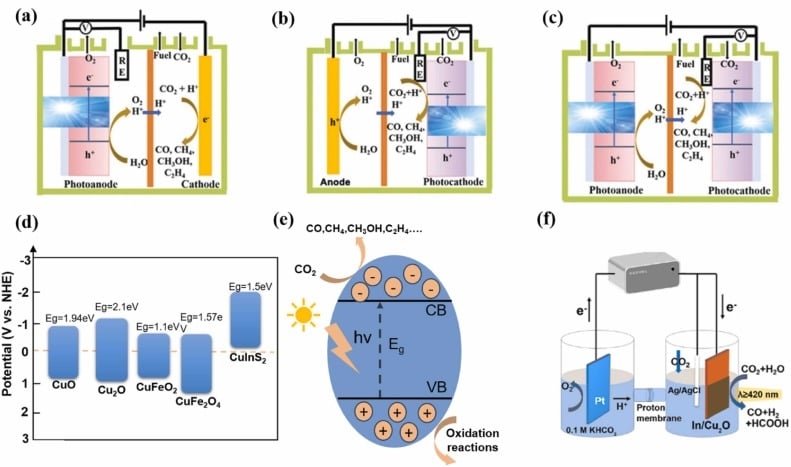
PEC CO2 reduction system. Image used courtesy of Science Direct
Despite its potential, PEC CO2 reduction faces several technical barriers. According to the Cambridge researchers, efficient hydrocarbon formation requires high photovoltages. Yet most semiconductors, including Si, BiVO4, and III–V compounds, generate less than 0.7 V, which is insufficient to drive C2 product formation without external biasing.
Additionally, CO2 reduction competes with the hydrogen evolution reaction (HER) and, therefore, reduces overall selectivity. Copper-based catalysts remain the only known materials that can enable C–C coupling for C2+ synthesis—and they suffer from high overpotentials (0.5–0.8 V) and instability.
An Alternative for Sustainable Fuels
While scaling up PEC CO2 reduction systems remains a challenge for the researchers, their perovskite-based photocathodes and copper nanoflower catalysts suggest a pathway toward more viable solar-driven hydrocarbon synthesis. In future developments, the team will focus on enhancing stability and selectivity while increasing overall conversion rates.
If researchers can further optimize PEC architectures and integrate them into existing chemical production infrastructure, this technology may influence a more sustainable carbon economy.