Facebook
 Google
 GitHub
 Linkedin
Supercapacitors vs. Batteries for Cold-Weather Engine Starts
Cold climates present engine-starting challenges. Here’s how batteries compare to supercapacitors for cold-weather engine starts.
A reliable engine start system is crucial for any vehicle in cold environments. However, cold climates present challenges for today’s battery systems, and even gold-standard batteries can cause an engine to stall. Trying to continuously start the engine when it is stalling and the battery has become defective causes more charge to be depleted. Although jump-starting a car can solve the immediate problem, it is an unsustainable long-term approach.
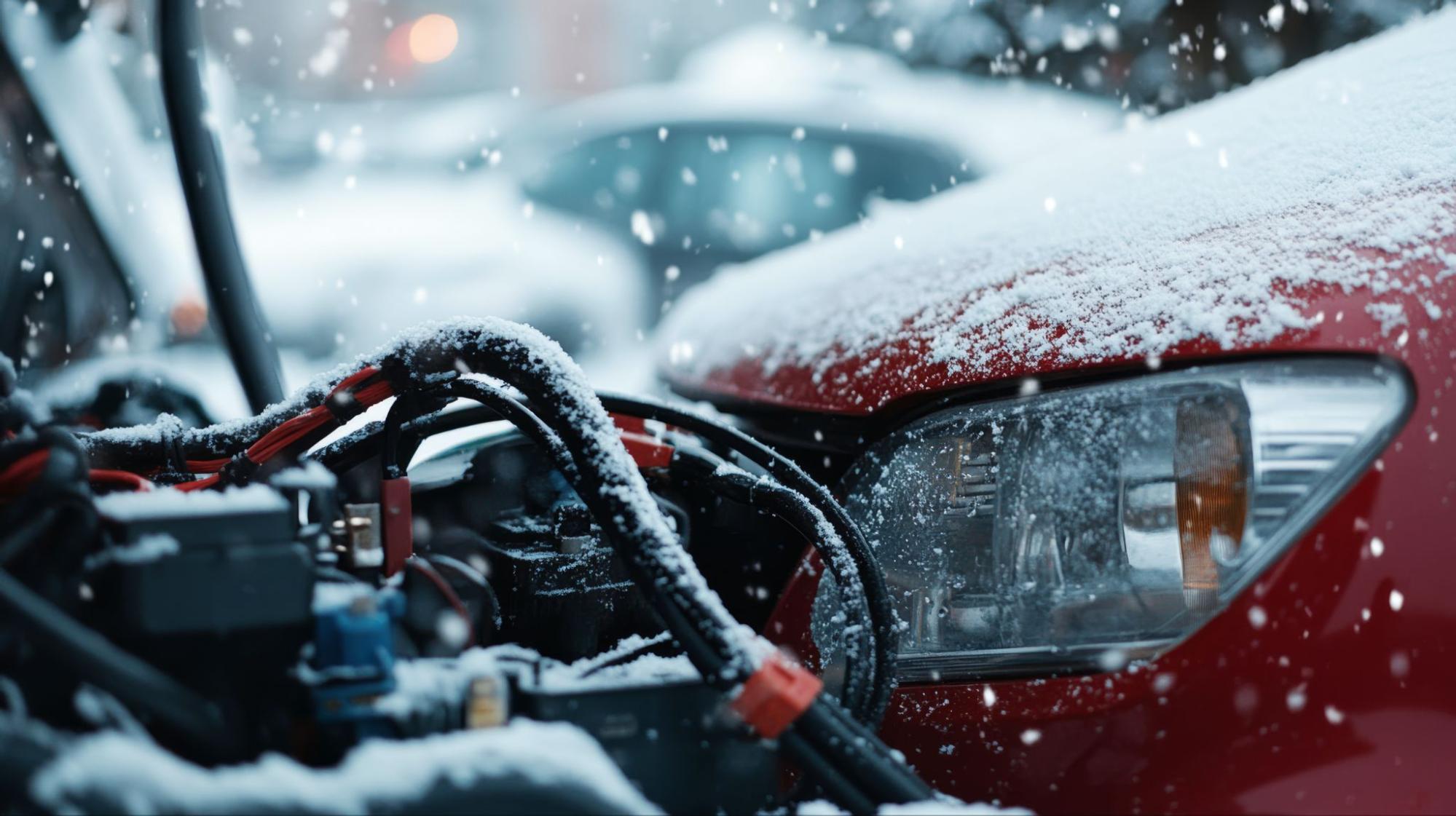
Jump starting a car in cold weather isn’t ideal. Image used courtesy of Adobe Stock
Batteries have been used ubiquitously in engines because their energy density is much higher than other energy storage systems. However, supercapacitors can be paired to build arrays that can rapidly discharge to start engines much more efficiently than batteries can—particularly in extreme conditions—and can be charged in less than a minute more than a million times over.
Batteries for Cold-Weather Engine Starts
Lead-acid and Li-ion batteries are the most common energy storage devices for starting cars and commercial vehicles, especially diesel engines. Batteries store and release energy via electrochemical reactions using an anode, a cathode, and an electrolyte that facilitates ion movement between the two electrodes. A difference in potential allows current to flow within the battery, which powers any connected electronic system. Batteries are governed by a Faradaic process, meaning the charge transfer between the electrodes and the electrolyte at the electrode-electrolyte interface is proportional to the current.
Batteries are poor performers in cold weather
Despite their widespread use, batteries have inherent issues for vehicle engines, especially those trying to start in cold weather. Because batteries have a limited operating temperature range, their performance suffers outside that range. The battery degrades internally, potentially causing leaks.
This is true for high and low temperatures, with most commercial batteries offering an operating temperature range of only -20 °C to +40 °C. At low temperatures, Li-ion batteries have a slower chemical-reaction activity and charge-transfer velocity, which causes a low ionic conductivity and diffusion coefficient for the Li-ions traveling between the electrodes. This leads to a low startup current, which affects the battery’s ability to start in cold temperatures. For lead-acid batteries, low temperatures can freeze the electrolytes. This prevents any electrochemical reaction from occurring, which stops a current from being generated.
Batteries are limited by charge cycles
Over time, the charge and discharge process in batteries leads to an irreversible breakdown of the electrode material. Cyclic stresses on the battery cause the electrode material to crack, decomposing the salt and solvent components of the electrolyte. This degradation stops any reversible electrochemical from taking place.
In Li-ion batteries, a permeable passivation layer, known as the solid-electrolyte interphase (SEI), prevents electrolyte decomposition and extends battery life. However, SEI consumes lithium and electrolyte materials, reducing capacity and power density. When SEI breaks down, it causes the battery to overheat and fail.
These technical challenges mean batteries can only undergo a relatively small number of cycles, limiting their usable lifespan. For example, lead acid batteries can last up to 3000 cycles with a typical lifespan of only 0.5 to 5 years. Li-ion batteries have a slightly better cycle life: as many as 10,000 cycles and a usable lifetime of three to ten years, depending on the battery’s operating conditions. However, both fall far below what is possible with supercapacitor technology.
How Supercapacitors Solve Technical Engine Startup Challenges
Because they have a much wider operating temperature range than batteries, supercapacitors overcome the technical challenges of batteries. Supercapacitors can store a lot of charge and discharge it rapidly and readily to start an engine in almost all environments. When the engine is started, supercapacitors provide instantaneous high-density power and low-end torque for failsafe engine starting, regardless of the local weather conditions, although extreme cold may require starting aids and engine warmers for the anti-freeze and engine oil.
Supercapacitors have a much longer cycle life (up to millions), an overall efficiency of about 98% (compared with 90% for Li-ion batteries), and are more efficient under full load conditions. Unlike batteries, which tend to have a few useful years of life, supercapacitors can last for 10 to 20 years, depending on the charge voltage and operating temperature. They are much lighter than batteries, making them a better long-term solution for vehicle engines.
Eaton’s XLR-LV Supercapacitor Module
Unlike batteries, supercapacitors store energy as a static charge rather than an electrochemical reaction. Supercapacitors have an electric double-layer capacitor (EDLC) architecture, in which two electrode plates are insulated from each other using a separator. Supercapacitors use an electrolyte solution, which is critical for forming the double layer of the supercapacitor because the electrodes attract oppositely charged ions from the electrolyte to the surface of the electrode.
The double layer of the EDLC is formed by creating a separation of charges between the plates due to oppositely polarized ions adsorbing at the electrode surface, separated by Helmholtz layers—a few Angstroms’ thickness layers at the surface of the electrode that balance the surface layer charges on the electrode. Charge is stored in the supercapacitor by applying a voltage differential across the positive and negative plates.
XLR-LV supercapacitor modules are compact, lighter, and more reliable energy storage devices that deliver a high starting power with a very low equivalent series resistance (ESR). The cycle life of Eaton’s supercapacitors—up to 20 years— is much higher than batteries due to a minimal electron transfer across the electrode interface that removes hard failure modes. This results in few chemical and phase changes where supercapacitors will not have a determined failure point; there will just be deviations from the optimal parameters that signal that they have reached the end of their useful life.
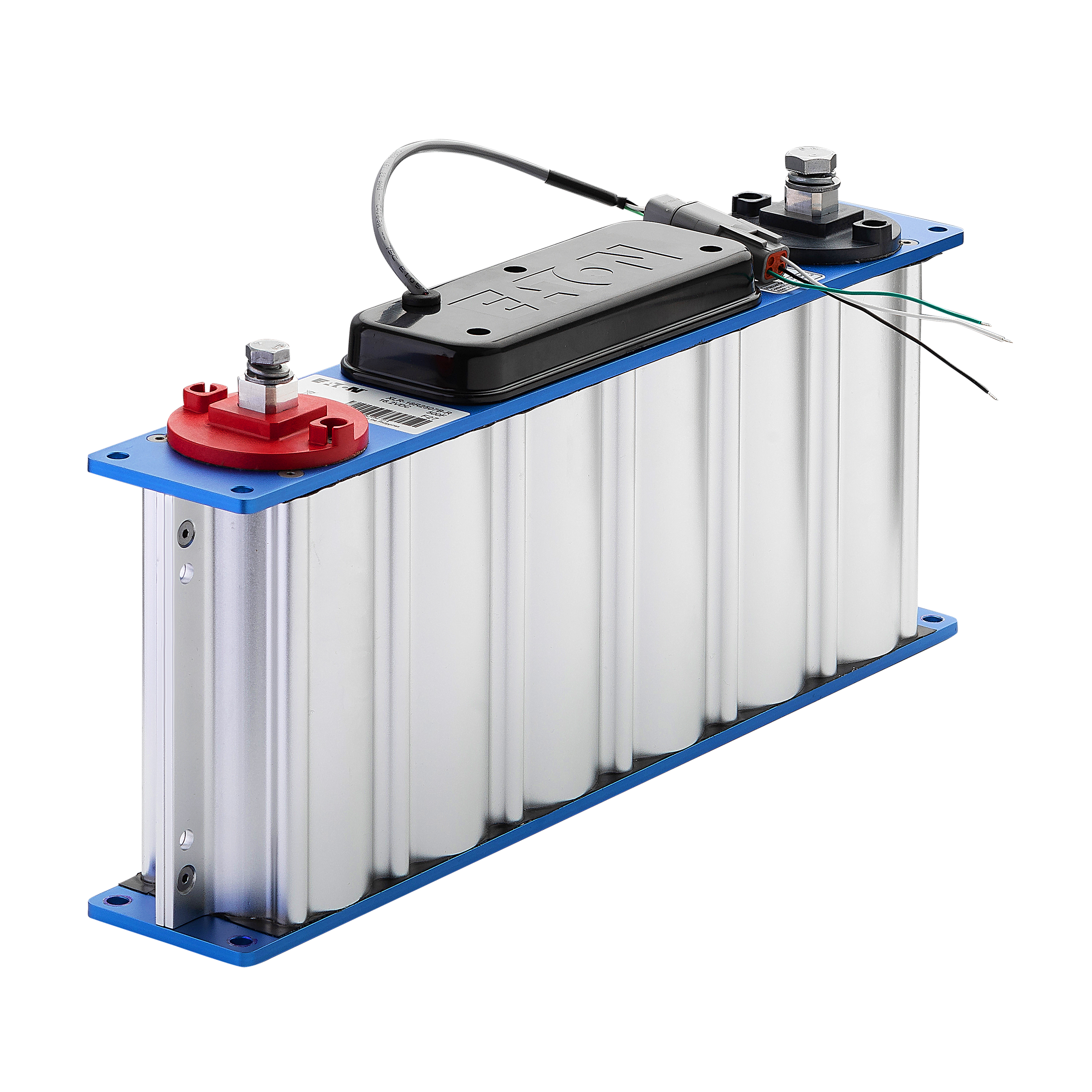
Eaton's XLR-LV supercapacitor provides advantages to engine-staring applications, suitable for a wide range of temperatures. Image used courtesy of Eaton
The module itself is composed of six individual XL60 supercapacitor cells, which have an ultra-low resistance. As a complete module, the XLR-LV provides 500 F of capacitance and can be arranged for 12 V and 24 V starters. During the ignition, the XLR-LV provides instant high-density power that starts the engine without fail in the coldest conditions.
Besides longevity, the XLR-LV supercapacitor has key benefits compared to conventional battery technologies for engine-starting applications, including:
- Maximum voltage of 18 V and peak power of 47.6 kW
- Industry-leading ESR
- High peak power cycling capability
- Charging times of only a minute
- Operating temperature of -40 °C (suitable for cold starting) up to +65 °C (suitable for starting hot engines)
- Over 98% efficiency
- Rugged design to withstand high vibrations, moisture, and dust
- Eco-friendly materials
- Practically maintenance-free
XLR-LV modules are constructed by combining multiple supercapacitor cells. This improves the energy and power output of the module. In the module, the cells are connected in series and parallel configurations, and combining multiple cells in different configurations provides higher voltages and better energy storage capabilities.
While each individual supercapacitor cell has a voltage of only 2 V to 3 V, if multiple cells are connected in series, the working voltage is increased to as high as 1,500 V of direct current (VDC). The cells can also be arranged in parallel to meet current or power needs, and series and parallel configurations often can be utilized together. Building supercapacitor arrays in this way means they can replace batteries in vehicle engines as a much lighter and more efficient alternative.
For example, in a 10-15 L diesel engine, a 12 V starter would need the module to be in parallel, whereas a 24 V starter would require two modules to also be connected in series. In a gas engine, a 12 V starter would require only one module. The ability to use one or two capacitor modules to start an engine also brings significant weight savings. For a 15 L diesel engine, using two 16 V modules in parallel would only weigh 5.7 kg, whereas the battery equivalent could be 10 times greater. Aside from the weight, batteries add a lot more bulk than supercapacitors, a factor that can limit manufacturers trying to create compact systems.
Batteries vs. Supercapacitors
Many factors influence the choice of an energy storage device for different applications, and the properties of different battery architectures vary from supercapacitors. Let’s look at how supercapacitors compare to batteries in key parameters.
Table 1. How batteries differ from supercapacitors
| XLR-LV | Li-ion battery | Lead-acid battery | |
| Operating temperature (°C) | -40 to 65 | -20 to 45 | -20 to 40 |
| % degradation over T | 5% to 10% | 40% to 60% | 25% to 50% |
| # of charge/discharge cycles | >1,000,000 | 10,000 | 3000 |
| Expected lifespan (years) | 5 to 20 | 3 to 10 | 0.5 to 5 |
| Weight (kg) | 5.7 | 13 | 25 to 40 |
| Efficiency (%) | >98 | 80-90 | 70 |
| Power density (W/L) | 1000-10000 | 850-3000 | 100-1000 |
| Discharge time | 1 second | 1 hour | 10 hours |
Supercapacitor Advantages Beyond Cold Starting
Although cold starting, and more reliable starting, are important for different engine types, switching to supercapacitors has other benefits. Supercapacitors are nearly maintenance-free and last the vehicle's life, resulting in much less downtime. Combining these factors provides a lower total cost of ownership (TCO) than Li-ion and lead-acid batteries. Lead-acid batteries are also a theft risk. But, because supercapacitors are embedded into the engine, they cannot be easily removed.
Eaton XLR-LV supercapacitors can be used to start a range of cold engines with higher reliability than batteries in vehicles such as commercial trucks, vans, buses, and passenger vehicles. Beyond conventional engines, the XLR-LV is also an excellent starting module for marine vehicles, locomotives, and natural gas generators, so it is a versatile starting device for many types of engines.