
 Facebook
 Google
 GitHub
 Linkedin
Cities Can Become Giant Batteries for Grid Stability
Electric vehicles and hot water systems could provide city-scale energy storage and demand flexibility equivalent to several gigawatt-hours, according to Australian researchers.
Cities have long been viewed as insatiable consumers of energy, their dense infrastructure drawing power from grids designed for centralized generation. However, Australian National University (ANU) researchers argue that cities could play a radically different role in the clean energy transition: they could store power like a giant, distributed battery.
The idea rests on a simple observation. Electric vehicles and hot water systems, both central to future all-electric cities, are not just energy consumers but also energy reservoirs. EVs spend roughly 90% of their time parked, and their high-capacity batteries sit unused for most of the day. Electric hot water systems, meanwhile, act as thermal batteries, storing heat that can be strategically shifted to match grid conditions.
In a city like Canberra, where electrification of transport and household systems is already accelerating, these devices could collectively provide 46 kWh of storage per resident, according to ANU’s modeling. This is the energy equivalent of three or four Tesla Powerwalls in every home. More importantly, about 5 kWh of electricity per person could be shifted from peak demand periods to off-peak hours each day, significantly easing strain on the grid.

Can a city become a gigantic storage battery? Adapted from image used courtesy of Unsplash
How an Electrified City Behaves Like a Battery
The ANU study in Renewable Energy combines high-resolution travel data, hourly electricity demand profiles, and geospatial mapping to understand how urban energy use could be managed. The analysis shows that EVs provide the bulk of storage (around 43 kWh per capita), with hot water tanks contributing an additional 2.6 kWh. If properly coordinated, these systems could mimic the behavior of large-scale stationary batteries.
The study also emphasizes that without management, widespread electrification could create new challenges. If EVs and water heaters draw power during existing peak times, peak demand in Canberra could surge by over 30%, forcing costly grid upgrades. However, shifting just half of this flexible load to off-peak periods could halve the increase in peak demand.
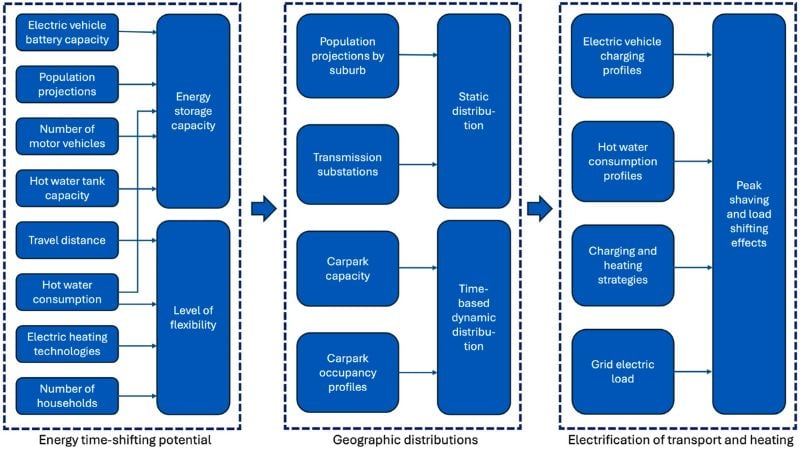
A schematic overview of ANU’s modelling framework. The dashed-line boxes outline the key components of modeling inputs and outputs. Image used courtesy of Renewable Energy
The technical modeling points to timing and coordination as the defining factors. Charging EVs in the middle of the day, when solar generation is strongest, could turn a potential liability into a benefit. Hot water systems can operate in a similar fashion, pre-heating water during low-demand or high-renewable periods. In aggregate, these flexible loads could reduce evening spikes in consumption, stabilizing the grid and avoiding the need for additional generation capacity.
Storage Hotspots and Smart Infrastructure
The team’s GIS-based analysis highlights the importance of geography and time of day. During working hours, EV batteries migrate from residential suburbs to commercial and employment hubs, creating what the researchers call “storage hotspots.” In Canberra’s central business district, for example, EV storage capacity jumps from less than 3% of the city's total to over 20% during business hours.
These hotspots represent opportunities for smart workplace charging, where bidirectional vehicle-to-grid (V2G) chargers could enable EV fleets to act as a balancing resource. Aggregated through virtual power plant platforms, thousands of parked cars could collectively feed energy back into the grid when demand peaks or provide load balancing services when renewable output fluctuates.
Hot water systems, while less mobile, add valuable short-term flexibility. Their ability to store heat for hours means they can soak up excess solar power at midday and release it as needed in the evening. The study modeled thermal storage losses and found that they range between 10% and 40%, compared to 15 to 20% for EV battery storage. These losses can be mitigated with modern tank insulation and smart controls.
_from_electric_vehicle_batteries_(blue)_and_hot_water_storage_(orange)_at_SA2_and_SA3_levels.jpg)
Geographic distribution of the storage capacity (MWh) from electric vehicle batteries (blue) and hot water storage (orange) at SA2 and SA3 levels. Image used courtesy of Renewable Energy
A New Energy Paradigm?
The concept of cities as distributed batteries is not just a thought experiment; it is increasingly aligned with global energy trends. Rooftop solar, bidirectional chargers, and digital energy management platforms already enable small-scale examples of this approach. By extending these technologies across entire metropolitan areas, urban centers could become self-balancing ecosystems, capable of absorbing surplus renewable energy and supplying it during shortfall periods.
The ANU modeling suggests that this approach’s first visible benefits could come from workplace charging strategies and dynamic pricing incentives, which encourage consumers to shift flexible loads. Over time, as more EVs adopt V2G technology, these flexible urban assets could rival the capacity of large utility-scale batteries.
As cities continue to electrify, the question is no longer whether they can act as giant batteries but how quickly utilities and policymakers can adapt to make this vision a reality.








This sounds like a great idea until those packs catch fire which they have in many cities there was several of in Central California that burned for quite a while causing people to evacuate. Batteries aren’t going to fix everything they may help some things but you still need energy to charge them and when they do catch fire they’re almost impossible to put out