Facebook
 Google
 GitHub
 Linkedin
Solvent-Free Process Boosts Efficiency of Perovskite Solar Cells
A crystal orientation trick using lead chloride closes the long-standing stability gap between solvent-free and solution-processed perovskite cells.
Researchers have figured out how to make high-performance perovskite solar cells without using any liquid chemicals, and the key was a surprisingly small tweak to the manufacturing process.
The crystal engineering process delivers a certified 18.35% efficiency and stability that matches the best solution-processed cells, while keeping the whole fabrication process compatible with industrial vacuum deposition equipment.
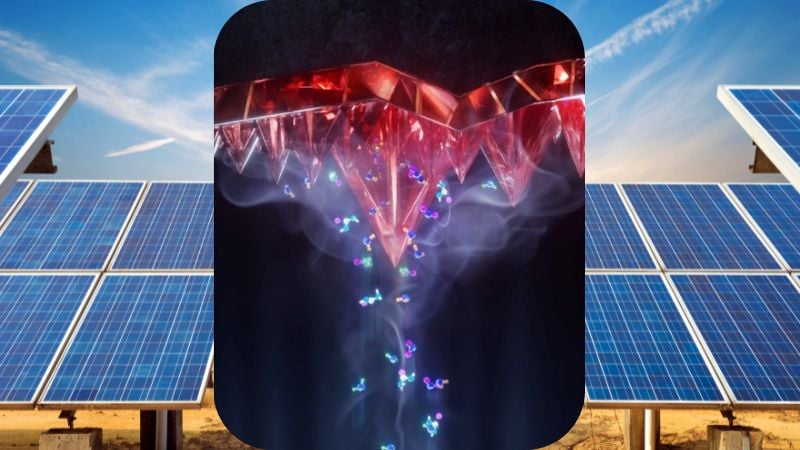
Illustration of perovskite crystal structure on standard silicon wafer. Image used courtesy of Hong Kong University of Science and Technology
Crystal Facet Engineering
The problem with vacuum-deposited perovskite cells has always been crystal quality. When perovskite precursors are evaporated onto a substrate, the resulting film tends to form tiny, randomly oriented grains with poor phase purity. Unfortunately, that translates directly into lower efficiency and faster degradation.
Researchers from the University of Oxford and the Hong Kong University of Science and Technology found that swapping out 5% of the lead iodide source for lead chloride (PbCl2) changes all of that.
With lead chloride in the mix, the perovskite crystals grow in a strongly preferred "face-up" (100) orientation, with their planes aligned parallel to the substrate. X-ray diffraction measurements confirmed the shift, with the (100) peak narrowing by roughly twofold compared with every other process variant tested, and the photo-unstable lead iodide phase that appeared in all the reference films was completely absent.
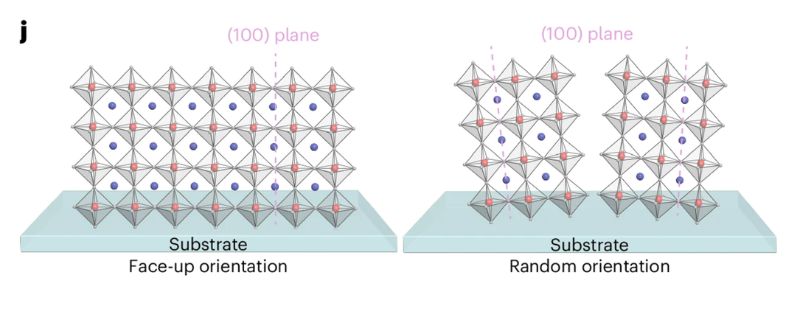
Face-up vs. random orientation. Image used courtesy of Shen et al.
Scanning electron microscopy showed larger, flatter grains spanning the full film thickness, representing a stark contrast to the misoriented polycrystalline mess that co-evaporated perovskites are known for.
Annealing at 135°C in ambient air for 30 minutes was also critical to locking in the structure. In situ X-ray scattering tracked the process in real time and showed the (100) peak intensity quadrupling as the film reached temperature. Films annealed for less than ten minutes developed pinholes and discoloration within a couple of hours of air exposure. The composition is also tunable, with the researchers noting that varying the lead chloride fraction shifts the bandgap continuously between 1.65 and 1.72 eV.
Impressive Stability Numbers
Under the ISOS-L-2 protocol—full-spectrum simulated sunlight at 75°C, open-circuit—champion 0.25 cm² evaporated cells held 80% of peak efficiency for 1,080 hours. On 1 cm² cells, it was 900 hours. Solution-processed cells made with the same composition but without stabilizing additives hit the same threshold in under 80 hours. Under optical microscopy, the evaporated films showed no visible degradation until 196 hours, whereas solution-processed films exhibited pinholes within 48 hours and were fully discolored by 96 hours.
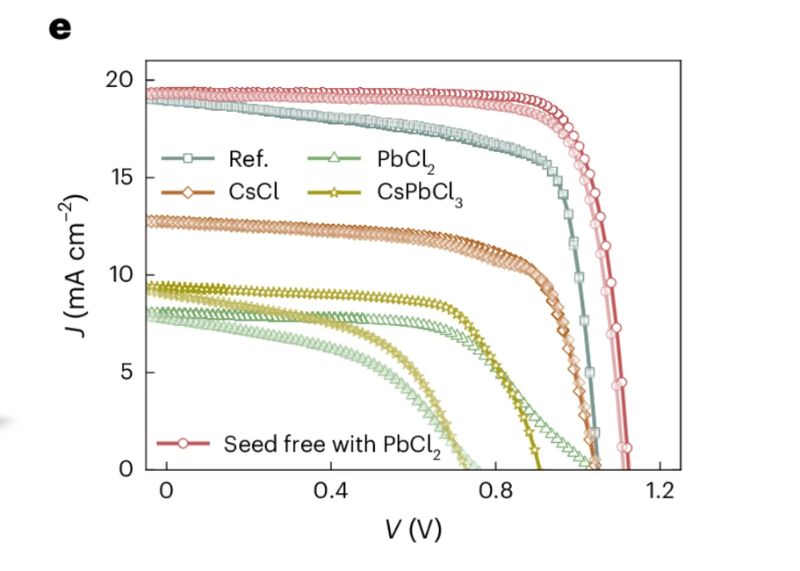
Efficiency comparison. Image used courtesy of Shen et al.
To understand why, the team used operando hyperspectral imaging to watch the cells aging in real time. Solution-processed films develop a network of micrometer-scale surface wrinkles caused by local halide heterogeneity, and under combined light and heat stress, those wrinkle regions seed degradation that spreads across the film.
Co-evaporated films had no wrinkle topography at all, and their photoluminescence stayed spatially uniform throughout aging. The team's charge-extraction analysis pointed to one root cause: the evaporated cells sustain high carrier-extraction efficiency over time, whereas the solution-processed cells don't.
Tandem Performance
The team also built perovskite-on-silicon tandem cells using an evaporated wide-bandgap layer, hitting 27.2% efficiency on 1 cm² devices with a solution-processed hole-transport layer and 24.3% with a fully all-vacuum stack.
To test real-world durability, they shipped laminated all-vacuum tandems to Eurac Research in Bolzano, Italy, for outdoor tests at maximum power points from August 2024 through March 2025. After eight months, they retained around 80% of initial performance, tracking closely with a reference commercial silicon heterojunction cell through the peak summer months.
One curious finding from the outdoor data was that the tandem's sensitivity to irradiance grew over time, requiring progressively longer daily light soaking to reach full output. The team attributes this to a gradual shift in operating behavior and flags it for follow-up. On the shelf-life side, unencapsulated evaporated cells stored in nitrogen in the dark held their ~18% peak efficiency past 20,000 hours—more than two years—suggesting the material is inherently robust when not under stress.
The work was published in Nature Materials.