Facebook
 Google
 GitHub
 Linkedin
Solar Efficiency: Perovskite, With a Side of Salt
Researchers at the National Renewable Energy Laboratory say salt could be the solution to creating better perovskite solar cells.
In the past decade, perovskite has proven to improve solar cell efficiency by as much as 30% when used in tandem with silicon or other substrates. While perovskite is highly conductive, it has been plagued by durability and stability issues. Scientists have experimented with several methods of increasing perovskite performance and scalability, with varying success.
At the National Renewable Energy Laboratory, researchers discovered that using an ionic salt improved the electron transport layer of the perovskite layer by up to three times. The breakthrough could lead to more stable, longer-lasting solar panels.
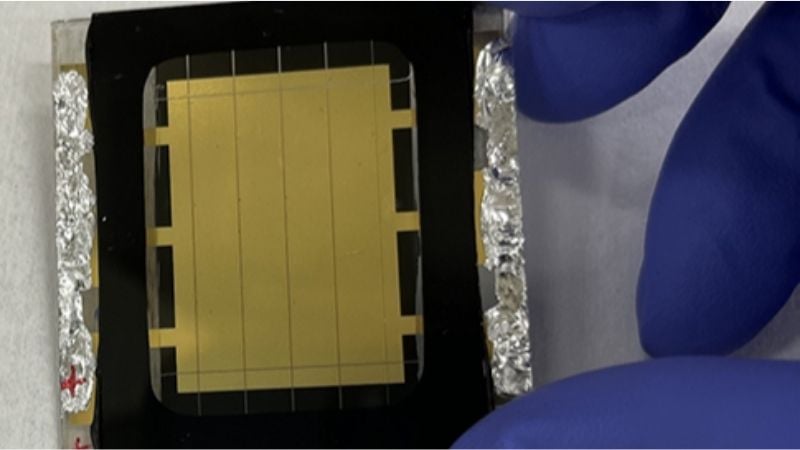
Perovskite solar cell. Image used courtesy of NREL
Perovskite Pros and Cons
Perovskite solar cells are a type of photovoltaic technology using perovskite-structured compounds—typically hybrid organic-inorganic metal halides—as the light-absorbing active layer. Producing these materials takes a low-cost, simple manufacturing technique, such as printing or coating. The perovskite cells can be made into thin, lightweight, and flexible solar panels.
Perovskite refers to both a specific mineral and a broader family of materials that share a distinctive crystal structure. The mineral perovskite is calcium titanium oxide, with the chemical formula CaTiO₃, first discovered in the Ural Mountains of Russia in 1839 and named after the Russian mineralogist Lev Perovski. The term "perovskite" is used to describe any material with the same type of crystal structure as the mineral perovskite, typically represented by the general formula ABX₃, where "A" is a larger cation at the center of the lattice, "B" is a smaller cation at the corners, and "X" is an anion (often oxygen or a halide) at the face centers.
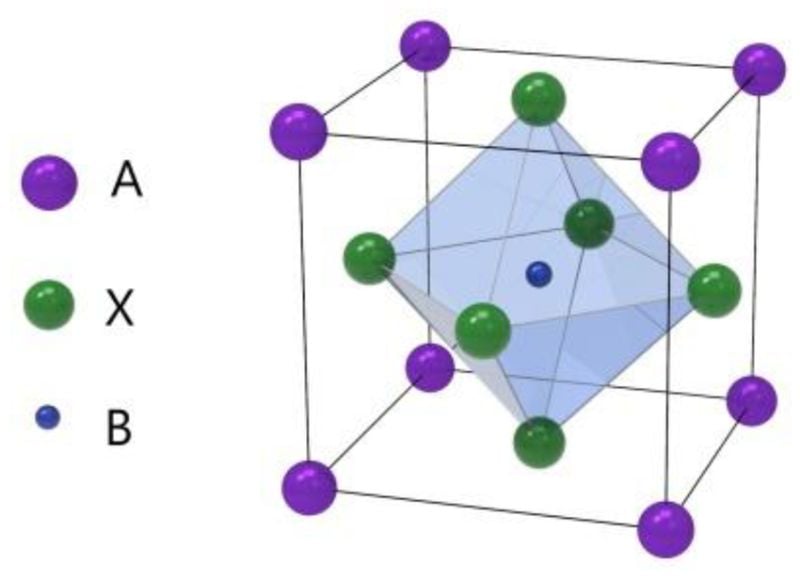
Perovskite crystal structure. Image used courtesy of Liu et al.
This structure is highly adaptable, allowing for many different combinations of elements, which gives rise to a wide range of physical properties and technological applications. Perovskites are notable for their roles in next-generation solar cells, superconductors, and other advanced materials due to their unique electronic, magnetic, and optical properties.
The first perovskite solar cell (3.8 percent efficiency) using methylammonium lead iodide in dye-sensitized architecture was developed in 2004, and by 2012, a shift to solid-state architectures (e.g., spiro-OMeTAD hole transport layer) boosted efficiencies to ~10 percent.
However, perovskite tends to degrade quickly under sunlight and in humidity, leading to a rapid decline in efficiency. Scaling perovskite technology from the lab to manufacturing has also proved difficult due to high costs and the risk of introducing imperfections.
How Salt Improves Solar Cell Efficiency
The National Renewable Energy Laboratory (NREL) has been studying perovskite to improve the motion of electrons triggered by sunlight through the cell to generate electricity. An electron transport layer within the cell is commonly made from fullerene C60. However, the molecular nature of this material has a weak interface that limits the solar cell’s performance.
Fullerene C60, also known as buckminsterfullerene, is a molecule composed of 60 carbon atoms arranged in a highly symmetrical, spherical structure resembling a soccer ball. Its structure consists of 12 pentagons and 20 hexagons, with each carbon atom bonded to three others, forming a closed cage. C60 is a semiconductor with a small energy gap between its highest occupied and lowest unoccupied molecular orbitals, but it can become a conductor or even a superconductor when doped with alkali metals. Unfortunately, its weak mechanical adhesion and long-term stability issues under field conditions have prompted a search for an alternative material.
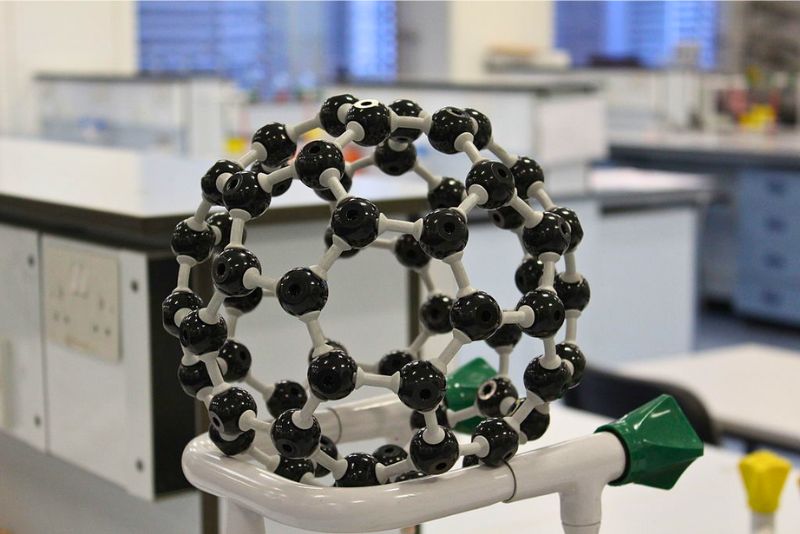
Model of C60, also called buckminsterfullerene. Image used courtesy of Wikimedia Commons
In the journal Science, NREL researchers reported that altering the usual fullerene layer by reactions with acids and chemical compounds formed a layer of an ionic salt that resulted in a boost in performance, durability, and efficiency in perovskite solar cells. The researchers found a three-fold increase in mechanical strength of the electron transport layer, an increase of efficiency from 25.5% for the C60 version to 26.1% for the ionic salt, and less than 9% efficiency degradation after 2,200 hours at 55 degrees Celsius.
The discovery could lead to more widespread commercialization of perovskite solar technology.
Between 2014 and 2018, NREL initiated projects to understand perovskite solar cells and device physics, develop tandem cells, and address stability. In 2016, NREL-developed techniques improved PSC performance, achieving certified efficiencies reaching 22.7 percent in 2017. By 2022, an NREL-led team achieved 24 percent certified efficiency with enhanced stability (87 percent retention after 2,400 hours at 55°C).
Taking Perovskite Solar Cells To Market
Widespread mass-market commercialization of perovskite solar cells is still constrained by challenges related to long-term durability, stability, and manufacturing scale. Most commercial activity is currently focused on demonstration projects, pilot production lines, and niche applications such as building-integrated photovoltaics, portable power, and indoor energy harvesting. With the efficiencies of perovskite solar cells now rivaling silicon, and with NREL’s success in using ionic salt to improve the performance and durability of the ionic transport layer, perovskites have become a promising technology for the future of renewable energy.