Facebook
 Google
 GitHub
 Linkedin
Simulation Model Predicts Sodium-Ion Battery Health and Longevity
The model is the first to be compatible with non-lithium batteries.
Lithium-ion batteries’ dominance in the battery market may be coming to an end. A global increase in energy demands, heightened concerns about the environmental impact, and supply chain issues associated with lithium have spurred research into alternative battery technologies.
Why are predictive battery analytics important? Video used courtesy of TWAICE
Among these alternatives, sodium-ion batteries have emerged as a promising contender thanks to abundant raw materials, improved safety, and better performance in certain conditions. As the industry explores these options, advanced analytics and simulation tools are needed to understand and optimize emerging battery technologies’ performance.
Battery software platform TWAICE has released a simulation model to assess aging in sodium-ion batteries. The model could assist engineers and researchers in using and improving the batteries.
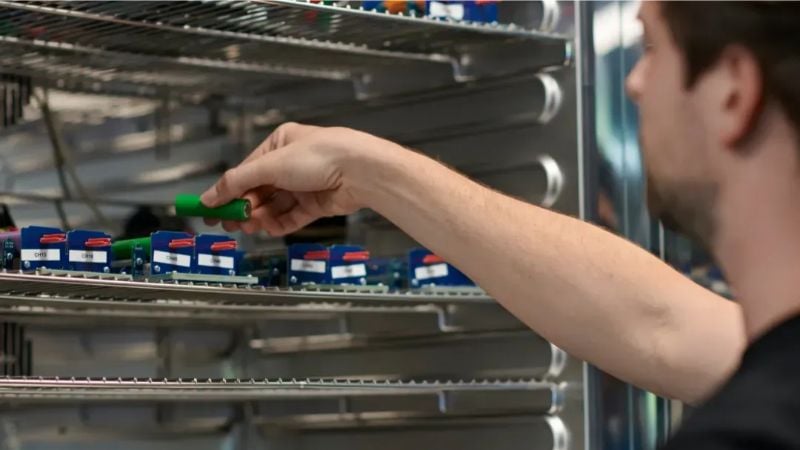
Battery testing. Image used courtesy of TWAICE
Examining Sodium Ions for Batteries
The growing interest in sodium-ion technology stems from several factors, including the abundance and low cost of sodium resources, its minimal environmental impact, and its improved safety characteristics.
Unlike lithium, sodium is extremely abundant on earth (for example, it can be extracted from seawater), potentially alleviating supply chain concerns associated with lithium mining. Since sodium-ion diffusion requires lower activation energy than lithium-ion diffusion, it performs better at low temperatures.
Sodium ions are bulkier in density than lithium, leading to lower voltage and reduced gravimetric and volumetric energy density. Currently, sodium-ion batteries offer a gravimetric energy density of 90-150 Wh/kg, potentially exceeding 200 Wh/kg and surpassing the theoretical limit of lithium-ion-phosphate (LFP) batteries. In power density, sodium-ion batteries could reach 1 kW/kg, outperforming nickel-manganese-cobalt at 340-420 W/kg and LFP at 175-425 W/kg.
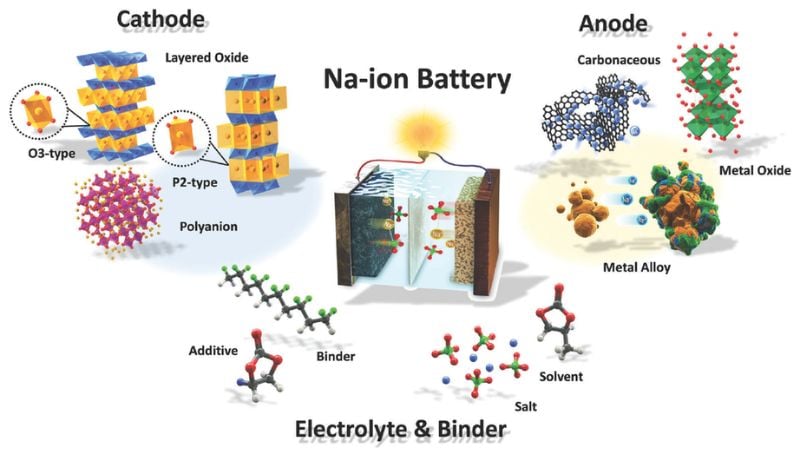
Sodium-ion battery composition. Image used courtesy of Wikimedia Commons
Despite sodium-ion batteries’ potential, understanding the long-term behavior and aging characteristics remains a significant challenge. Compared to well-established lithium-ion batteries, the technology is relatively new, and comprehensive data on their performance over extended periods and under various operating conditions is lacking. This knowledge gap poses difficulties for battery operators and researchers in predicting lifespan, optimizing charging strategies, and developing effective battery management systems.
Aging Simulation Model
To mitigate these challenges, TWAICE has developed a novel aging model for sodium-ion batteries.
According to TWAICE, designing a battery simulation model involves accounting for electrochemical kinetics, thermal behavior, charge/discharge profiles, diffusion rates, and the properties of electrode materials and electrolytes. TWAICE’s solution, the first simulation model compatible with non-lithium batteries, is based on measurements from their battery research center. Functionally, it uses this data to extrapolate lithium-ion intercalation principles to simulate sodium-ion batteries' aging behavior effectively.
TWAICE’s model also accounts for sodium-ion batteries' current energy density range and projects future improvements. The company's simulation software allows researchers and engineers to conduct in-depth analyses of sodium-ion battery properties, aging behavior, and performance comparisons with lithium-ion counterparts.
Bridging Present and Future
As the energy storage landscape evolves, TWAICE’s simulation model for sodium-ion batteries is timely and topical. Moving forward, the ability to accurately predict and optimize battery performance will be necessary in advancing sustainable energy solutions, and TWAICE’s solution does just that. So, as industries continue to strive toward meeting global energy demands with more environmentally conscious solutions, tools like TWAICE’s model will be of the utmost relevance and importance to engineers.