Facebook
 Google
 GitHub
 Linkedin
Researchers Create First Working Quantum Battery Prototype
The proof-of-concept battery can charge faster as it gets bigger and complete a full charge-storage-discharge cycle.
Researchers at CSIRO in Australia have created the first working prototype of a quantum battery. The battery uses quantum effects to charge more rapidly than conventional batteries, and the larger it gets, the faster it charges.
While the prototype retains the charge for longer than previously researched versions, it can still hold only a fraction of a second’s charge. Still, the prototype demonstrates that quantum batteries are possible—they will just take years to become usable.
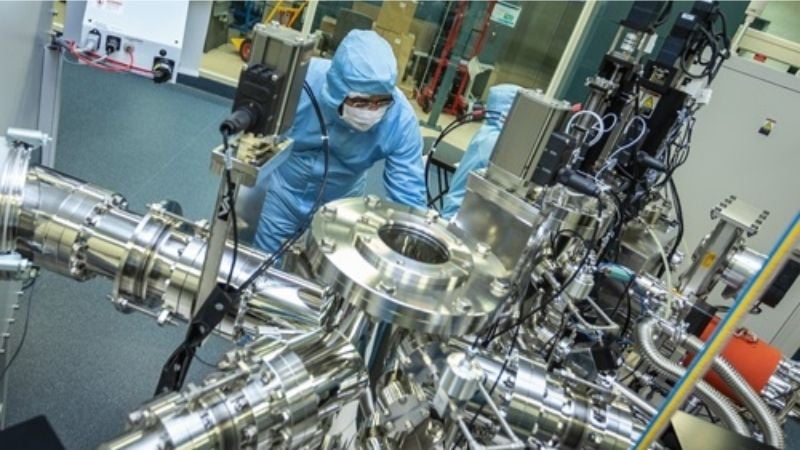
Inside CSIRO’s quantum battery lab. Image used courtesy of CSIRO
What Is a Quantum Battery?
Quantum batteries are a next-generation energy storage technology that uses quantum mechanics rather than classical chemistry to charge rapidly. Quantum batteries still store and discharge energy, but they charge using light instead of electrons. These batteries possess super-absorption properties for the photons, and their absorption excites atoms in the battery to higher energy levels.
Quantum batteries also use quantum entanglement principles to trigger collective effects that increase the coupling between the battery and energy source. This leads to faster charging, especially as the batteries scale up in size.
Many experiments have tested various aspects of quantum batteries and examined their isolated properties, but CSIRO’s development is the first time a fully functional battery has been developed and tested.
The Quantum Battery Prototype
Researchers first built a quantum battery prototype in 2022. That battery used an organic microcavity composed of a multi-layered sandwich of materials specially engineered to trap light. This research was the first to directly show that quantum batteries can charge efficiently and that they take less time to charge as they get larger.
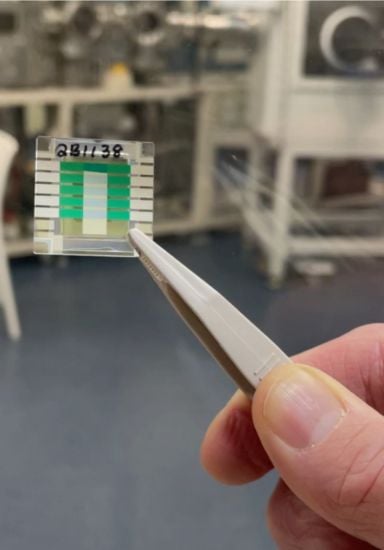
The quantum battery prototype. Image used courtesy of CSIRO
More specifically, it showed that quantum batteries have a charging time relationship denoted by the relationship:
$$\text{Charging time} \propto \frac{1}{\sqrt{N}}$$
where N is the number of molecules in the battery.
The more molecules that are added to the battery, the faster the battery charges.
However, while this first battery prototype could be charged, the researchers couldn’t release the stored charge.
The 2022 researchers had added additional charge-transport layers to the device's resonant microcavity. These charge transport layers converted the stored energy into an electrical current. Using the same theories, formula, and basic design, the scientists at CSIRO created a fully functional battery prototype that could both charge and discharge.
The device could charge by either coherent or incoherent light, but there is a caveat. The prototype’s stored charge lasted only nanoseconds. In other words, it can only store nanoseconds' worth of charge and discharge energy for a few nanoseconds. Nevertheless, it is the first instance of a quantum battery undergoing a full charge-and-discharge cycle and represents a pivotal moment that scientists can build upon in future iterations.
The Bigger Battery, the Faster It Charges
The battery’s charging principle is that the bigger it gets, the faster it charges. The microcavity has superabsorbing light capabilities because the layers are tuned to the first excited singlet transition of the absorber molecules in the cavity (copper phthalocyanine). This induces strong light-matter coupling, creating “superextensivity” in the battery, enabling the individual battery units to behave as a single coherent system rather than as separate units.
In superextensivity, the system's response scales linearly with its size due to the collective quantum effects. As the batteries are stacked together, they undergo quantum entanglement, linking them into a collective unit.
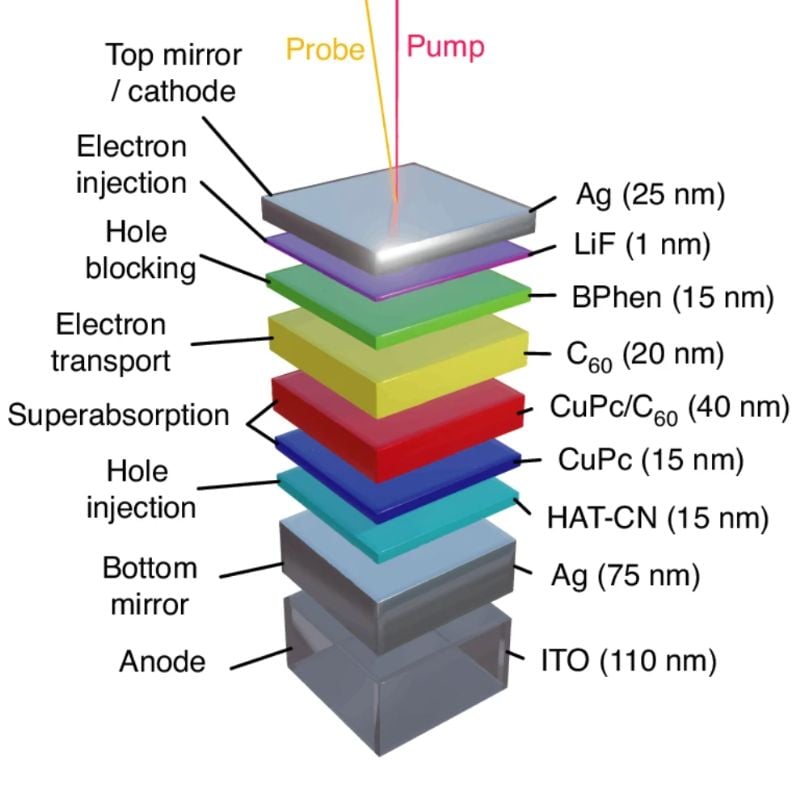
The quantum battery’s layers. Image used courtesy of Hymas et al.
So, in the future, if multiple batteries were stacked together, the charging time could be miniscule, and the more that are added, the quicker the charging could be. This is a practical scenario based on the \(\frac{1}{\sqrt{N}}\) theory that has now been proven experimentally. While it might seem implausible, it’s based on fundamental physics, and now just requires batteries with much larger charging and discharging capabilities.
In this study, published in Light: Science & Applications, the researchers tested the batteries’ superextensivity using ultrafast spectroscopy and found that the charging rate scales with the number of absorber molecules. The proven analysis showed that the copper phthalocyanine transferred the incoming energy into a metastable triplet state, retaining it for six orders of magnitude longer than the charging laser pulse. The spectroscopy results also showed that the charge transport layers prevented recombination by inducing an energy gradient that favored separation and transport over recombination.
Still Early Stages Yet
While the research shows significant progress as the first real working prototype, we are still a long way from a usable system. Nanosecond-scale energy discharge might be suitable for some quantum computing applications, but it will take many years before these rapid charging capabilities can occur in everyday systems.
The research does show that quantum batteries are possible, and it’s no longer a theoretical technology. The researchers plan to scale up quantum batteries as a standalone technology, but they are also considering hybrid systems that will utilize the ultra-fast charging speed of these quantum batteries alongside longer storage times of classical batteries.