Facebook
 Google
 GitHub
 Linkedin
Super Hybrid Battery Promises Ultra-Fast Charging, Extended Range
CATL’s Freevoy Super Hybrid Battery offers a 400 km electric range and 4C superfast charging.
Hybrid electric vehicles (HEV) are a popular choice for drivers who want eco-friendly options without fully committing to electric. However, in the electric-only range, hybrid batteries face slow charging rates and reduced efficiency in extreme temperatures.
CATL has introduced the Freevoy Super Hybrid Battery, a solution promising over 400 kilometers of electric range and ultra-fast 4C charging for hybrid vehicles. CATL’s breakthrough could help address the need for improvement in HEV battery technology.
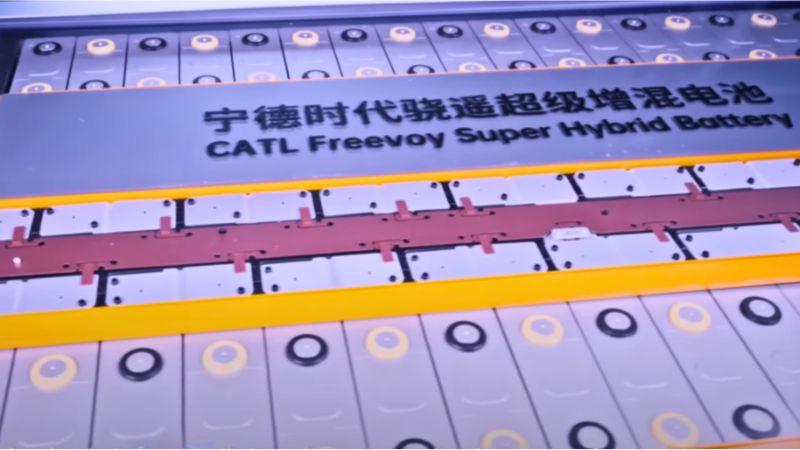
Freevoy battery for hybrid vehicles. Image used courtesy of CATL
HEV Background
Hybrid electric vehicles merge an internal combustion engine with electric motors for a single propulsion system. In standard HEVs, dedicated onboard batteries power the electric motors when driving in electric motor mode and recharge through regenerative braking and the engine. Grid charging isn’t necessary.
In plug-in HEVs (PHEV), the onboard batteries are larger and can be recharged by plugging into an external power source, such as a public charging station. This allows PHEVs to operate in electric-only mode for extended distances before relying on the internal combustion engine.
In either case, the battery greatly influences a hybrid vehicle’s range, power delivery, and operations in all-electric mode. Unfortunately, hybrid batteries face significant challenges that limit their capabilities.
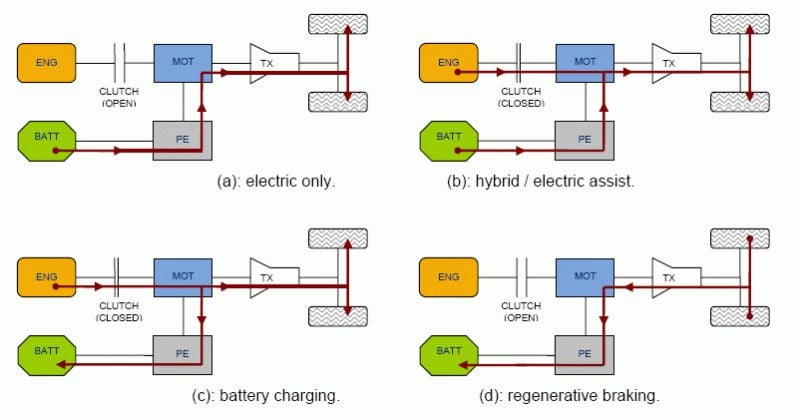
HEV function modes. Image used courtesy of Wikimedia Commons
Since HEV and PHEV batteries have limited electric-only range, they often fall short of driver expectations. The batteries struggle to balance capacity, power, and longevity, limiting mileage in electric mode. Their slow charging rate diminishes their convenience compared to fully electric vehicles and traditional vehicles’ fast refueling times.
Other issues occur when extreme temperatures impact battery efficiency, particularly in colder climates where the chemical reactions within lithium-ion batteries slow down. This leads to reduced range and slower charging speeds. In systems already strapped for range, cold weather impacts are significant in HEVs.
CATL’s Freevoy Super Hybrid Battery
CATL’s Freevoy Super Hybrid Battery for hybrid vehicles achieves a pure electric range exceeding 400 kilometers alongside 4C ultra-fast charging capabilities.
Designed specifically for PHEVs, the Freevoy battery integrates several architectural advancements to address hybrid battery limitations. One major innovation is a surface-modified cathode with a high-voltage electrolyte that creates a nano-protective layer to reduce internal side reactions and enhance lithium-ion transport. This design also incorporates high-activity particles in the cathode to optimize ion movement and power efficiency.
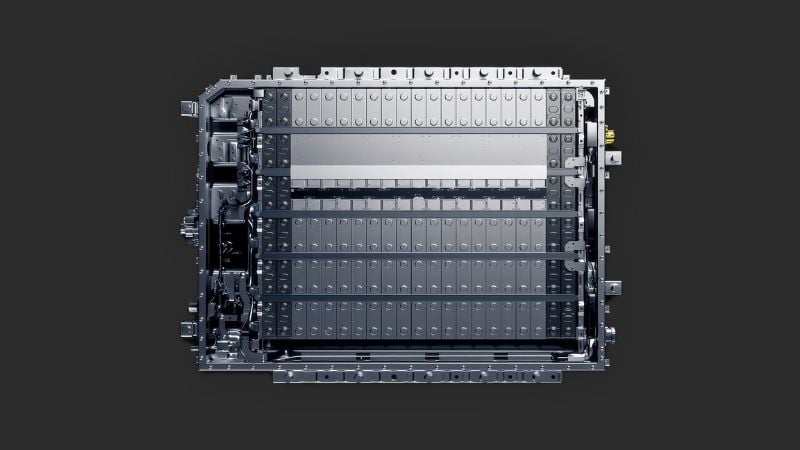
Freevoy HEV battery. Image used courtesy of CATL
The Freevoy’s SOC system utilizes an advanced, high-precision model and upgraded BMS algorithms. These advancements boost SOC control accuracy by 40% and electric utilization by 10%, which contributes to achieving the battery’s 400-kilometer range. For fast charging, CATL employs an ultra-conductive electrolyte formulation and a multi-layer electrode design featuring a second-generation fast-charging graphite and specialized nano-coating for the anode. This setup allows the Freevoy to deliver 280 kilometers of range on a 10-minute charge.
Moreover, Freevoy’s architecture includes sodium-ion battery technology that maintains discharge capability in conditions as cold as -40°C, supports charging down to -30°C, and achieves stable driving performance at -20°C.
Future of Hybrid Battery Technology
By achieving extended range and fast-charging capabilities, the Freevoy battery presents a path forward for historically restrained hybrid vehicles. As the market for eco-friendly vehicles expands, CATL’s Freevoy solution could bridge the gap between internal-combustion vehicles and EVs, ultimately supporting the transition to a fully electric future.