Facebook
 Google
 GitHub
 Linkedin
New Consortium Aims to Reduce Impediments to Expanded Transmission Capacity
As high-voltage transmission line demand explodes in the U.S, a new consortium gearing up to tackle the key legal and regulatory changes needed to expand capacity.
Since about 2007, US electricity consumption has been almost flat. However, consumption has begun to grow again (Figure 1). Contributors to this observed and anticipated growth include a combination of things such as the growth of data centers and AI, charging EVs, wide adoption of heat pumps, decarbonizing heavy industry, production of electrofuels, etc.
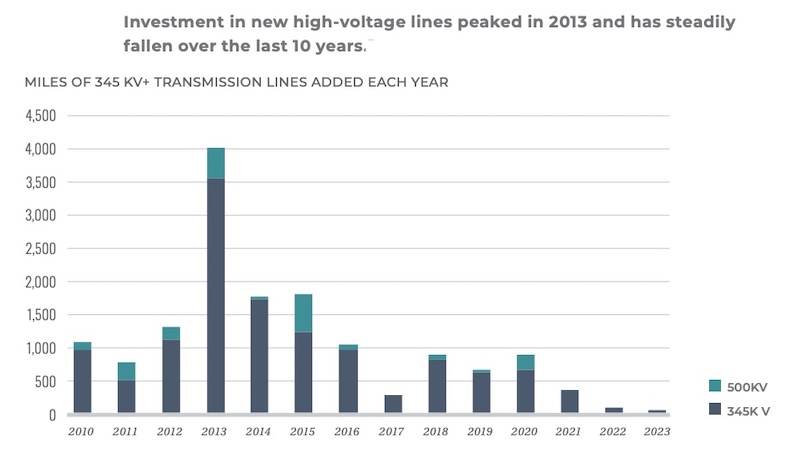
Figure 1. This plot (2024) clearly demonstrates that, despite a growing need, the U.S. is not managing to build very many new transmission lines. Image used courtesy of ACEG.
To decarbonize the energy system, while assuring that electric power remains resilient, a growing group of experts inside and outside of government have concluded that the US must do something that will be difficult: break the logjam that makes it difficult, often impossible, to build new lines to move power from locations where it is produced such as remote solar, hydro, wind, and other new generators, to the locations where it is needed.
Much More U.S. High-Voltage Transmission Capacity Needed
Distributed generation, end-use efficiency, and locating new loads next to generation can help—for example, as Microsoft is doing in restarting the undamaged reactor at Three Mile Island. However, the US Department of Energy has argued that if the economy is going to stay strong, and the nation is going to make serious progress in reducing CO2 emissions, by 2050 the US will need to more than double our regional and inter-regional high-voltage transmission capacity.
At the same time, it has become difficult, sometimes even impossible to build new transmission, and the incentives that power companies are receiving from State public utility commissions (PUCs) often encourage local upgrades over expanding regional and interregional transmission capacity.
ExTx Consortium Sees New Challenges to Address
FERC and others have been working hard to address this problem. However, given the constraints under which they operate, almost everything they are doing has been incremental. While those efforts should help, their impact thus far has been marginal. To solve the underlying problems, the founders of the Expanded Transmission Capacity Consortium (ExTx) have come to believe that much more fundamental legal and regulatory changes will be needed.
While a solid technical and economic underpinning will be essential, ExTx sees the key challenges as:
- Assessing legal, regulatory, institutional, and political obstacles to expanding transmission capacity along with those arising from interest groups. Note: A significant body of formal and gray literature addresses some of these issues. We are reviewing and will build on this prior work.
- Examining the sources of public resistance to new transmission and improving public understanding of the need for expanded transmission capacity.
Once they’ve done that, ExTx will then propose and actively promote needed fundamental changes to legal structures, regulatory processes, public communications protocols, and policy.
To undertake this effort, ExTx founders assembled an interdisciplinary multi-institutional Consortium.
The US-based Sloan Foundation has recently provided $610,000 of initial support to begin this effort. The founders are actively looking for additional support to cover both faculty time and PhD students. Below we list the researchers and investigators who are Consortium participants.
|
Investigators at Carnegie Mellon Univ. |
- Jay Apt, Emeritus Professor, Tepper and EPP
- Paulina Jaramillo, Trustee Professor, EPP
- Soummya Kar, Professor, ECE
- Valerie Karplus, Professor, EPP
- M. Granger Morgan, Hamerschlag University Professor of Engineering, EPP, ECE, and Heinz
- Destenie Nock, Assistant Professor, CEE and EPP
- Larry Pileggi, Coraluppi Head and Tanoto Professor, EC
- Ramteen Sioshansi, Professor, EPP and Director, Electricity Industry Center
- Madeline Yozwiak, Postdoctoral Fellow (who will work full time on the project), EPP and UCSD.
|
Abbreviations key: ECE = Electrical and Computer Engineering; EPP = Engineering and Public Policy; |
|
Investigators from Elsewhere |
- Ahmed Abdulla, Associate Professor, Mechanical and Aerospace Engineering, Carleton University, Ottawa, Canada
- Seth Blumsack, Professor, Energy Policy and Economics and International Affairs and Co-Director, Center for Energy Law and Policy, Penn State University
- Wändi Bruine de Bruin, Provost Professor of Public Policy, Psychology, and Behavioral Science, Sol Price School of Public Policy, University of Southern California (USC)
- Duncan Callaway, Professor of Energy and Resources, UC Berkeley
- Jeff Dagle, Chief Electrical Engineer, Pacific Northwest National Laboratory
- David Victor, Professor and Peter Cowhey Center on Global Transformation Chair in Innovation and Public Policy, School of Global Policy and Strategy, UC San Diego
This consortium is not serving as a research project. Rather, the founders of ExTx have set the objective as identifying and actively promoting strategies that can reduce the impediments to expanding U.S. transmission capacity. Table 1 shows a summary of ExTx’s work plans.
|
Lay key foundations and background |
- Identify and analyze past siting & upgrade failures and successes.
- Develop engineering/ economic models of capacity expansion strategies.
- Use power systems and other models to assess impacts of expansion options.
|
Expand capacity using traditional ROWs |
- Identify obstacles to the use of:
- reconductoring
- HVAC to HVDC conversion
- others
- Develop and promote legal, regulatory and other strategies to align incentives to overcome obstacles
|
Develop non-traditional ROWs |
- Identify obstacles to the use of:
- highway ROWs
- rail ROWs
- lake/river/canal ROWs
- others
- Develop and promote legal, regulatory and other strategies to align incentives to overcome obstacles.
|
Improve understanding of public knowledge and perceptions |
- Conduct “mental model” studies of public beliefs about transmission and the need for capacity expansion.
- Develop, evaluate, refine and disseminate communication materials to improve public understanding.
Table 1. Above is a summary of some of the research and policy work that the Consortium plans to lay a fact-based foundation for the strategies we develop and promote. Details available on request.
In April, Consortium members helped to develop and participate in a three-day workshop at the US National Academies of Sciences, Engineering, and Medicine on non-traditional RoWs.
|
Terri Boston |
Former CEO of PJM and former VP of TVA |
|
Jeanne Fox |
Adjunct Professor, Columbia and former chair of NJ PUC |
|
Colette Honorable |
EVP of Exelon, former member of FERC, chair of Arkansas PUC and President of NARUC |
|
Mike Howard |
CEO Emeritus of EPRI |
|
Donald Jessom |
CEO of Transmission Developers Inc. |
|
Susan Tierney |
Senior Advisor of Analysis Group, former Assistant Secretary for Policy at DOE and former PUC Commissioner |
|
Trey Ward |
CEO of SooGreen, Inc. |
Table 2. Experts who have agreed to review and offer advice and feedback on written products produced by the Consortium.
At the request of the Board and the President of the National Academy of Science, CMU Prof. Granger Mogan organized a two hour symposium (see video below) on expanding transmission capacity at the NAS Annual Meeting held on Saturday Apr 26. Several other ExTx experts participated. The session was very well received.
Featured image used courtesy of Adobe Stock (licensed).