Facebook
 Google
 GitHub
 Linkedin
Nanotech Transforms Transformers: Cooler, Calmer, Stronger
Researchers have simulated high thermal conductivity materials for better heat transfer to extend transformer life.
The power industry has faced increasing challenges in maintaining aging infrastructure while adapting to electricity demands. Renewable energy sources and the need for a more resilient grid have collectively put unprecedented stress on existing systems. As the industry grapples with these issues, innovative solutions are needed to enhance grid components' efficiency, reliability, and longevity.
University of Texas Austin researchers used nanoparticles, advanced materials, and computational modeling to change grid transformer technology. They aim to address conventional transformers’ weaknesses and improve longevity and performance, leading to a more resilient grid.
Power grid transformers. Video used courtesy of Science Channel
The Role of Transformers
Transformers are electromagnetic devices that utilize mutual induction to transfer and modify AC signals.
A transformer’s core structure comprises two insulated inductive coils wrapped around a laminated steel core. Additional elements may include a protective tank housing the assembly, terminal bushings, and an oil conservator for cooling. These devices play an integral role in power transmission by increasing or decreasing voltage and current levels based on the turns ratio. This is useful in power distribution, where voltages can be stepped up to high levels for low-loss long-distance distribution and then stepped back down for use at the point of delivery.
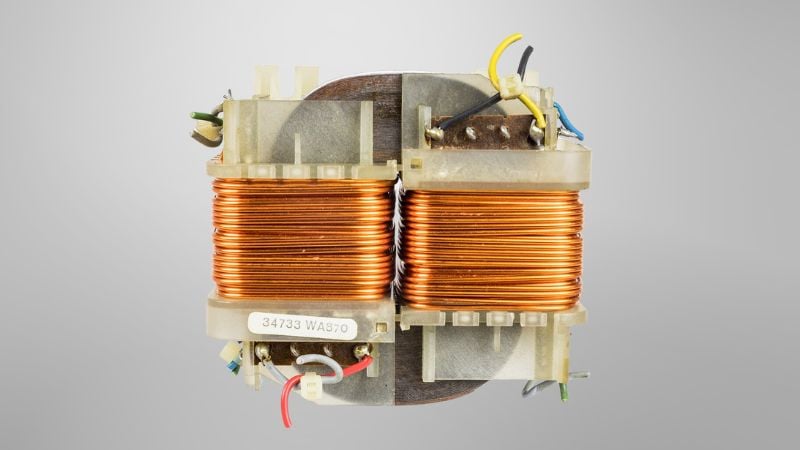
Transformer coils. Image used courtesy of Wikimedia Commons
A primary challenge in transformer maintenance is managing heat dissipation. Transformer insulation is typically made from cellulose-based materials like kraft paper. When transformers operate, they generate heat due to resistive losses in the windings and magnetic losses in the core. This heat accelerates insulation degradation, particularly in cellulose materials, through processes like oxidation and hydrolysis.
Insulation prevents short circuits between windings and conducts heat away from the core and coils. Poor insulation can lead to partial discharges, power outages, grid instability, and catastrophic failures. The relationship between temperature and insulation degradation is exponential; a 6-8°C increase in operating temperature can halve the insulation's life expectancy. Therefore, effective cooling and insulation maintenance are necessary for grid reliability and longevity.
A COOL Innovation
University of Texas at Austin researchers recently developed high thermal conductivity papers for transformer insulation.
Traditional kraft paper-like insulation is a good electric insulator, but it traps heat, leading to overheating and potential failures. The research team tackled the problem by doping conventional cellulosic paper with boron nitride nanoparticles, enhancing thermal conductivity. Follow-up tests showed remarkable results, where even a modest increase in thermal conductivity reduced internal hotspot temperatures by 5 to 10°C. According to researchers, this temperature reduction, while seemingly small, could potentially double or triple the transformer lifespan.
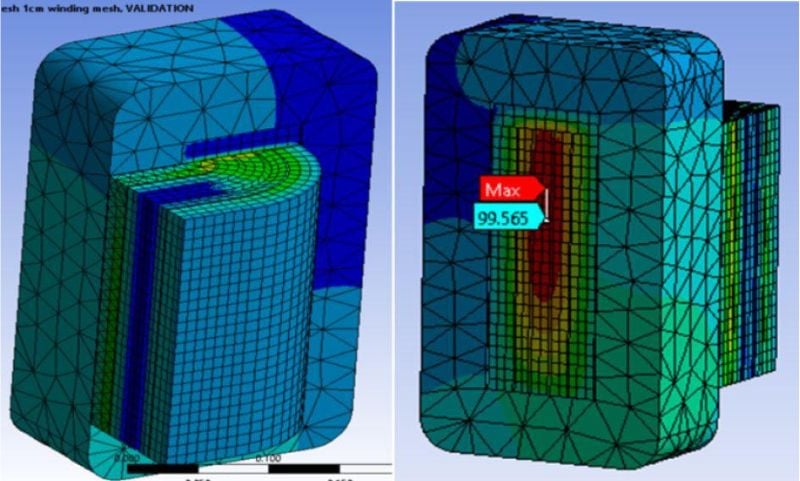
Simulated 3D image of transformer’s internal temperature. Image courtesy of the NSF
To validate their approach, the researchers utilized the Stampede2 supercomputer at the Texas Advanced Computing Center, which the National Science Foundation funds. Using a 3D heat-transfer model, they simulated and predicted thermal performance with impressive speed and accuracy. The team noted that transformer internals could reach temperatures as high as 100°C, and their new material effectively mitigated these extreme conditions.
Future Prospects
While the research team’s primary focus has been on transformers, they are also exploring future applications for this technology in cooling next-generation chips, especially in AI and cloud applications.