Facebook
 Google
 GitHub
 Linkedin
Bigger, Taller, Stronger: Offshore Wind Installation Innovation
Offshore wind turbines are getting bigger and heavier. Installation equipment is stepping up to the challenge.
Building an offshore wind farm is easier than land-based wind projects in some ways. The ocean is spacious and requires fewer environmental disruptions. Transporting turbine parts and equipment by boat and truck takes less effort. However, as more recent offshore turbines have grown in size—some towering 280 meters above the base—constructing these wind-generating devices poses logistical challenges. Conventional cranes and hoists often can’t handle the turbine’s bulk and weight.
Watch Mammoet build offshore wind turbines in Scotland. Video used courtesy of Mammoet
However, several companies worldwide have developed solutions for installing heavy parts for wind turbines in marine environments. Danish company Cadeler has added a powerful hybrid-electric installation vessel to its fleet. Marine contractor Van Oord teamed up with Mammoet, specializing in heavy lifting and transportation, to place an innovative installation lifter in the Netherlands. In Texas, CLS Wind has invented an innovative turbine installer that doesn’t need cranes or hoists.
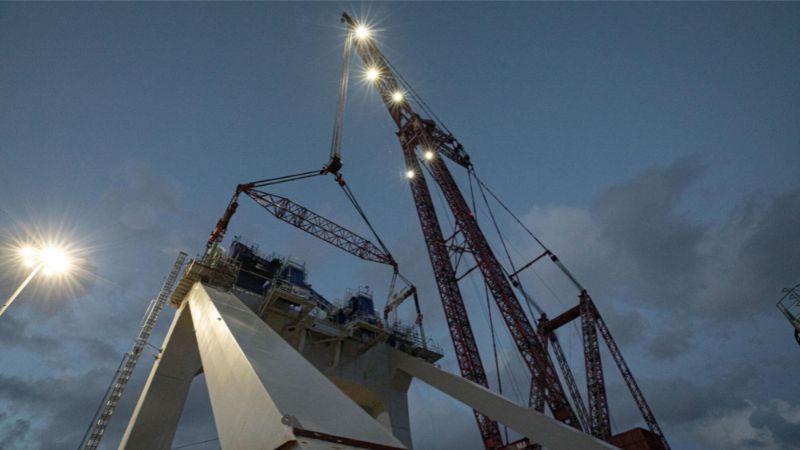
A-frame crane. Image used courtesy of Mammoet
Wind Turbine Installation Goes Renewable
The hybrid-electric Wind Peak, Cadeler’s fifth ship in its fleet of offshore wind installation vehicles, started operations in August. A sister ship, the Wind Pace, is under construction. The company says the high-tech ships can handle the largest offshore wind turbines planned globally.
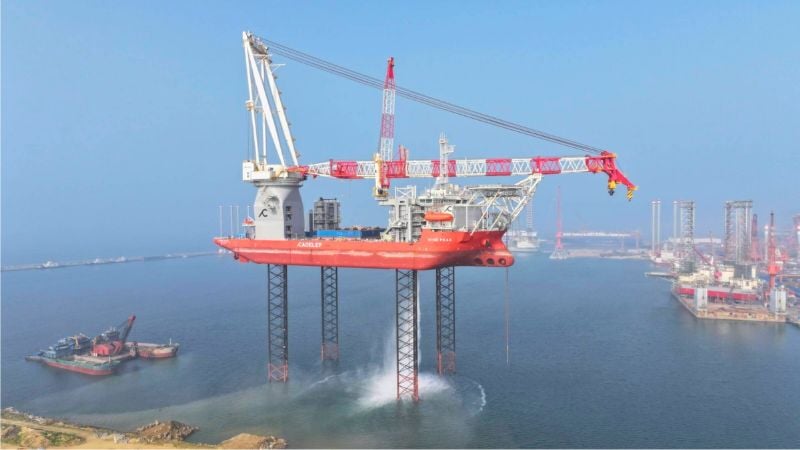
The Wind Peak. Image used courtesy of Cadeler
Wind Peak and Wind Pace are engineered to operate at some of the most challenging offshore installation sites worldwide. Cosco Shipping Heavy Industry in Qidong, China, constructed the vessels.
The Wind Peak becomes the largest vessel in Cadeler’s fleet, with a 5,600-square meter deck and a crane that can lift more than 2,500 tons at heights of 53 meters. The payload capacity tops 17,600 tons. In a single load, the Wind Peak can transport and install up to seven complete 15 MW turbines or five sets of 20+ MW turbines.
The ability to transport such a large load decreases total costs per turbine and reduces the installation’s carbon footprint, Cadeler states.
Up to 130 crew members and technicians can work aboard the Wind Peak at once.
Installing an A-Frame Lift
Van Oord uses a heavy-lift A-frame mounted on its vessel, the Svanan, to place turbine parts in offshore projects. To install larger turbine monopiles, the company wanted to upgrade to a larger 960-tonne A-frame measuring 26 by 30 meters.
Van Oord called Mammoet, who had the equipment to hoist the larger A-frame high enough to clear the Svanen’s 65-meter deck. Mammoet’s heavy lifter is the PTC210-DS ring crane, which can perform in environments and situations where other cranes can’t. The crane’s main boom is 107 meters, and the luffing jib is 67 meters. It has more than 4,000 tonnes of counterweight.
The A-frame was prefabricated in warehouses near Rotterdam and then shipped to Mammoet’s headquarters. Mammoet transported the frame’s three parts to a laydown area using its self-propelled modular transporters. The assembly used gantry masts, crawler cranes, a 250-tonne harbor crane, and floating sheerlegs.
The PTC ring crane lifted the completed A-frame onto the Svanen. The feat reduced the installation time from months to weeks.
The new A-frame lift increases the Svanen’s height to 125 meters.
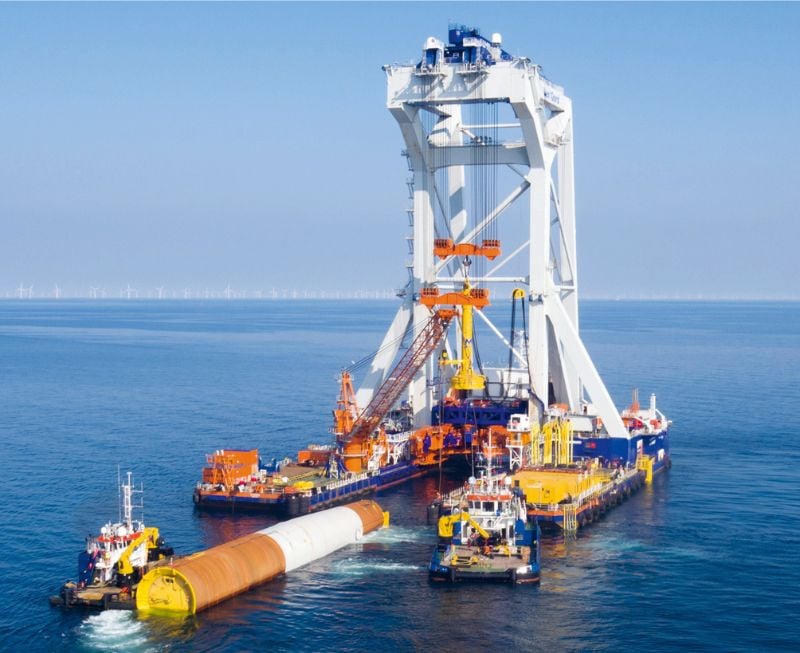
The Svanen. Image used courtesy of Van Oord
Offshore Elevator Installation
Houston-based CLS Wind has dispensed with cranes, barges, and other heavy equipment. Instead, the company uses an elevator-style lift to install, maintain, and decommission large onshore and offshore wind turbines and parts. The company says the device lowers costs and reduces the environmental impact.

Installing turbine blades via elevator-style lift. Image used courtesy of CLS Wind
The floating lift can raise blades, nacelles, and other turbine parts for assembly on-site.
The American Bureau of Shipping (ABS) granted approval in principle for CLS’s turbine assembly system in July. ABS visited the demo unit and reviewed designs.
“It is important that we work together to find solutions that lower cost and increase installation efficiencies to support offshore wind energy production, and we are delighted to be working with ABS in these technologies,” Kent Johnson, CLS Wind CEO, said in a press release.