Facebook
 Google
 GitHub
 Linkedin
GaN Devices Hot Enough for Venus
Gallium nitride will be a key enabler for high-temperature electronics, including possible missions to Venus.
Electronics based on silicon semiconductors are vital to the modern world. They work fine for designing systems to operate at moderate temperatures up to 250°C (482°F). But once temperatures rise above 300°C (572°F), silicon-based electronics can’t operate for long.
However, applications like jet engines, automotive exhausts, chemical plants, geothermal energy, and even exploration on Venus, require electronic devices that can operate for long periods at temperatures of up to 500°C (932°F) or more.
Gallium nitride (GaN) could provide a viable solution.

Illustration of the Large Quezalpetlatl Corona on Venus. Image courtesy of NASA/JPL-Caltech/Peter Rubin
Gallium Nitride Semiconductors
One solution for building semiconductors that can withstand temperatures of 500°C or higher is gallium nitride. Made from gallium and nitrogen atoms, GaN was first synthesized in 1932. In the 1990s, light-emitting diodes (LEDs) using GaN were developed, and in 2004, the first GaN high electron mobility transistors were available commercially. In 2018, GaN-powered integrated circuits became commercially available, led by companies like Navitas.
Gallium nitride is used in Earth-based electronics, such as fast chargers, consumer electronics, LEDS, power electronics, and cell towers.
Unlike silicon-based semiconductors, GaN is chemically stable and does not easily dissociate at high temperatures. This stability allows GaN devices to operate reliably at temperatures over 600°C. The combination of GaN's wide bandgap, high thermal conductivity, low numbers of free charge carriers (low intrinsic carrier concentration), high breakdown field, and chemical stability at elevated temperatures make it an excellent material for high-temperature electronic and optoelectronic devices compared to silicon and other conventional semiconductors.
MIT Tackles Hot Topic
Despite its growing applications, scientists have not understood how GaN behaves at extremely high temperatures, specifically at the 482°C (90 °F) temperatures found on Venus. This inhospitable place is hot enough to melt lead, and one reason the planet hasn’t been explored with landers and rovers is that silicon-based electronics cannot survive on its surface.
Massachusetts Institute of Technology (MIT) researchers are participating in a multiyear research effort to examine GaN’s characteristics and properties at high temperatures. Their study detailed the impact of temperature on the contacts used with GaN devices.
Contact resistance is important to semiconductors’ performance, as too much resistance leads to higher power consumption and slower operating frequencies. Although much is known about contact resistance at room temperatures, little has been studied at temperatures up to 500 degrees.
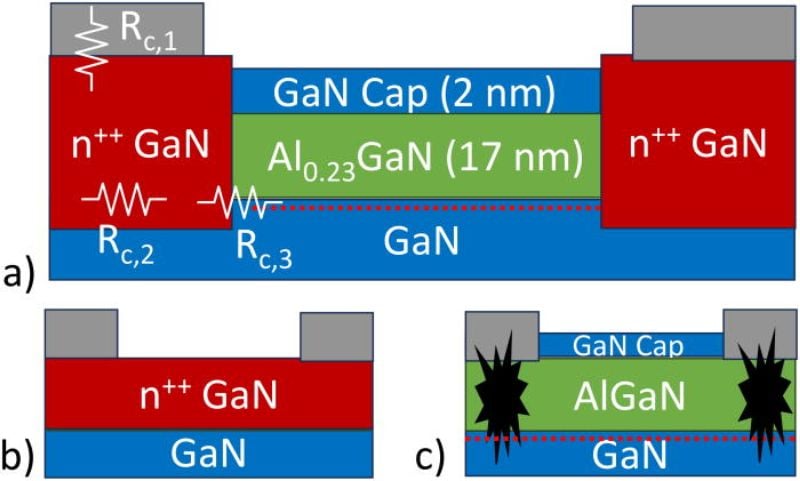
MIT studied various GaN structures to test for temperature stability. Image used courtesy of the authors
MIT scientists examined GaN contacts at temperatures up to 500°C for 72 hours, and surprisingly, the contact resistance remained constant or may have improved slightly. This was unexpected and is considered a significant step forward in developing GaN transistors for use in landers and other vehicles to explore Venus’ surface.
Translating device-level advances to designing transistors at the circuit level should dramatically improve the ability to create more effective high-temperature electronics. Back on Earth, such devices could also find applications in geothermal energy systems, other forms of energy generation, or in monitoring the performance and safety of jet engines.