Facebook
 Google
 GitHub
 Linkedin
How Mercedes-Benz Recycles 96% of Its EV Battery Materials
Mercedes-Benz will boost the supply chain with an innovative technique for recycling EV batteries.
Mercedes-Benz is turning used batteries into high-value inputs for its electric vehicles. The car giant recently opened Europe’s first industrial-scale mechanical-hydrometallurgical battery recycling facility in Kuppenheim, Germany.
The 73,194-square-foot facility combines mechanical crushing and shredding, chemical treatment, and solvent extraction to recover more than 96% of materials. The process yields battery-quality sulfates from lithium, cobalt, and other inputs.
With 2,500 tonnes of annual capacity, the plant will supercharge Mercedes-Benz's circular supply chain strategy. The recycled raw materials will be transformed into more than 50,000 battery modules for all-electric EVs.
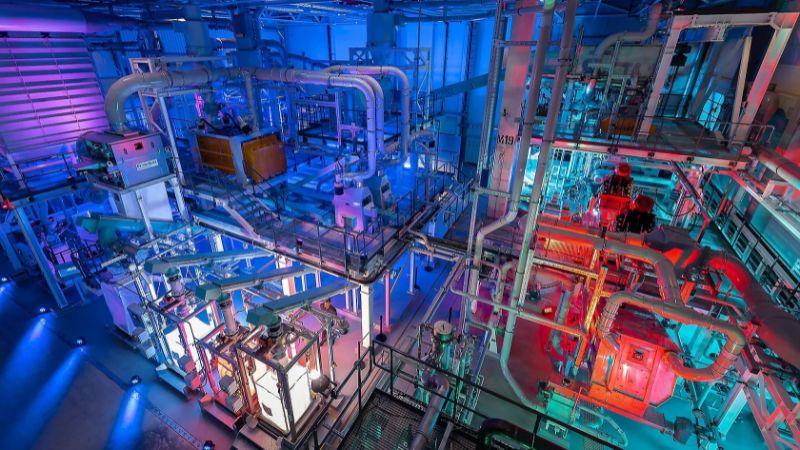
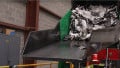
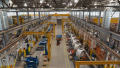
Mercedes-Benz battery recycling facility in Kuppenheim, Germany. Image used courtesy of Mercedes-Benz
How Does Mechanical-Hydrometallurgical Recycling Work?
Germany-based Primobius developed a specialized process for Mercedes-Benz’s factory, leading engineering, equipment, and installation activities.
The procedure starts with engineers checking the modules’ state of charge and placing them on a conveyor belt. Each unit is crushed in a shredder, washed in a friction washer, and separated using a gravity-based air separator (for plastic, copper, and aluminum) and an electromagnetic separation machine (for iron).
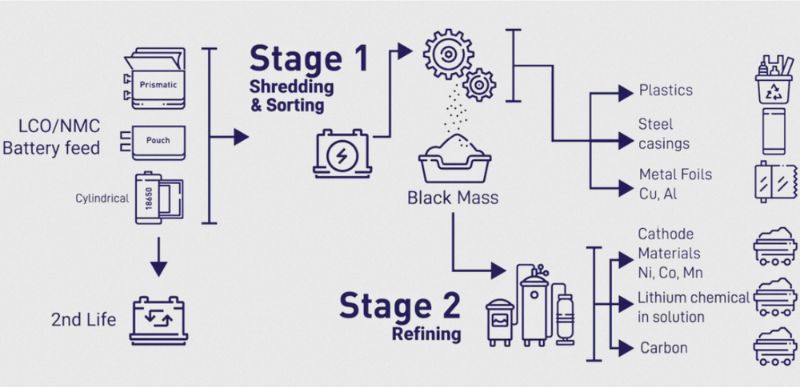
Primobius’s hydrometallurgical recycling and refining process. Image used courtesy of Primobius
The next step targets black mass, the high-value intermediate material that comprises up to half of EV batteries’ weight. Black mass contained in the coarse metal and plastic then moves to a vacuum dryer, mill, and filter press. The largest share of black mass is filtered and processed with the coarse material. The metals are then dissolved via leaching, in which water and sulphuric acid are applied to form a liquid solution.
Undissolved graphite is separated and packaged through a filter press. The same occurs with iron and aluminum, treated by neutralizing ammonia and hydrogen peroxide. Finally, solvent extraction yields raw sulfates containing lithium, manganese, cobalt, copper, and nickel. These materials are processed through solvent extraction, which combines sulphuric acid, ammonia, and an organic solvent. Cobalt and nickel are then crystalized into active battery materials for future production.
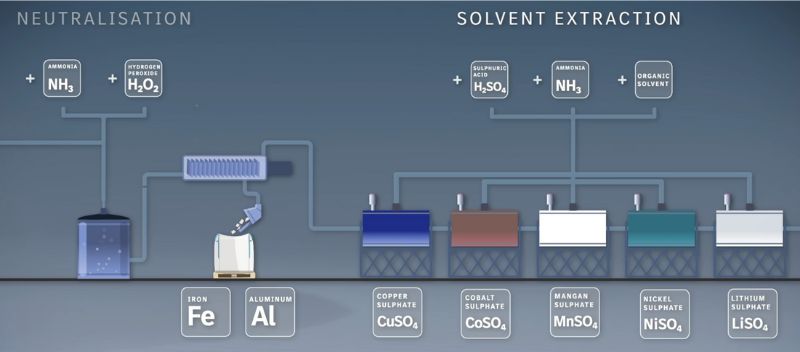
The end stage of Mercedes-Benz’s chemical treatment yields raw materials like lithium and cobalt as sulfates. Image used courtesy of Mercedes-Benz
Metal Refining and Extraction Techniques
Mercedes-Benz’s multi-stage mechanical-hydrometallurgical method focuses on downstream black mass processing, a high-demand capability in the EV industry. Recycled battery-grade materials can be injected back into the supply chain for new cells. Hydrometallurgical recycling consumes less energy than conventional pyrometallurgy, which applies extreme heat to convert metal oxides into compounds. Mercedes-Benz operates the process at up to 80°C, keeping thermal demands relatively low. Though pyrometallurgy is simpler and offers more flexibility with feedstocks, it incurs significant energy costs for combustion and calcination, typically operating above 1,400°C.
Mercedes-Benz’s plant is also net-carbon neutral, powered by a rooftop solar photovoltaic system providing over 350 kW of peak output. The company compensates for the site’s remaining emissions through carbon offsetting programs.
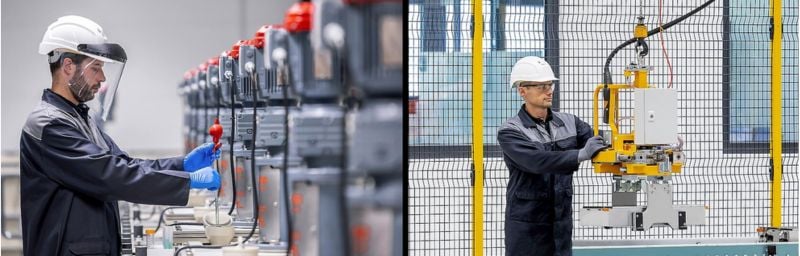
Scenes from Mercedes-Benz’s new battery recycling facility. Images used courtesy of Mercedes-Benz
The factory could be a blueprint for other European carmakers. Last year, the European Union adopted minimum recycling content requirements for new EV batteries, mandating 16% recycled cobalt, 85% for lead, and 6% for lithium and nickel. The rule also targets 50% lithium recovery from batteries by late 2027 and 70% by 2031.
While Mercedes-Benz‘s integrated recycling plant is a first for Europe, other EV manufacturers are pursuing smaller-scale recycling projects, too. General Motors partnered with Redwood Materials to recycle cathode and anode material from cell scrap. Toyota also teamed up with Redwood to source recycled copper foil and cathode active material.