Facebook
 Google
 GitHub
 Linkedin
Research Revs Up EV Battery Recycling
Researchers develop two recycling techniques to recover valuable materials from used lithium-ion batteries.
Increases in electric vehicles and renewable energy storage have led to more lithium-ion battery production. While these batteries play an integral role in reducing carbon emissions, they also present a significant environmental challenge at their lifecycle’s end.
Conventional recycling methods for lithium-ion batteries are often energy-intensive, costly, and environmentally harmful. As battery demands grow, more efficient and sustainable recycling processes are increasingly urgent. In response to these challenges, two research teams have made breakthroughs in battery recycling technology.
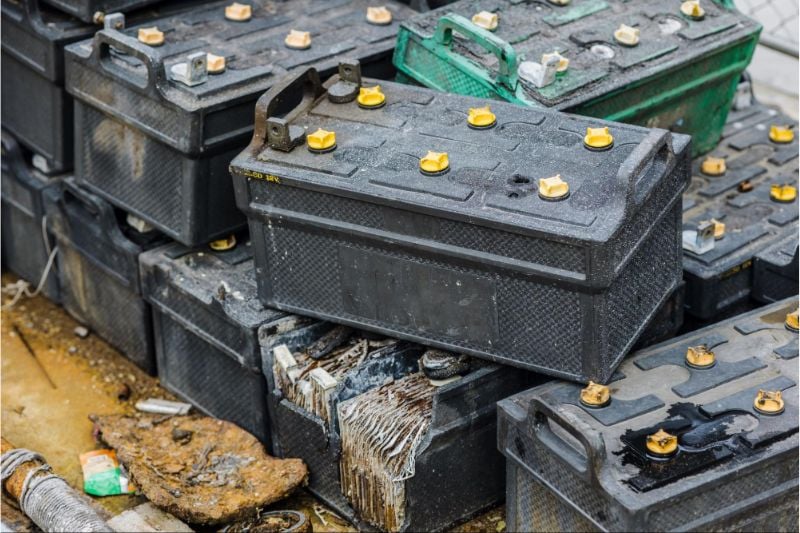
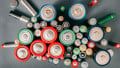
Discarded batteries. Image used courtesy of Adobe Stock
Recycling With Flash Joule Heating
Researchers at Rice University have developed a method for recycling lithium-ion batteries using solvent-free flash Joule heating (FJH) to recover valuable battery materials efficiently.
The technique involves rapidly heating battery waste to 2,500 Kelvin using an electric current, transforming the materials into forms allowing magnetic separation. Magnetic separation is a physical process exploiting the varying magnetic properties of components in a mixture. For example, the researchers found that cobalt-based cathodes, commonly used in EVs, exhibited magnetism in their outer layers of spinel cobalt oxide. Applying a magnetic field to these materials distinguishes particles with magnetic properties from those without, based on their magnetic susceptibility and volume, resulting in effective materials separation.
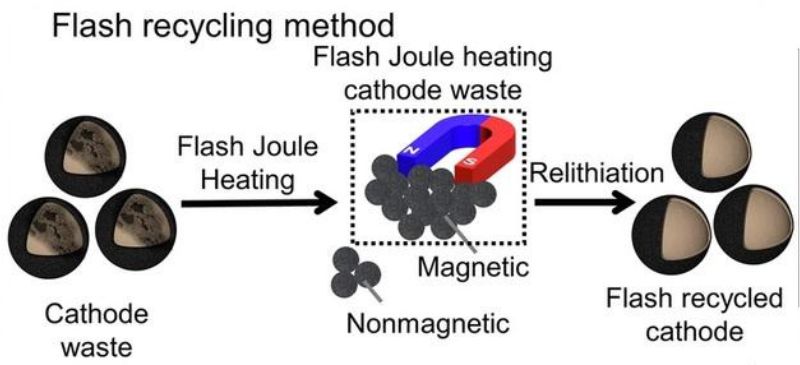
Flash recycling method for cathode separation. Image courtesy of Chen et al.
Their process facilitates the separation of spent battery materials and effectively purifies them. The method achieved a high recovery yield of 98% in tests while maintaining the materials’ structural integrity and functionality. The research found that reconstituting the materials into new cathodes was feasible.
Recycling With Froth Flotation
Scientists at Argonne National Laboratory and Michigan Technological University have jointly developed a froth flotation technique for separating cathode-active materials from spent lithium-ion batteries.
Froth flotation is a concentration method to selectively separate hydrophobic materials from hydrophilic waste. The process involves immersing mixed cathode-active materials in an aqueous solution containing a selective collector chemical. This agent hydrophobizes specific material types while leaving others hydrophilic. The hydrophobized components float to the surface in a froth, facilitating their collection. Multiple iterations of this process achieve optimal purity and yield of the separated cathode materials.
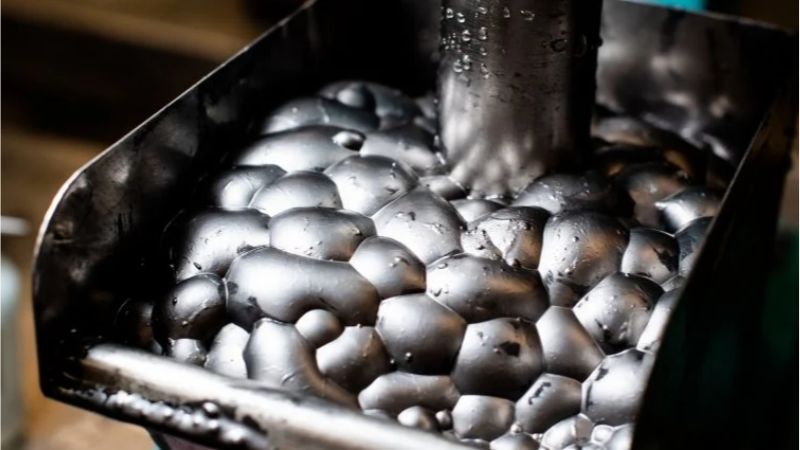
Froth flotation method. Image used courtesy of Michigan Technological University
By selectively altering surface properties, the method enables precise separation of materials that are otherwise challenging to distinguish and isolate.
A Green Horizon
Batteries will be integral to a sustainable future, whether used as energy storage for renewables or powering electric vehicles. Battery recycling techniques have grown more important, as a circular economy and reduced landfills will have major impacts on the technologies’ carbon footprints.
With a slew of new battery recycling advancements from academia, researchers hope to pave the way for more sustainable EV and renewable energy industries. As these methods move from laboratory to industrial scale, we can hope for reduced reliance on primary resource extraction and decreased environmental impact from battery production.