Facebook
 Google
 GitHub
 Linkedin
Challenging China: The Push for a Domestic Battery Supply Chain
Over two dozen companies will develop a U.S. supply chain for critical battery inputs.
China and other international supply sources dominate America’s energy storage and electric vehicle supply chains. According to the U.S. Geological Survey’s (USGS) 2024 Mineral Commodity Summaries, the nation relies on imports for 57% of its nickel, 67% of its cobalt, and 25% of its lithium supply—all critical ingredients in large-capacity batteries.
However, 25 U.S.-based manufacturers will soon counter China’s dominance with new facilities producing battery anodes, cathodes, electrolytes, and critical minerals and compounds. The Department of Energy has allocated $3 billion spread across 14 states to shore up domestic manufacturing capacity to meet market demand while competing with China.
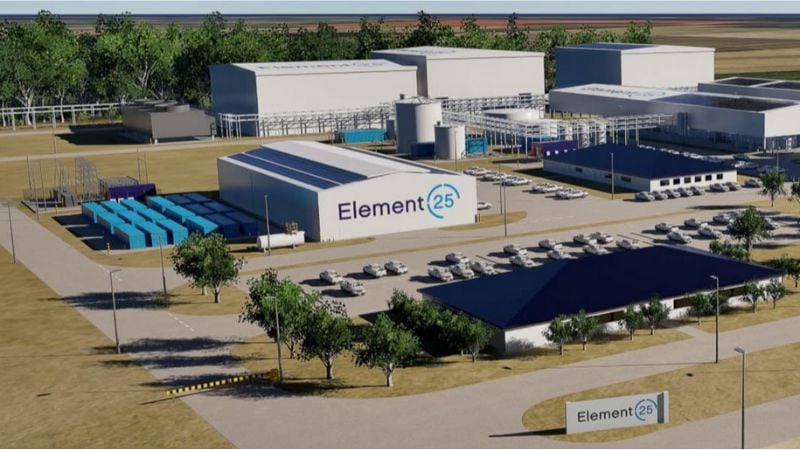
A rendering of Element 25’s upcoming manganese sulfate production facility in Louisiana. Image used courtesy of Element 25
Battery Component Manufacturing
Lithium-ion battery manufacturing capacity is expanding rapidly across the U.S., from just three facilities in 2019 to about a dozen today, according to USGS data. Another 28 factories are under development, partly driven by federal incentives in the Bipartisan Infrastructure Law, which funded the DOE’s $3 billion award round.
One project headed by Mitra Future Technologies will nearly double the nation’s lithium-iron-phosphate (LFP) capacity, producing 15,000 tonnes annually by 2027. The company will add a manufacturing line with LFP cathode active materials for EVs and energy storage systems. It will also integrate its next-gen, high-density lithium-manganese-FP (LMFP) materials with existing cathode production processes. Mitra recently synthesized its LFP samples to meet EV specifications.
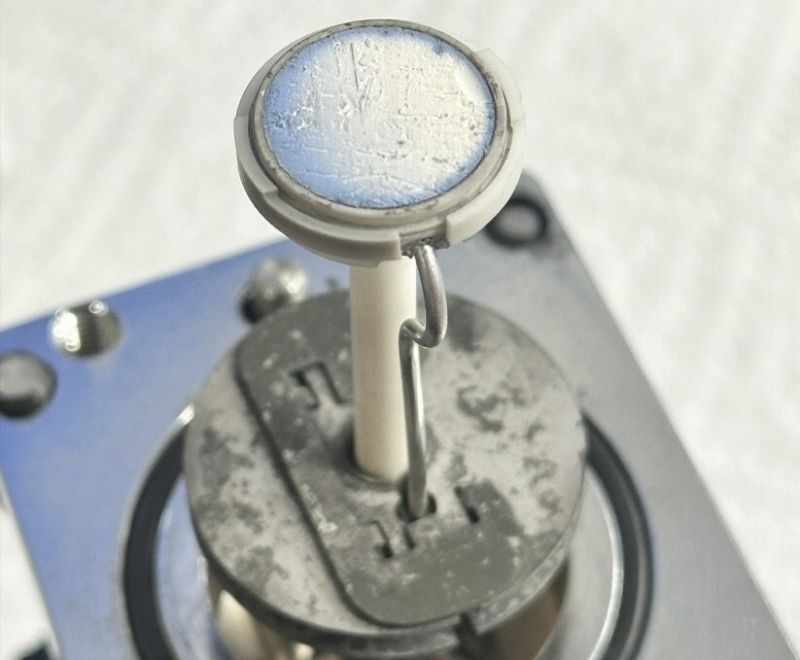
A sample of Mitra’s LFP cathode active material. Image used courtesy of Mitra Chem
In Michigan, Nanograf will open a facility to produce 2,500 tonnes of silicon monoxide annually for battery anodes. At the same time, Albemarle U.S. will retrofit its North Carolina site to accommodate an annual capacity of 50 metric tons of lithium metal anode material for use in electric vertical takeoff and landing vehicles, among other markets.
Three battery cell manufacturing projects also received funding:
- Form Energy is scaling its 100-hour energy storage technology, with plans to install its first iron-air battery line at a former steel mill in West Virginia. It will ramp up to 20 GWh annually by 2027.
- Forge Battery will develop high-energy 21700 lithium-ion cylindrical cells at its new gigafactory in North Carolina. The cells are based on Forge Nano’s atomic layer deposition nanocoating, an ultra-thin material that boosts performance and durability and prevents unwanted reactions at the surface. The company expects its NMC/Si-G 21700 cells will hit the market in 2026 and produce 3 GWh annually by 2029. Forge recently started bulk customer shipments for its 300 Wh/kg lithium-ion cells earlier this year.
- EnerSys Advanced Systems will build a lithium-ion battery cell plant in South Carolina with an initial 5 GWh of capacity by 2028 to produce prismatic and cylindrical cells for direct-current fast-charging, backup power, defense, and industrial applications. The ENS1 prismatic cell technology offers enhanced performance with 2,500 cycles and a 250 Wh/kg energy density.
Raw Materials
Energy storage installations and EV sales are driving up demand for critical minerals. Global lithium demand climbed 30% last year alone, per the International Energy Agency. Nickel, cobalt, graphite, and rare earth elements charted 8-15% growth. Global graphite consumption in the battery industry has skyrocketed by 200% since 2019, per the USGS.
The DOE aims to expand domestic graphite availability for anode and cathode components. In Alabama, Urbix will establish 10,000 tonnes of annual anode-grade graphite production, potentially growing to 30,000 tonnes later. In South Carolina, Birla Carbon will build a facility to supply 25,000 tonnes of synthetic graphite annually for energy storage and EV markets. That’s enough anode active materials to support over 40 GWh of production at battery plants.
Two projects will convert lithium chloride from regional brines into battery-grade carbonates. SWA Lithium and TerraVolta Resources each received $225 million to deploy direct lithium extraction (DLE) technology in southwest Arkansas and Texarkana. SWA will produce up to 45,000 tonnes of lithium carbonate annually, including some of the nation’s highest-known lithium brine concentrations, using Standard Lithium’s integrated DLE and purification process. TerraVolta’s 25,000 tonnes of planned capacity could support up to 500,000 EVs annually.
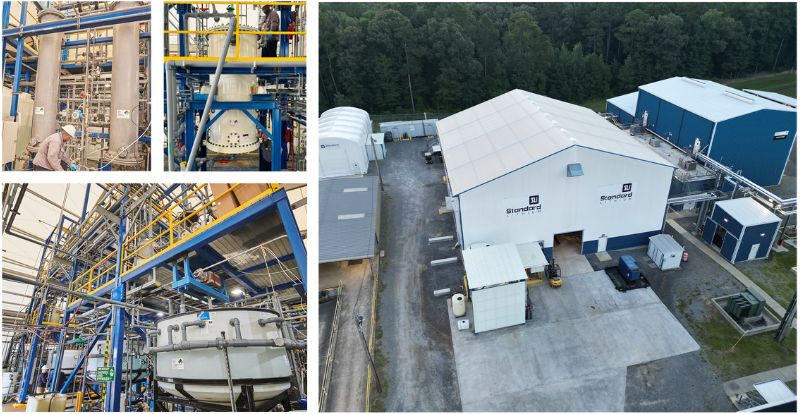
Standard Lithium’s direct lithium extraction demonstration plant in Arkansas. Image used courtesy of Standard Lithium
Manufacturers are also expanding production for salts and solvents used in electrolytes. Honeywell will build an electrolyte salt facility in Louisiana to produce lithium fluorosulfonyl imide (LiFSI), a higher-performing alternative to lithium hexa-fluoro phosphate. In the Gulf Coast, Dow Chemical Company will reuse waste carbon dioxide to make battery-grade carbonate solvents for lithium-ion battery electrolytes. Solid Power Operating, a leading supplier of sulfide-based electrolytes for all-solid-state batteries, will expand its Colorado facility and cut costs through a new continuous manufacturing process.
Conductive additives will also get a boost from the DOE. Cabot Corporation will build a plant in Michigan with an annual capacity for 1,000 tonnes of battery-grade carbon nanotubes and 12,000 tonnes of conductive additives—key components that connect active materials in battery electrodes. Once built, the facility could support 100 GWh of batteries.
Other recipients include Group14 Technologies, which will produce silane for silicon-based anode materials in Washington, and Braskem America, which will upgrade its polyethylene facility in Texas to meet demand for lithium-ion battery separators.
The project will also add manganese processing capacity in two states:
- South32’s Hermosa project will establish a mining site for high-purity manganese sulfate monohydrate (HPMSM), an EV battery chemistry currently produced in China. Hermosa will source ore in Arizona, initially processing up to 60,000 tonnes of HPMSM annually in the first phase.
- Australian mining company Element 25 will operate an HPMSM refining facility in Louisiana. The site will produce 71,650 tons annually, sourcing manganese ore from the company’s mine in Australia. General Motors and Stellantis have signed deals to receive the plant’s battery-grade manganese sulfate in 2026.
Circular Supply Chain: Battery Recycling
The DOE will fund several facilities to reclaim nickel, cobalt, and other metals from spent batteries.
Revex Technologies’ REV Nickel Project will install a nickel separation and processing line at Michigan’s Eagle Mine, a nickel-copper resource currently producing cobalt-containing nickel concentrate. The project spans three facilities: Eagle Paste will process mine waste containing residual nickel, reClaim will deliver 21,250 tonnes of green nickel concentrate, and reCover will grind and separate 16,000 tonnes of black mass annually. When complete, the project’s annual capacity could support 462,000 EV batteries.
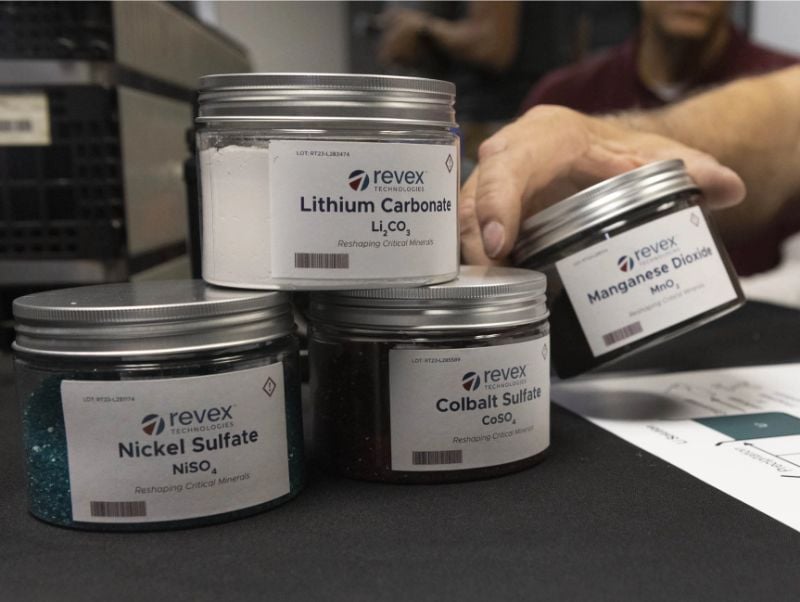
Recycled materials from Revex Technologies. Image used courtesy of Revex Technologies
Three South Carolina recycling projects also received funding: American Battery Technology will build a lithium-ion battery recycling facility with a 100,000-tonne annual output for critical materials like cobalt, copper, nickel, and graphite. Cirba Solutions received $200 million to recycle lithium-ion batteries from EVs, energy storage systems, and other scrap, processing over 60,000 tons annually for cathode-grade manufacturing. Clarious Circular Solutions will retrofit its existing facility to transform used batteries into cathode active materials, with 20,000 tonnes of annual capacity.
In Oklahoma, Blue Whale Materials will expand its baseline lithium-ion battery processing capacity by 2.5x, recovering enough cobalt, nickel, and lithium for over 100,000 EVs annually. Blue Whale’s process delivers a high-purity metal precursor, Blacksand, that contains up to 98% of the cobalt and nickel metals in used batteries.
GM-backed startup Li Industries will retool a plant in Ohio to recycle 10,000 tonnes of LFP cathode active material annually. Another funding recipient, Ascend Elements, will recover and purify graphite at its battery precursor recovery plant currently under construction in Kentucky. The facility will convert graphite residue from recycled lithium-ion batteries and cathode materials into battery-grade graphite with 99.95% purity.