Facebook
 Google
 GitHub
 Linkedin
EIA Energy Outlook: While Solar Soars, Fossil Fuels Flounder
A U.S. Energy Information Administration report estimates that 32.1 GW of solar generating capacity will come online in 2026.
The U.S. Energy Information Administration (EIA) projects that solar energy will contribute the largest share of new electricity generation over the next two years.
In its January 2026 Short-Term Energy Outlook (STEO), the EIA anticipates that solar will add 32.1 GW of capacity in 2026 and 36.5 GW in 2027, representing a 31.2% increase in solar electricity generation over this period and bringing total output to approximately 424 billion kWh.
At this level, solar will account for roughly 10% of all U.S. electricity generation. The EIA expects total electricity generation from all sources to increase by 1.1 percent in 2026 and 2.6 percent in 2027, reaching approximately 4,423 billion kWh.
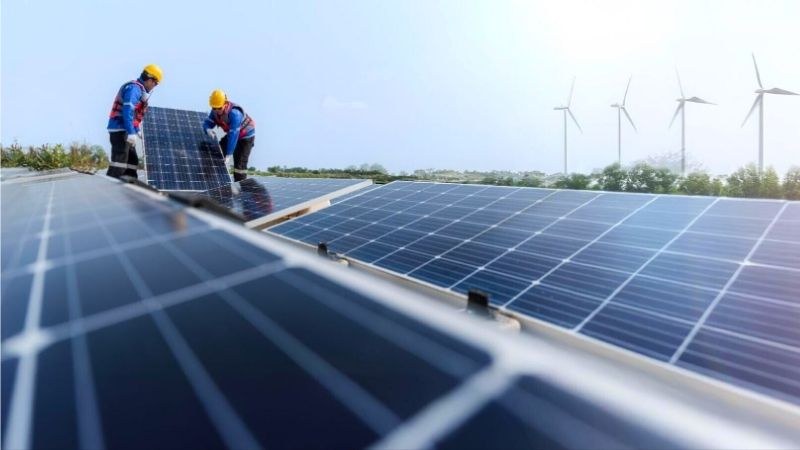
Constructing a solar array. Image used courtesy of Adobe Stock
A Sunny Future for Texas?
Much of the utility-scale solar capacity coming online will be concentrated in Texas. Solar electricity generation delivered to the Electric Reliability Council of Texas (ERCOT) grid is projected to nearly double, increasing from 56 BkWh in 2025 to 105 BkWh by 2027. Battery energy storage capacity, which helps manage daily fluctuations in solar output, supports this growth.
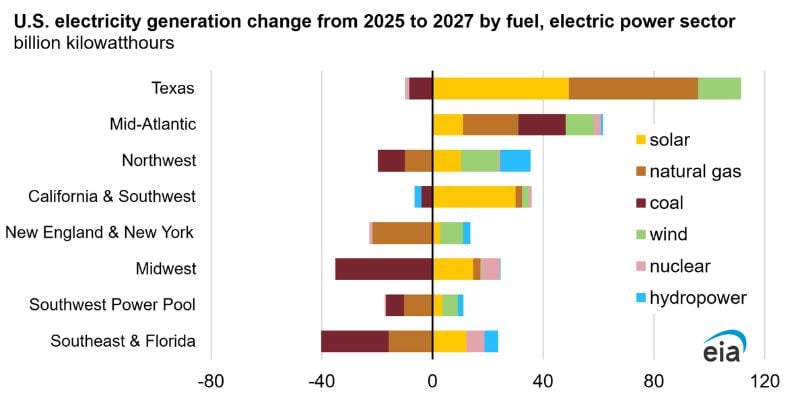
Regional solar growth. Image used courtesy of EIA
Texas is particularly prominent for new energy capacity, as more data centers are planned or under construction in the state. In 2024, ERCOT tracked 56 GW in large load interconnection requests, which nearly quadrupled to 205 GW by late 2025. AI data centers, particularly, have massive power demands, which can threaten grid stability.
Google plans to construct three new data centers, and OpenAI and Oracle’s Stargate data center is already operational in Abilene, Texas. The Stargate project is a hybrid facility that draws power from its own natural-gas generator and the ERCOT grid. It’s not clear whether new constructions will be entirely self-powering, hybrid, or grid-reliant.
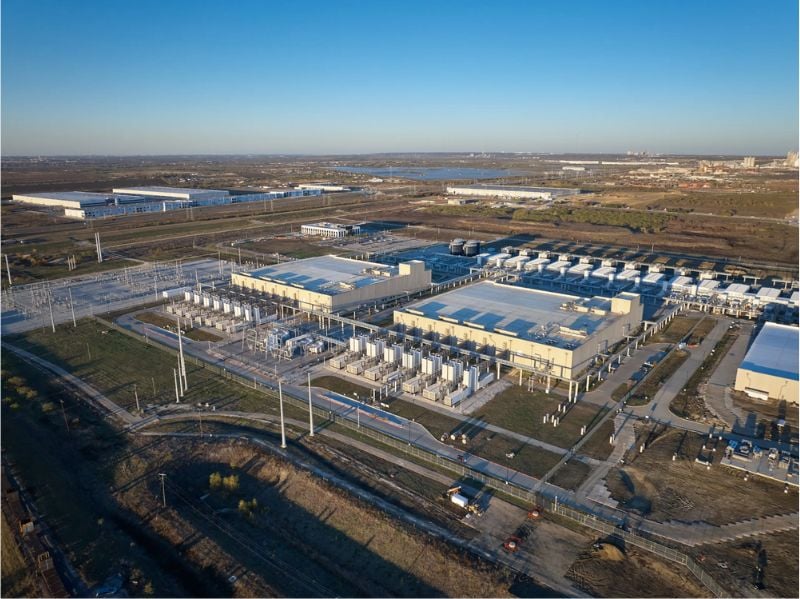
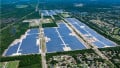
Google’s data center in Midlothian, Texas. Image used courtesy of Google
ERCOT’s solar capacity has grown more than 200 percent over the past four years, with 877 solar projects under development in November 2025, according to Cleanview’s project tracker.
Conventional Fuels Decline
While solar is growing rapidly, conventional energy sources are declining.
The STEO reports that natural gas generation declined in 2025 and is expected to remain plateaued through 2026 before increasing again in 2027. Even with this rebound, natural gas generation is projected to remain 3% below 2024 levels, resulting in a reduced share of total U.S. generation.
Coal generation is projected to decline more sharply, falling by 9.6% by 2026 compared with 2025. Collectively, natural gas, coal, and nuclear—which accounted for 75% of total U.S. electricity generation in 2025—are expected to drop to 72% in 2027.
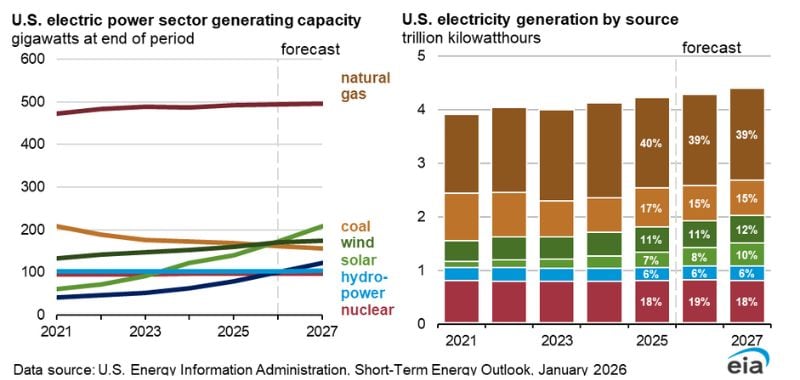
Generation by major energy sources. Image courtesy of EIA
Solar in the U.S. and the World
In the past year, the solar industry has faced growth challenges in changing policies and regulations, supply chain disruptions, and long waits for grid connection. These obstacles, however, have plagued all modes of energy generation as the industry positions for increasing needs and decarbonization goals.
Worldwide, solar energy remains the cheapest form of energy available and, paired with solar systems, will likely continue to grow, according to the EIA.