Facebook
 Google
 GitHub
 Linkedin
Chemical Precipitation Extracts Lithium from Geothermal Brine
A University of Connecticut study outlines a scalable, low-emission process to extract lithium from geothermal brines, offering a sustainable solution to lithium supply issues.
As the global demand for electric vehicles and energy storage systems surges, so does the need for lithium, a non-substitutable element central to battery technology. Yet, the United States relies heavily on imports from a few international sources, creating environmental concerns and supply chain risks. With forecasts pointing to a tenfold increase in global EV demand by 2030, the lithium bottleneck is quickly becoming one of the biggest challenges in the energy transition.
A team at the University of Connecticut’s College of Engineering concluded that a solution may lie in an overlooked domestic resource: geothermal brines. These naturally occurring, mineral-rich fluids are already used to generate renewable electricity but contain high concentrations of dissolved lithium.
The researchers’ study in Resources, Conservation and Recycling details a sustainable process to extract lithium from these brines using chemical precipitation, potentially transforming geothermal sites into dual-purpose power and mineral recovery facilities.
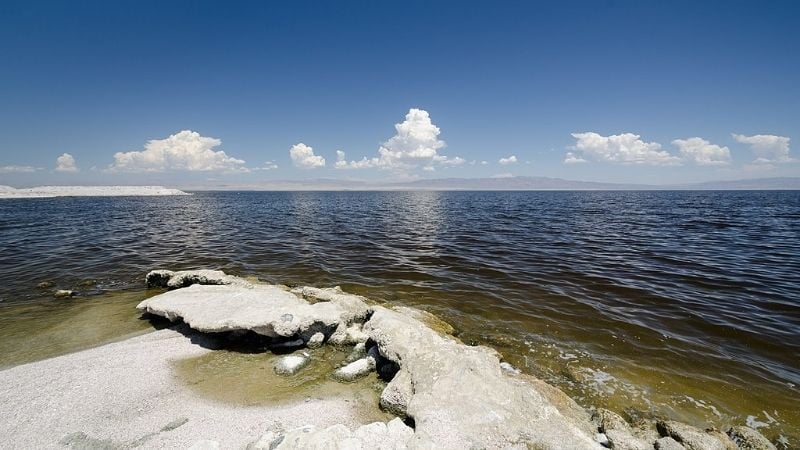
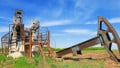
California’s Salton Sea. Image used courtesy of Wikimedia Commons
A Dual-Resource Opportunity
Geothermal brines are hot saline waters that circulate deep underground through mineral-rich formations. When pumped to the surface, they can turn turbines to generate power, and as they do, they carry valuable dissolved elements such as lithium, boron, and potassium. California’s Salton Sea, for example, has been recognized by the U.S. Department of Energy as a strategic domestic lithium resource due to its vast geothermal potential.
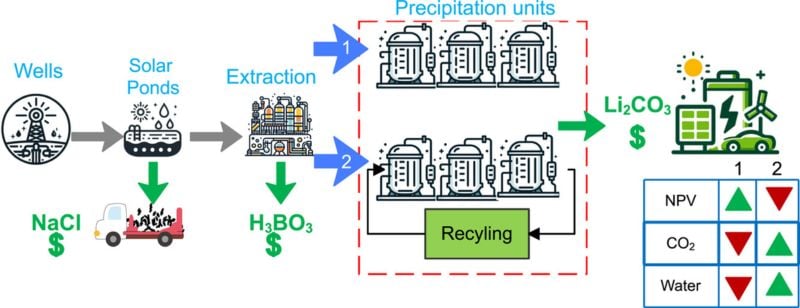
How the researchers’ process could work in practice. Image used courtesy of Nikkhah, et al
According to the researchers, geothermal brine is an emerging resource, delivering both renewable energy and essential minerals from a single operation. While traditional lithium extraction from salt lakes and hard rock mining is resource-intensive and often damaging to ecosystems, geothermal systems already have the infrastructure in place for fluid management. The environmental footprint can be drastically reduced by layering in efficient lithium separation processes.
Engineering a Cleaner Extraction Process
The UConn-led team developed a process model using chemical precipitation to recover lithium from geothermal brines. This method selectively isolates lithium by reacting it with chemical agents that form solid lithium compounds, which can then be collected and refined.
To minimize waste and emissions, the researchers integrated on-site recycling of these precipitating agents into the system. The result was a projected 50% reduction in carbon dioxide emissions compared to conventional extraction methods. The team also built a digital twin (a computer model of the physical process) to simulate and optimize system performance under different scenarios.
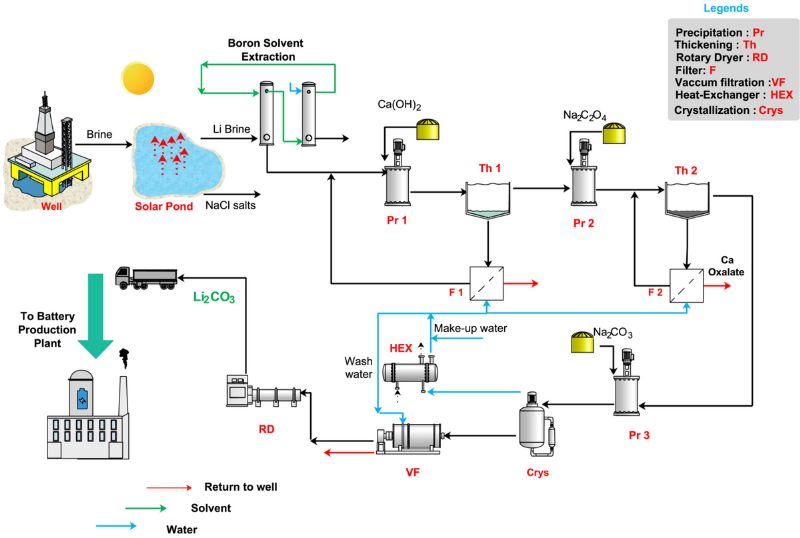
A process flowsheet of lithium recovery from geothermal brine. Image used courtesy of Nikkhah, et al
The researchers expanded the scope by linking the lithium extraction process to the broader U.S. EV supply chain. Using mathematical models, the team mapped out optimal locations for lithium recovery, battery manufacturing, and EV production across the country. Their study suggested where EV production plants might be located to meet localized EV demand.
Their modeling suggests that developing a domestic lithium supply chain based on geothermal brines could reduce costs, support over 100,000 direct jobs, and reduce reliance on overseas materials, which is particularly important given the heavy shipping costs and geopolitical risks tied to lithium imports.
Building a Sustainable Lithium Future
While the potential is clear, scaling geothermal lithium recovery presents technical challenges. Current methods are still evolving, and large-scale deployments require capital investment, regulatory support, and public-private collaboration. The team stressed the importance of lifecycle assessment and techno-economic analysis in identifying the most viable paths forward.
Still, momentum is growing. With federal recognition of the Salton Sea and increased attention on critical minerals, geothermal brine is positioned to become a central player in the next phase of energy storage development.